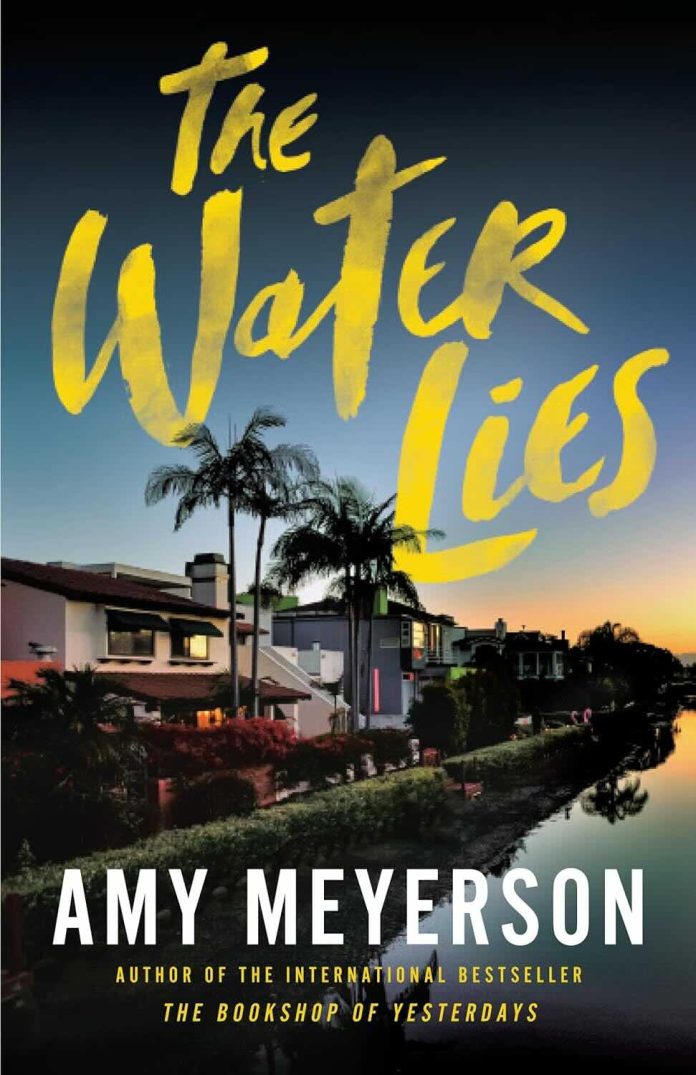
Amy Meyerson’s fourth novel plunges readers into the murky depths of the Venice Canals, where pristine glass houses conceal secrets far more toxic than the stagnant water below. The Water Lies examines motherhood through a warped lens, asking uncomfortable questions about fertility, trust, and the lengths we’ll travel when everyone dismisses our instincts as paranoia.
The story opens with Tessa Irons, heavily pregnant with her second child, navigating a toddler meltdown at a Venice Beach coffee shop. When eighteen-month-old Jasper screams for a tattooed stranger he calls “Gigi,” Tessa dismisses it as typical toddler chaos. The next morning, that same woman’s body emerges from the canal outside their home. What follows transforms from neighborhood tragedy into something far more sinister—a web of deception that will shatter Tessa’s carefully constructed life.
Enter Barb Geller, the drowning victim’s estranged mother, who refuses to accept that her daughter Regina died from drunken misadventure. Regina had been seven years sober; the official story makes no sense. When Barb crosses paths with Tessa at a police station, two mothers from opposite ends of life—one entering motherhood, one grieving its loss—forge an unlikely alliance. Together, they become amateur investigators in a community where everyone watches but nobody sees.
The Venice Canals: A Character in Itself
Meyerson transforms the Venice Canals into something simultaneously beautiful and suffocating. These waterways, modeled after their Italian namesake but quintessentially Californian, exist as a tourist destination wrapped around private lives conducted in glass houses. The author captures the paradox brilliantly: residents choose transparency—floor-to-ceiling windows that expose every domestic moment—yet remain strangers who avert their eyes from each other’s displayed intimacy.
The canals themselves carry a peculiar menace. Despite regular flushing with seawater, one and a half feet of putrid water perpetually stagnates in the basin, breeding algae and debris. This viscous soup becomes a metaphor for the rot beneath Venice’s polished surface. When tourists photograph the picturesque bridges and painted bungalows, they miss the undertow of secrets flowing through every conversation, every glance across the waterway.
The constant surveillance creates an oppressive atmosphere reminiscent of Hitchcock’s Rear Window. Tessa watches her neighbors Dan and Claire Huntsman through their transparent walls, witnessing what appears to be domestic violence. Yet nothing is quite what it seems in this fishbowl existence, where performance and reality blur until even the observer questions her own perceptions.
Dual Perspectives, Converging Truths
Meyerson structures the narrative through alternating chapters between Tessa and Barb, a technique that gradually reveals how their lives intersect in ways neither could imagine. Barb’s chapters carry the weight of regret—a recently retired HR professional forced out after defending a young colleague, now estranged from her only daughter. She’s acerbic, observant, and struggling with the particular invisibility that middle-aged women experience. When she arrives in LA, the city’s self-absorbed beauty culture renders her practically transparent.
Tessa’s sections pulse with the vulnerability of late pregnancy combined with creeping paranoia. She’s a jewelry designer who specializes in antique styles—new disguised as old—which mirrors the deceptive nature of her entire life. Her husband Gabe, a fertility specialist at Longevity Fertility clinic, represents stability and success. Yet Tessa’s maternal instincts detect wrongness she can’t quite articulate. The pregnancy that should bring joy instead amplifies her isolation when everyone dismisses her concerns as hormonal anxiety.
The contrasting voices work beautifully. Barb brings the perspective of experience—she’s lived long enough to recognize patterns, to trust her judgment even when others gaslight her. Tessa embodies the raw terror of new motherhood, where every instinct screams danger but society expects composed, grateful serenity. Their partnership validates what women constantly experience: being told they’re overreacting when they’re actually onto something real.
The Fertility Industry’s Dark Underbelly
What begins as a straightforward mystery—who killed Regina and why?—evolves into an indictment of the largely unregulated fertility industry. Without spoiling the intricate plot mechanics, Meyerson explores how desperate parents become vulnerable to exploitation, how medical professionals can weaponize trust, and how easily ethical boundaries dissolve when profits and prestige are involved.
The Water Lies touches on real scandals that have rocked fertility clinics: doctors using their own sperm on patients, embryos implanted in wrong mothers, egg harvesting schemes that prey on young women. Regina’s role in the conspiracy adds complexity—she wasn’t merely a victim but a participant, someone whose addiction and financial desperation made her complicit in violating other women’s reproductive autonomy.
This moral ambiguity elevates the thriller beyond simple good-versus-evil dynamics. Meyerson forces readers to consider degrees of culpability. Can we sympathize with someone who facilitated unethical practices while struggling with her own demons? When does survival justify moral compromise? The questions linger uncomfortably, as they should.
Where the Narrative Occasionally Falters
Despite its considerable strengths, The Water Lies occasionally succumbs to the domestic thriller’s inherent challenges. The middle section drags slightly as Tessa and Barb conduct repetitive searches and interviews, circling information without significant forward momentum. Some readers may find the eventual revelation telegraphed through heavy-handed foreshadowing, though others will appreciate the careful placement of clues.
The peripheral characters—particularly the mom-group friends Ines, Erin, and Claire—function more as types than fully realized individuals. They exist primarily to either support or doubt Tessa, rarely transcending their designated roles in her journey. While this serves the claustrophobic atmosphere Meyerson cultivates, it sometimes feels like missed opportunities for richer texture.
Additionally, certain plot mechanics strain credibility. Would a toddler who can barely speak really be the linchpin connecting disparate threads? The book asks readers to accept several convenient coincidences that, while not deal-breakers, occasionally bump against the otherwise grounded realism Meyerson establishes.
Maternal Bonds: Biology Versus Choice
The heart of The Water Lies beats in its examination of motherhood’s many forms. Barb grieves not just her daughter’s death but their fractured relationship—years of well-intentioned interference that Regina experienced as suffocation. Tessa discovers that the biological foundation of her family is built on lies, forcing her to reckon with what truly constitutes parenthood when genetics have been manipulated.
Key thematic explorations include:
- Maternal intuition as valid knowledge: Both protagonists are repeatedly dismissed—by police, husbands, society—when they trust their instincts
- The performance of motherhood: Living in glass houses becomes a metaphor for how mothers are constantly observed and judged
- Fertility as commodity: How desperation for children can be exploited by those who control reproductive access
- Chosen family versus biological bonds: The resolution suggests that love and commitment matter more than DNA
The ending, which finds Barb integrated into Tessa’s family despite having no biological connection to the children, offers a radical proposition: motherhood transcends blood. In a novel centered on fertility manipulation, this feels like the ultimate reclamation—choosing whom we parent and who parents us.
Meyerson’s Evolution as a Writer
For readers familiar with Meyerson’s previous work—The Bookshop of Yesterdays, The Imperfects, and The Love Scribe—The Water Lies marks a tonal departure. While her earlier novels blended family drama with lighter elements (literary treasure hunts, magical realism), this venture into darker suspense territory demonstrates impressive range. She retains her trademark warmth and insight into family dynamics while successfully building genuine dread.
The writing itself has sharpened. Meyerson’s prose moves with fluid efficiency, particularly in the thriller’s latter half when revelations cascade rapidly. She’s learned to trust silence and subtext, allowing scenes to breathe rather than over-explaining emotional beats. The Venice Canals setting is rendered with such specificity that readers can practically smell the algae bloom and feel the oppressive California sun.
For Readers Who Appreciate
The Water Lies will resonate strongly with fans of:
- Karin Slaughter’s Pieces of Her: Another thriller exploring how mothers’ lies shape their children’s understanding of identity
- Lisa Jewell’s Watching You: Suburban surveillance and secrets hidden in plain sight
- Julie Clark’s The Last Flight: Women taking justice into their own hands when institutions fail them
- Greer Hendricks & Sarah Pekkanen’s The Wife Between Us: Unreliable narrators and marriages that aren’t what they seem
- Megan Miranda’s All the Missing Girls: Dual timelines revealing how past secrets poison present lives
Readers who enjoyed Meyerson’s character-driven earlier works will find that same emotional intelligence applied to higher-stakes material in The Water Lies. Those primarily seeking pulse-pounding action should know this thriller prioritizes psychological tension and relationship dynamics over physical danger, though the climactic confrontation delivers genuine suspense.
Final Verdict: A Successful Genre Evolution
The Water Lies succeeds as both domestic thriller and meditation on modern motherhood. Meyerson’s willingness to interrogate uncomfortable truths about fertility, female intuition, and the surveillance culture we’ve normalized elevates this beyond standard genre fare. While it occasionally suffers from the domestic thriller’s predictable rhythms, the novel’s thematic depth and emotional resonance compensate for structural familiarity.
The Venice Canals setting proves inspired—a location where beauty and decay coexist, where privacy is performed rather than practiced, where everyone is watching but no one wants to see. In this environment, Meyerson constructs a mystery that’s ultimately about what we choose to believe about the people we love and trust most.
This isn’t a perfect thriller, but it’s an intelligent, emotionally sophisticated one that respects its readers’ intelligence while delivering the satisfactions the genre promises. Most importantly, it validates what women know: that maternal instinct isn’t hysteria, that refusing to ignore your gut when everyone tells you to stand down requires courage, and that the most dangerous lies aren’t the ones we tell strangers—they’re the ones we tell ourselves about our own families.







