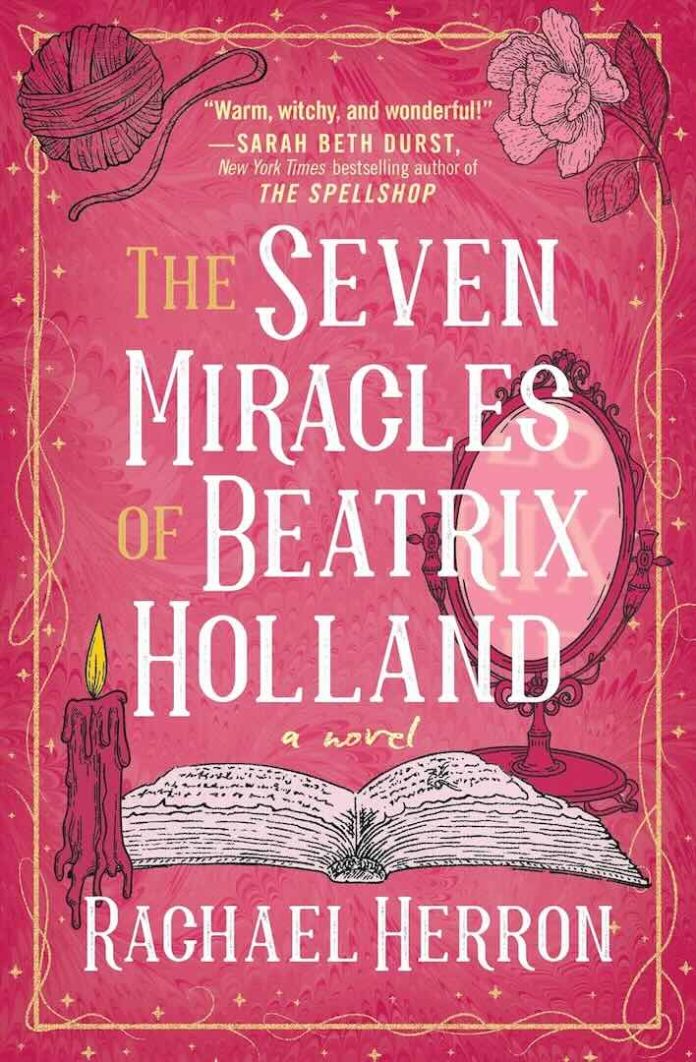
Rachael Herron’s latest novel, The Seven Miracles of Beatrix Holland, begins with perhaps the most relatable magical premise ever written: What happens when the universe insists you’re destined for something extraordinary, but you’re too pragmatic to believe in destiny? Beatrice Barnard—practical accountant, spreadsheet enthusiast, and firm non-believer in anything that can’t be quantified—finds herself thrust into a world where psychic predictions collide with family secrets on the mystical Skerry Island.
The story opens with Beatrice discovering her husband’s affair and, in a moment of defiant independence, taking their planned anniversary vacation alone to a Pacific Northwest island. Within hours of arrival, she narrowly survives what should have been a fatal accident with a rogue wood chipper blade—her first “miracle”—and soon discovers the twin sister she never knew existed, plus a mother who supposedly died when she was two years old.
The Magic That Feels Real
Herron’s greatest achievement in this novel is making magic feel utterly believable and grounded in emotion rather than spectacle. The Holland family’s gifts are beautifully rendered: they commune with the dead, manipulate energy through sigils, and possess an ancient understanding of the mystical forces that pool on Skerry Island. Rather than flashy spell-casting, Herron presents magic as an intimate, sometimes overwhelming connection to the world beyond the veil.
Beatrice’s journey from skeptic to believer unfolds with remarkable authenticity. Her initial resistance to accepting her magical heritage feels genuine—she’s spent her entire life building safety through knowledge and control, so naturally she’d resist something as unpredictable as witchcraft. When she finally experiences her first sigil working, the warmth spreading through her chest “like being hugged but from the inside,” the description captures both wonder and unease with delicate precision.
The author’s approach to magic draws from genuine spiritual traditions while avoiding both appropriation and the tired tropes of pointy hats and cauldrons. The Holland family grimoire, the significance of twin magic, and the ancient feud with the Velamen spirits create a mythology that feels both fresh and rooted in history.
Characters That Breathe
Beatrix (nee Beatrice): The Reluctant Witch
Herron crafts a protagonist who defies the typical “chosen one” archetype. Beatrix is thoroughly ordinary in the most extraordinary ways—she’s competent, organized, and deeply committed to understanding the world through logic. Her transformation isn’t a sudden personality transplant but a gradual opening to possibilities she’d never allowed herself to consider. Her evolution from Beatrice (the name she chose) to Beatrix (her birth name) symbolizes not just self-acceptance but the courage to embrace the unknown.
Cordelia: The Sister She Never Knew
The relationship between the twins forms the emotional core of the novel. Cordelia has known about Beatrix her entire life but never searched for her, carrying the guilt of this decision throughout their reunion. Their dynamic feels authentic—the immediate connection overlaid with decades of missed experiences and different worldviews. Cordelia’s mastery of witchcraft contrasts beautifully with Beatrix’s analytical approach, showing how the same heritage can manifest in vastly different ways.
Minna: The Fearless Future
Perhaps the most compelling character in “The Seven Miracles of Beatrix Holland” is fifteen-year-old Minna, Cordelia’s transgender daughter and the seventh-generation Holland witch on Skerry Island. Herron writes Minna with remarkable depth, avoiding both tokenism and unrealistic perfection. She’s confident in her identity while still dealing with typical teenage struggles, magical and otherwise. Her fearlessness in embracing her power contrasts sharply with the adults’ cautious approach to magic, and her relationship with both Beatrix and Cordelia adds layers of family complexity that enrich the entire narrative.
Reno: Love After Loss
The romance between Beatrix and Reno develops with genuine emotional weight. Reno, a widow still grieving her late wife, represents the possibility of finding love again after devastating loss. Their relationship never feels forced or convenient—instead, it emerges naturally from shared vulnerability and mutual recognition of damaged but hopeful hearts.
The Shadow of Ancient Grudges
The Velamen family curse provides the novel’s central conflict, but it never overshadows the character development. The historical animosity between the Holland and Velamen families, rooted in centuries-old betrayal and magical theft, manifests as a genuine threat to the newly reunited Holland women. The way Herron handles this supernatural antagonist—as malevolent spirits seeking to reclaim stolen power through the living—feels both threatening and thematically appropriate.
The magical battle sequences never devolve into flashy special effects prose. Instead, they focus on the emotional and physical toll of wielding power, the importance of family bonds, and the sacrifices required to protect those we love.
Themes That Resonate
Family and Identity
At its heart, “The Seven Miracles of Beatrix Holland” is a story about what makes a family. Astrid’s decision to separate the twins as babies to protect them from the Velamen threat raises complex questions about sacrifice and choice. The novel doesn’t offer easy answers about whether her actions were right or wrong—instead, it explores how families navigate the consequences of impossible decisions.
Belief and Skepticism
Beatrix’s journey from skeptic to believer mirrors many readers’ own relationship with the mystical. Herron doesn’t mock scientific thinking or present belief as inherently superior to skepticism. Instead, she suggests that the most powerful magic might come from combining analytical understanding with openness to mystery.
Love in All Its Forms
“The Seven Miracles of Beatrix Holland” celebrates multiple types of love: sisterly bonds, parental devotion, romantic connection, and the love of found family. Reno’s continuing connection to her deceased wife never feels like an obstacle to her new relationship with Beatrix—instead, it becomes part of the magic that binds them together.
Writing Style and Pacing
Herron’s prose strikes an excellent balance between accessibility and sophistication. She has a gift for making complex magical concepts understandable without oversimplifying them, and her dialogue feels natural and unforced. The pacing builds steadily, allowing time for character development and world-building while maintaining momentum toward the climactic confrontation.
The author’s background in multiple genres serves her well here. The romantic elements feel genuine without overwhelming the fantasy plot, and the magical realism aspects ground the supernatural elements in emotional truth. Her experience with memoir writing brings authenticity to the family dynamics and personal growth arcs.
Minor Critiques
While “The Seven Miracles of Beatrix Holland” succeeds admirably overall, there are moments where the magical system could benefit from slightly more explanation. The exact mechanics of how Holland magic works, particularly the relationship between emotional intention and supernatural results, sometimes feels inconsistent. Additionally, some secondary characters, particularly those in the Skerry Island community, could use more development to make the setting feel fully lived-in.
The pacing occasionally slows during exposition-heavy sections, particularly when explaining the historical conflict between the Holland and Velamen families. While this information is necessary, it sometimes interrupts the narrative flow.
A Love Letter to Witches and Skeptics Alike
What makes The Seven Miracles of Beatrix Holland particularly remarkable is its appeal to both believers and skeptics. Herron doesn’t ask readers to accept magic wholesale—instead, she invites them to consider the magical possibilities that exist within everyday human connection, family bonds, and personal transformation.
The seven miracles structure provides excellent pacing while building toward the inevitable confrontation with both supernatural threats and personal fears. Each miracle feels earned rather than contrived, growing naturally from character development and plot progression.
Similar Reads for Your TBR Stack
Readers who connect with Herron’s blend of magical realism and family drama should consider:
For Similar Contemporary Magical Realism:
- The Ten Thousand Doors of January by Alix E. Harrow
- The Once and Future Witches by Alix E. Harrow
- The Invisible Life of Addie LaRue by V.E. Schwab
- The Midnight Girls by Alicia Jasinska
For Family-Centered Fantasy:
- The Witch Haven series by Sasha Peyton Smith
- The Very Secret Society of Irregular Witches by Sangu Mandanna
- The Rules of Magic by Alice Hoffman (prequel to Practical Magic)
- The Witches of New York by Ami McKay
And for LGBTQ+ Fantasy Romance:
- The Priory of the Orange Tree by Samantha Shannon
- She Who Became the Sun by Shelley Parker-Chan
- The House in the Cerulean Sea by TJ Klune
Final Verdict
The Seven Miracles of Beatrix Holland succeeds as both an engaging fantasy novel and a thoughtful exploration of family, identity, and belief. Herron has created a world that feels magical without sacrificing emotional authenticity, characters who grow and change in believable ways, and a plot that satisfies both heart and mind.
This novel will particularly appeal to readers who enjoyed Practical Magic but wanted more depth, or fans of contemporary fantasy who crave character development alongside supernatural elements. It’s a perfect choice for book clubs that enjoy discussing themes of family secrets, personal identity, and the nature of belief.
While it doesn’t revolutionize the magical realism genre, it offers a thoroughly satisfying entry that honors the genre’s traditions while bringing fresh perspectives on sisterhood, sexuality, and spiritual discovery. Herron has crafted a novel that reminds us that the most powerful magic might be the courage to embrace who we’re meant to become.
For readers seeking escape from ordinary life without losing touch with emotional truth, The Seven Miracles of Beatrix Holland offers exactly the right blend of wonder and wisdom. It’s a book that will leave you believing in the possibility of miracles—even if you came to it as a skeptic like Beatrix herself.







