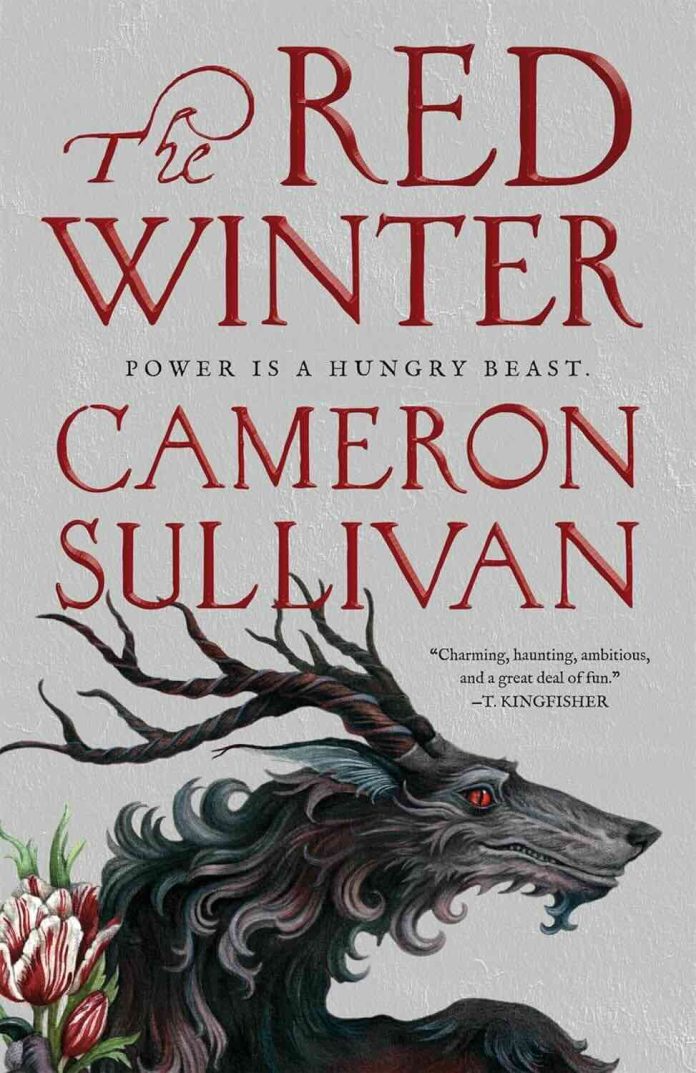
In the shadowed corridors where history meets horror, where romance tangles with the grotesque, The Red Winter by Cameron Sullivan emerges as a debut that refuses to play by conventional genre rules. This is not your typical historical fantasy—it’s a blood-soaked love letter to 18th-century France, wrapped in the skin of a monster hunt and delivered with the erudition of a classical scholar who’s spent far too much time contemplating mortality.
Sullivan’s novel takes the real historical mystery of the Beast of Gévaudan—a creature that terrorized rural France in the 1760s—and transforms it into something far stranger and more ambitious: a meditation on war, love, immortality, and the hidden supernatural forces that shape human history.
The Magician and His Demon
At the heart of The Red Winter by Cameron Sullivan stands Sebastian Grave, our immortal narrator who pens this account from modern-day Florence while reminiscing about events from two centuries past. Sebastian is no simple hero—he’s a magician bound to Sarmodel, an ancient demon who demands human hearts as payment for his services. This relationship forms the novel’s most compelling dynamic: part symbiotic partnership, part cosmic marriage, wholly unusual in its intimacy and complexity.
Sebastian’s voice carries the weight of millennia. He speaks with the casual authority of someone who studied at universities long since turned to dust, who knew Rome before its fall, who witnessed Joan of Arc’s rise and horrifying end. Yet Sullivan never lets this erudition become insufferable. Instead, Sebastian’s narration crackles with wit, self-awareness, and a profound weariness that makes his occasional moments of genuine feeling all the more powerful.
The novel’s structure—presented as Sebastian’s memoir complete with footnotes both helpful and sardonic—allows Sullivan to:
- Build a richly detailed magical system without info-dumping
- Insert moments of dark humor through annotated asides
- Create narrative distance that paradoxically increases emotional intimacy
- Reference classical literature and history with scholarly precision
This framing device isn’t mere stylistic flourish; it’s integral to understanding how an immortal processes trauma, how memory calcifies into story, and how even someone who’s lived thousands of years can be undone by a single mortal love.
A Romance Written in Blood and Regret
The Red Winter by Cameron Sullivan presents an LGBTQ+ romance between Sebastian and Antoine Avenel d’Ocerne that feels both achingly tender and doomed from its inception. Their relationship, forged during the first hunt for the Beast twenty years before the novel’s present action, haunts every page. Sullivan crafts their connection with remarkable restraint—allowing sensual moments and emotional vulnerability to emerge naturally from the horror and violence surrounding them.
What makes this romance particularly effective is Sullivan’s refusal to sanitize or simplify it. Antoine is flawed, sometimes cruel, ultimately weak in ways that matter catastrophically. Sebastian’s love for him becomes a liability, clouding his judgment and leading to choices that echo across decades. The author never asks us to root for their reunion uncritically; instead, we watch Sebastian grapple with whether the memory of love is worth preserving when it exists alongside betrayal, manipulation, and profound moral compromise.
The novel’s queer representation feels organic to its 18th-century setting rather than anachronistic. Sebastian’s relationships exist in a world where such connections were dangerous, clandestine, yet possible—adding another layer of peril to an already precarious existence.
The Beast and the Spirit of War
Sullivan’s reimagining of the Beast of Gévaudan as Avstamet—the ancient Spirit of War known to Greeks as Ares and Romans as Mars—elevates The Red Winter by Cameron Sullivan beyond simple monster-hunting narrative into genuine horror-philosophy. The Beast isn’t merely a wolf-like creature killing peasants; it’s the incarnation of humanity’s basest impulses, the voice that whispers conquest and violence into willing ears across millennia.
The historical connections Sullivan draws are ambitious and often chilling. By linking the Beast to Gilles de Rais’s atrocities, Joan of Arc’s visions, and ultimately positioning the Gévaudan uprising as the true spark of the French Revolution, the novel proposes that our recorded history is merely the surface of deeper, darker currents. War doesn’t simply happen—it’s fed, nurtured, incarnated by forces that feast on human discord.
This philosophical underpinning gives weight to what might otherwise be straightforward action sequences. When the Beast tears through the marketplace at Saint-Julien, we’re not just witnessing horror—we’re seeing the moment when accumulated resentment, class rage, and supernatural manipulation converge into violence that will reshape a continent.
Where the Shadows Grow Too Deep
Yet for all its ambition, The Red Winter by Cameron Sullivan occasionally stumbles under the weight it carries. The novel’s middle section sags as Sebastian recounts the original hunt, and while these flashbacks provide necessary context, they sometimes halt forward momentum. Sullivan’s devotion to his magical system—complete with Latin terminology, arcane hierarchies, and complex rules about spiritual energy (anima)—can overwhelm readers seeking narrative propulsion over worldbuilding minutiae.
The footnotes, while often delightful, become exhausting in their abundance. Some add genuine insight or humor; others feel like the author couldn’t bear to cut interesting research that doesn’t quite serve the story. This scholarly impulse reflects Sebastian’s character beautifully but sometimes works against the novel’s dramatic tension.
Additionally, the supporting cast beyond Sebastian, Sarmodel, and Antoine can feel underdeveloped. Jacques, Antoine’s cursed son who should command our sympathy, remains frustratingly opaque. The Bishop of Mende makes an effective antagonist but lacks complexity. Lorette’s arc, while thematically important, feels rushed in its execution.
The novel’s denouement—a violent uprising at Château d’Ocerne that devolves into massacre—is both powerful and somewhat muddled, as if Sullivan couldn’t quite decide whether to embrace the revolution’s idealism or condemn its inevitable bloodshed. This ambivalence might be intentional, but it leaves certain narrative threads feeling unresolved.
A Debut That Demands Attention
Despite these criticisms, The Red Winter by Cameron Sullivan announces a distinctive new voice in dark fantasy. Sullivan writes with confidence rare in debut authors, trusting readers to follow him through complex magical systems, morally ambiguous protagonists, and historical tangles. His prose can be lush without tipping into purple, scholarly without becoming dry, romantic without growing maudlin.
The novel succeeds most brilliantly in its small moments: Sebastian’s hands trembling as he recognizes a relic he’s chased for centuries. Sarmodel’s unexpected tenderness when Sebastian grieves. The terrible intimacy of Antoine closing manacles around Sebastian’s wrists while apologizing. These beats demonstrate Sullivan’s understanding that horror works best when it’s personal, when it violates relationships we’ve come to care about.
For readers willing to immerse themselves in its dark waters, The Red Winter by Cameron Sullivan offers rewards beyond mere entertainment. It’s a novel about the stories we tell ourselves to survive, about whether immortality is gift or curse, about how love can be both our salvation and our doom. It’s about recognizing that history’s monsters were often human, and humans can become monstrous when circumstances demand it.
For Readers Who Crave
If The Red Winter by Cameron Sullivan speaks to your literary appetites, consider these similar dark delights:
Similar Reads:
- The Historian by Elizabeth Kostova: For readers who appreciate scholarly narrators investigating supernatural histories
- Circe by Madeline Miller: If you enjoyed mythological reimagining with intimate character focus
- Jonathan Strange & Mr Norrell by Susanna Clarke: For those drawn to footnote-heavy historical fantasy with academic rigor
- The Essex Serpent by Sarah Perry: If the Victorian gothic atmosphere and doomed romance resonated
- This Is How You Lose the Time War by Aditya Martine and Max Gladstone: For readers who loved the romantic letters and poetic prose amid violence
Final Reckoning
Cameron Sullivan has crafted a debut that’s unafraid to demand much from its readers while delivering something genuinely original. It’s not perfect—it meanders, occasionally overwhelms, and sometimes prioritizes intellectual complexity over emotional clarity. But its ambitions, its willingness to explore difficult moral territory, and its refusal to provide easy answers mark it as something special in contemporary fantasy.
This is a book that will haunt you, that will send you down research rabbit holes about the real Beast of Gévaudan, that will make you reconsider the monsters lurking beneath history’s surface. It’s a book that understands that sometimes the greatest horrors aren’t supernatural at all—they’re the choices we make when we love someone more than we love ourselves, or when we value our own survival above all else.
The Red Winter by Cameron Sullivan is a blood-drenched meditation on memory, monstrosity, and the terrible price of living long enough to become the villain in someone else’s story. It deserves your attention, your patience, and your willingness to follow it into the dark.







