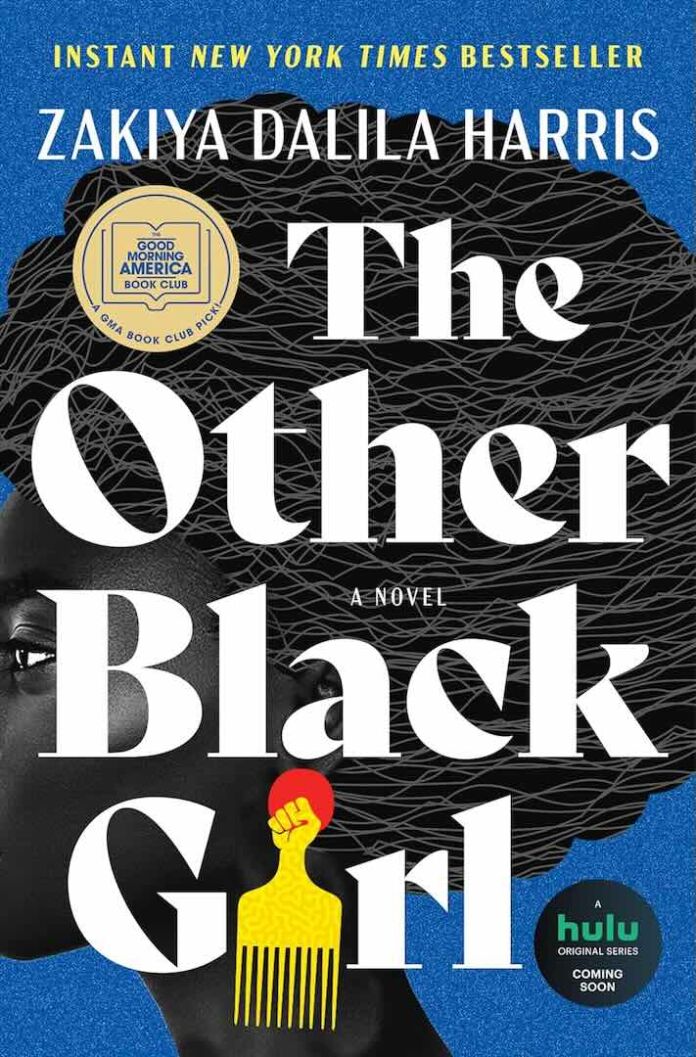
Zakiya Dalila Harris’s debut novel, The Other Black Girl, is a masterclass in genre-blending and tonal precision. With a premise that flirts with workplace drama and a delivery that escalates into psychological thriller and social horror, this novel wields its sharpest weapon—social commentary—with eerie elegance. It begins with the scent of cocoa butter and ends in a haunting transformation, mirroring the uncomfortable realities of being “the only one” in corporate America.
Much like Get Out and The Stepford Wives, Harris’s novel uses the eerie and absurd to peel back the mask of progressivism in white liberal institutions. It isn’t just a story about microaggressions and marginalization—it’s about the cost of assimilation, the warping of identity, and the quiet terror of being replaced, redefined, and erased.
Plot Overview: Cocoa Butter, Competition, and Control
At Wagner Books, a prestigious and predominantly white publishing house in Manhattan, 26-year-old Nella Rogers is tired of being the only Black woman. When Hazel-May McCall is hired and placed in the cubicle next to hers, Nella’s cautious optimism blossoms. Here, finally, is someone who understands her plight, someone she can trust, maybe even befriend.
But as Hazel begins to rise—effortlessly charming senior editors, gaining praise, and surpassing Nella in influence—things take a turn. Notes begin to appear on Nella’s desk: LEAVE WAGNER. NOW. She suspects Hazel, but as paranoia and unease intensify, she begins to question everything. Is Hazel a friend, a foe, or something far more insidious?
The plot twists slowly, then wildly, shifting from a tale of workplace tension to an unsettling narrative about identity control, mind manipulation, and the dark underbelly of “diversity” in publishing. The suspense builds toward a crescendo that’s as disorienting as it is bold.
Main Character Analysis: Nella vs. Hazel
Nella Rogers: The Disillusioned Idealist
Nella is the perfect protagonist for a novel of creeping disillusionment. Smart, competent, and socially aware, she’s built her identity around surviving—and hopefully thriving—in a system that was never made for her. Harris crafts Nella with deliberate fragility; we watch her internalize workplace slights, self-police her reactions, and cling to hope that merit and respect will one day align.
As the novel progresses, her character arc transforms from compliant and hopeful to unhinged and desperate. The psychological deterioration is nuanced and emotionally truthful. Nella’s descent into fear isn’t just about workplace politics—it’s about what happens when your identity becomes a battleground.
Hazel-May McCall: The Enigma
Hazel is brilliant in her ambiguity. She’s radiant, confident, and somehow effortlessly beloved by the same people who undervalued Nella. Is she genuinely supportive or strategically manipulative? Her motives unfold slowly, wrapped in mystery, charisma, and coded cultural signifiers. Hazel’s very presence is a critique of the superficial ways companies seek “diversity”—not for inclusion, but for image.
By the end, Hazel is no longer just “the other Black girl”—she is a chilling manifestation of what Blackness looks like when it’s been rebranded, packaged, and sold to corporate America.
Writing Style: Satirical Precision Meets Genre Ambiguity
Zakiya Dalila Harris writes with a voice that is both whip-smart and deeply observant. Her prose is layered and ironic, filled with millennial wit, editorial sharpness, and horror-tinged undertones. She deftly alternates between Nella’s internal monologue and the creeping horror around her, ensuring the reader feels as trapped and observed as Nella does.
Highlights of Harris’s style include:
- Dialogue that slices—sharp, socially aware, and laced with code-switching brilliance.
- Satirical yet grounded worldbuilding—Wagner Books is both every publishing house and its worst nightmare.
- Shift in tone—The novel transitions seamlessly from realism to surreal horror, never sacrificing narrative control.
Her writing echoes the dread and discomfort of Jordan Peele’s Get Out, but her satire also recalls Ottessa Moshfegh’s bleak humor and Nella Larsen’s psychological depth.
Themes Explored: A Deep Dive into the Mirror
1. Racial Isolation in Professional Spaces
Harris captures the exhaustion of being “the only one” with devastating clarity. The performative allyship, the fetishization of hair, the endless burden of representation—these aren’t just footnotes in Nella’s life; they’re the weight that threatens to crush her spirit.
2. The Commodification of Diversity
The Other Black Girl is scathing in its portrayal of how corporations tokenize identity. Hazel becomes a symbol of how “palatable Blackness” can be weaponized to undermine authenticity. The idea that representation can be manufactured and enforced is both terrifying and profoundly relevant.
3. Identity, Autonomy, and Resistance
Through Nella’s unraveling psyche, the novel questions how much of yourself you must sacrifice to succeed. What happens when the system asks not for your presence, but for your compliance? Can resistance exist when every voice is curated?
4. Horror of Transformation
There’s literal horror in the novel—hair grease that erases memory, people who become shells of themselves—but the real horror lies in what Nella might lose: her mind, her principles, and her sense of self.
What Works: The Triumphs of Harris’s Debut
- A Brilliant Blend of Genres: Mystery, satire, horror, and social commentary coalesce without feeling disjointed.
- Smart, Literary Allusions: Harris references everything from Kindred to Toni Morrison, subtly weaving a tapestry of Black literary history into the narrative.
- Unpredictable Plot: The slow-burn tension evolves into a gripping, eerie climax that feels earned.
- Nuanced Dialogue on Black Identity: From internalized racism to code-switching, Harris doesn’t flatten the Black experience—she expands it.
Where It Falters: Room for Refinement
Despite its strengths, The Other Black Girl is not without its imperfections.
- Pacing Issues: The novel starts off strong but sags slightly in the middle. The genre shift—while clever—may disorient readers who came expecting realism rather than speculative fiction.
- Side Characters Lack Depth: Some supporting characters—particularly white colleagues—feel caricatured, undermining the book’s emotional complexity.
- Abrupt Ending: While thematically fitting, the final twist leaves several threads unresolved. Readers craving closure may find the denouement unsatisfying.
These flaws, however, don’t undercut the novel’s ambition—they simply reflect a debut writer taking bold risks.
Comparative Reads: If You Liked This, Try…
- Get Out (film) by Jordan Peele – For its eerie social horror about race.
- Passing by Nella Larsen – For its layered exploration of Black identity.
- Such a Fun Age by Kiley Reid – For its sharp dissection of white liberalism and performative wokeness.
- Mexican Gothic by Silvia Moreno-Garcia – For a similar genre-bending approach to horror and oppression.
- The Vanishing Half by Britt Bennett
- My Sister, the Serial Killer by Oyinkan Braithwaite
Harris stands firmly among these authors, offering a voice that is urgent, complex, and necessary.
About the Author: Zakiya Dalila Harris
The Other Black Girl is Harris’s debut, but it reads like the work of a seasoned writer. A former editorial assistant herself, Harris brings lived experience to the narrative, making her critique of the publishing industry feel both authentic and scathing. With this novel, she positions herself as a literary voice to watch—someone unafraid to speak truth to power, even if it means conjuring a monster to do so.
We eagerly await her next book.
Final Verdict: A Bold Debut That Lingers
Zakiya Dalila Harris’s The Other Black Girl is unsettling, thought-provoking, and disturbingly real. It’s a book that dares to say the quiet part out loud: that diversity without inclusion is a new kind of horror. By the time the last page turns, Harris doesn’t just ask if we’re comfortable—she dares us to question whether we’ve been complicit all along.
Recommended For:
- Readers who enjoy intelligent thrillers with a conscience.
- Anyone interested in race, identity, and corporate culture.
- Fans of literary fiction that bends genre boundaries.
This is not just another workplace drama. It’s a chilling allegory of assimilation, control, and survival—a novel that doesn’t just want to be read. It wants to be seen.







