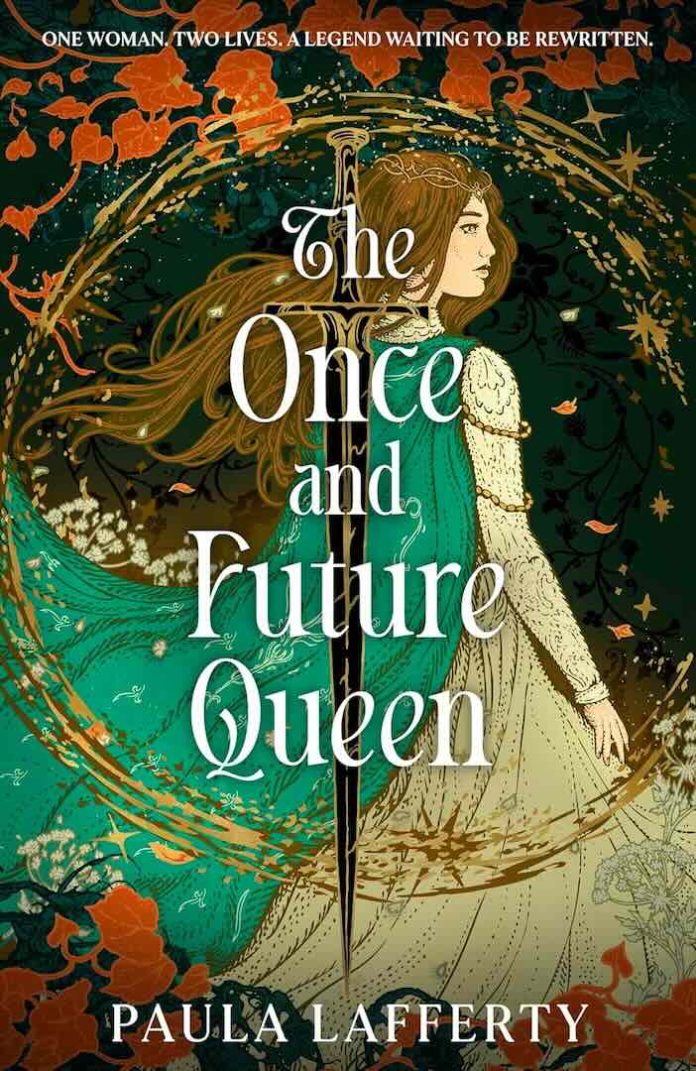
Paula Lafferty’s debut novel, The Once and Future Queen, breathes new life into one of literature’s most controversial figures: Queen Guinevere. But this isn’t the adulteress of legend we’ve come to expect. Instead, Lafferty crafts a feminist reimagining that asks compelling questions about identity, redemption, and what it means to be truly seen in a world determined to forget you.
Vera is a twenty-two-year-old woman living a forgettable existence in modern Glastonbury—running the breakfast shift at her parents’ hotel, jogging aimlessly each morning, and nursing wounds from a recent relationship. When a mysterious man named Merlin appears with an impossible claim that she was once Queen Guinevere of Camelot, Vera’s mundane life takes an extraordinary turn. Through time-travel magic, she’s thrust fourteen centuries into the past, into the body of a queen who died under mysterious circumstances—and whose memories hold the key to saving a crumbling kingdom.
The Weight of a Crown You Never Asked to Wear
What makes Lafferty’s approach remarkable is her refusal to simply transplant a modern woman into medieval times for laughs or easy fish-out-of-water moments. Vera arrives in seventh-century Britain stripped of Guinevere’s memories, facing a husband who can barely look at her and a court full of secrets she doesn’t understand. The author masterfully captures Vera’s disorientation and growing horror as she pieces together the truth: she’s not here to be queen, but rather to serve as a vessel for recovering another woman’s lost knowledge.
The exploration of Vera’s invisibility—both in her modern life and initially in Camelot—forms the emotional backbone of the narrative. Lafferty has crafted something genuinely poignant here: a protagonist who’s spent her entire life being forgotten by everyone around her, part of the very magic that brought her into existence. When Vera discovers that people in Camelot actually see her, remember her, and value her presence, the contrast hits with unexpected force. It’s a meditation on self-worth wrapped in fantasy trappings, and it resonates far beyond the medieval setting.
Deconstructing the Love Triangle That Never Was
Perhaps the novel’s most satisfying achievement is its complete dismantling of the traditional Guinevere-Arthur-Lancelot triangle. Where centuries of retellings have painted Guinevere as a faithless queen torn between duty and desire, Lafferty offers something far more nuanced and emotionally authentic. The relationship that develops between Vera and Lancelot is one of the book’s great pleasures—a friendship so immediate and profound that Vera initially suspects they must have been lovers in Guinevere’s past.
The truth, when it emerges, demonstrates Lafferty’s commitment to thoughtful representation. Lancelot’s character arc addresses the isolation and danger of being queer in the seventh century with sensitivity and emotional honesty, while never reducing him to his sexuality. His bond with Vera becomes the story’s emotional anchor—the kind of platonic intimacy that fiction too often dismisses in favor of romantic entanglements. Their midnight conversations in hidden caves, their morning runs through Glastonbury, and Lancelot’s fierce protectiveness all serve to highlight what was missing from Vera’s previous life: someone who truly sees her.
A King Who Needs Rescuing From His Own Legend
Arthur proves equally deserving of rehabilitation. Lafferty’s king is no idealized ruler of myth, but rather a young man bearing impossible burdens. His initial coldness toward Vera stems from legitimate trauma—a detail that unfolds gradually and devastatingly. The author demonstrates remarkable restraint in building their relationship, allowing Arthur and Vera to circle each other warily for much of the book. When they finally connect over reading The Hobbit together (in a genuinely charming anachronistic touch), the quiet intimacy of those scenes stands in stark contrast to the magical spectacle surrounding them.
The romantic development between them walks a delicate line. Lafferty complicates their growing feelings with questions about magical manipulation and manufactured emotion. Is their connection real, or merely the result of enchantment? The novel doesn’t provide easy answers, instead forcing both characters—and readers—to grapple with the authenticity of feelings that might be magically constructed. It’s a clever parallel to Vera’s own existential crisis: if you’re created to serve a purpose, can your choices ever truly be your own?
Magic as Metaphor and Mechanism
The magic system itself deserves attention for its originality and thematic resonance. Rather than offering unlimited power, magic in Lafferty’s Camelot is a finite, failing resource. The curse slowly draining the kingdom’s magical energy mirrors Vera’s own sense of being depleted and hollowed out. The various “gifts” possessed by mages—from sensory enhancement to emotional manipulation—serve both practical plot functions and deeper explorations of power, consent, and control.
Merlin emerges as perhaps the novel’s most morally complex figure. Neither villain nor hero, he’s a man so fixated on saving the kingdom that he’s willing to sacrifice anything—and anyone—to achieve his goals. The memory retrieval procedures he subjects Vera to are genuinely harrowing, raising uncomfortable questions about bodily autonomy and the ethics of using one person as a tool to save many. Lafferty doesn’t shy away from these implications; Vera’s rage and sense of violation after Merlin destroys her most precious memories creates one of the book’s most powerful sequences.
The Prose and Pacing Challenge
Where The Once and Future Queen occasionally stumbles is in its pacing. The first third moves with deliberate slowness as Vera acclimates to Camelot, and some readers may find the gradual reveal of information frustrating. Lafferty employs a structure that withholds key details—Guinevere’s actual fate, the nature of Viviane’s betrayal, Arthur’s reasons for keeping Vera at arm’s length—until well past the midpoint. While this builds mystery effectively, it can also create moments where character motivations feel opaque or actions seem arbitrary.
The prose itself is competent if occasionally uneven. Lafferty excels at emotional interiority and dialogue, particularly in quieter moments between characters. Vera’s internal voice rings authentic—sharp, self-deprecating, occasionally profane in ways that feel true to a woman from the twenty-first century. Action sequences and large-scale scenes prove less assured; a climactic confrontation late in the book feels somewhat rushed compared to the careful development that preceded it.
Additionally, the novel’s approach to historical detail is selective at best. While the author captures certain aspects of seventh-century life with research and care, she also openly anachronizes for effect. Characters discuss concepts and express attitudes that feel distinctly modern. This creative choice works within the book’s overall tone—after all, this is fantasy that includes time travel and portable magical lights—but readers seeking historical authenticity should adjust expectations accordingly.
Supporting Cast and Court Intrigue
The secondary characters populate Camelot with varying degrees of success. Matilda, Vera’s lady’s maid, transforms from a walking propriety lesson into a fully realized person with her own desires and traumas. Gawain, the mage who initially distrusts Vera, undergoes one of the book’s more satisfying character arcs. His relationship with Lancelot adds another layer of complexity and provides crucial plot developments.
Other figures feel less developed. The villainous Viviane appears primarily in memories and explanations rather than as an active presence, which diminishes her impact. Several of Arthur’s knights blur together despite the author’s efforts to distinguish them. The political machinations of the mage council, while important to the plot, sometimes feel like obligatory fantasy worldbuilding rather than organic story elements.
The Cliffhanger That Changes Everything
The novel’s ending deserves mention without spoiling its specifics. Lafferty commits fully to a devastating cliffhanger that recontextualizes everything that came before. It’s a bold choice for a debut—one that will leave readers desperate for the sequel while potentially frustrating those who prefer more resolution. The final chapters accelerate dramatically, cramming emotional revelations and plot twists into a compressed space after the novel’s measured pace throughout.
This structural choice reflects both the book’s greatest strength and its most significant weakness. Lafferty excels at character development and relationship building, taking time to let Vera earn her place in Camelot and in readers’ hearts. However, the narrative occasionally seems uncertain whether it’s primarily a romance, a coming-of-age story, or a fantasy adventure, resulting in some tonal inconsistency.
A Trilogy’s Promising Foundation
As the first installment in The Lives of Guinevere series, The Once and Future Queen establishes an intriguing mythology while leaving numerous threads dangling for future volumes. Questions about time travel mechanics, the true nature of Guinevere’s original betrayal, and the possibility of breaking curses remain tantalizingly unanswered. This approach rewards investment in the series while potentially leaving readers who prefer standalone satisfaction somewhat adrift.
The Once and Future Queen works best when embraced as character-driven fantasy that happens to feature Arthurian figures rather than a faithful adaptation of legend. Lafferty’s Camelot is less concerned with recreating medieval pageantry than exploring universal themes of belonging, purpose, and the courage required to forge your own identity when destiny tries to define you. Vera’s journey from invisible innkeeper to queen who matters—not because of whose memories she carries but because of who she chooses to be—provides genuine emotional payoff.
For Readers Who Will Appreciate This Journey
The Once and Future Queen will particularly resonate with readers who enjoy:
- Character-focused fantasy that prioritizes emotional development over action
- Feminist retellings that challenge traditional narratives
- Slow-burn romances built on genuine connection
- Stories exploring trauma, healing, and found family
- Time-travel narratives with complex emotional stakes
- LGBTQ+ representation integrated thoughtfully into historical fantasy
Readers seeking fast-paced adventure, intricate political machinations, or comprehensive worldbuilding may find the novel’s intimate focus somewhat limiting.
Similar Reads for Arthurian Enthusiasts
Those drawn to Lafferty’s reimagining in The Once and Future Queen might also enjoy:
- The Mists of Avalon by Marion Zimmer Bradley – Another feminist retelling of Arthurian legend from female perspectives
- The Once and Future King by T.H. White – The classic that influenced modern Arthurian retellings
- Guinevere Deception by Kiersten White – A YA take on Guinevere with magical intrigue
- The Winter King by Bernard Cornwell – A grittier, more historical approach to Arthur’s story
- The Song of Achilles by Madeline Miller – For readers who appreciated the queer subtext and emotional depth
Final Verdict: A Worthy Beginning Despite Imperfections
The Once and Future Queen announces Paula Lafferty as a writer to watch, even as it reveals the growing pains typical of debut novels. The book’s greatest asset is its heart—a genuine emotional core that makes readers care deeply about Vera’s struggle to become more than the sum of someone else’s memories. When Lafferty focuses on her characters’ internal landscapes and interpersonal dynamics, the novel soars. When it gets tangled in fantasy mechanics or rushes through plot machinations, it stumbles.
What ultimately distinguishes this retelling is its insistence that Guinevere’s story—and by extension, Vera’s story—matters beyond her relationships with famous men. While romance certainly plays a role, the novel’s true love story is Vera learning to love herself, to see herself as valuable independent of any external purpose. In an age of Arthurian adaptations, that perspective feels genuinely fresh.
The journey isn’t perfect, but it’s compelling enough to leave readers eager to see where Lafferty takes these characters next. For those willing to invest in a trilogy’s long game and patient enough to let relationships develop naturally, The Once and Future Queen offers a satisfying blend of familiar legend and innovative perspective—a queen’s story finally told on her own terms.







