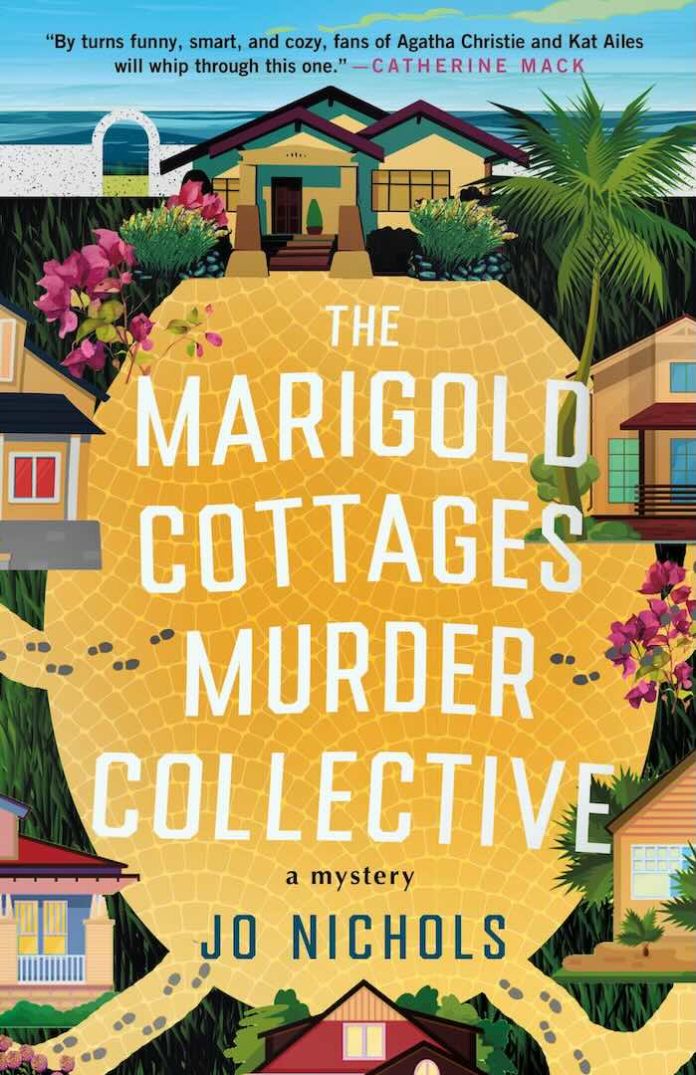
In the sun-drenched landscape of contemporary cozy mysteries, few debut novels manage to capture both the intimate warmth of community and the delicious darkness of human nature quite like The Marigold Cottages Murder Collective. Jo Nichols, the pen name for a husband-and-wife writing team with an impressive thirty-one book catalog across five genres, delivers a Santa Barbara-set mystery that feels both refreshingly original and comfortingly familiar.
The Heart of the Matter: Plot and Premise
The story unfolds in the titular Marigold Cottages, a collection of sage-green Craftsman bungalows owned by the formidable Mrs. B (Golda Bakofsky), whose philosophy of tenant selection runs deeper than credit scores. She curates her community like a master gardener, choosing residents who need both shelter and healing: Sophie, a traumatized playwright drowning her sorrows in both alcohol and artistic ambition; Hamilton, an agoraphobic intellectual whose isolation has made him both vulnerable and oddly wise; Ocean, a sculptor raising two children alone while carrying the weight of divorce; Lily-Ann, a perfectionist seeking purpose beyond her toxic marriage; and Nicholas, a city planner harboring secrets that threaten everything Mrs. B has built.
When Anthony Lambert, an ex-convict with face tattoos and a history of violence, moves into the sixth cottage, the delicate ecosystem Mrs. B has cultivated begins to shift. Three weeks later, real estate developer James Dedrick is found dead on the property, his skull crushed by what appears to be a South African knobkerrie. Anthony’s arrest seems inevitable—until Mrs. B shocks everyone by confessing to the crime herself.
Character Development: Where the Novel Truly Shines
The greatest strength of The Marigold Cottages Murder Collective lies in its richly developed ensemble cast. Each character is given their own voice through alternating first-person perspectives, a narrative technique that could have easily become confusing but instead creates a layered, almost symphonic storytelling experience. The authors demonstrate remarkable skill in maintaining distinct voices for each character while weaving their stories into a cohesive whole.
Mrs. B emerges as the beating heart of the story—a woman who sees potential where others see problems, who believes in second chances with the fierce determination of someone who has needed them herself. Her relationship with each tenant reveals different facets of her character, from maternal protector to shrewd judge of human nature.
Sophie’s journey from victim to empowered individual provides one of the novel’s most compelling character arcs. Her background as a stalking survivor adds genuine psychological depth to her nervous energy and hypervigilance, while her passion for theater gives the authors opportunities to explore themes of performance, identity, and truth through her in-progress play about the murders.
Setting as Character: Santa Barbara’s Seductive Charm
The authors’ combined thirty-six years of Santa Barbara residence infuses the novel with authentic local color that goes beyond mere window dressing. The Marigold Cottages feel lived-in and real, from Mrs. B’s passion fruit vines intertwined with bougainvillea to the drought-friendly desert landscaping of the central courtyard. The setting becomes almost another character, with its own moods and secrets.
The contrast between Santa Barbara’s picture-perfect exterior and the darker human dramas playing out within provides an effective backdrop for the mystery. The authors capture the unique California blend of laid-back beach culture and serious real estate money that drives much of the conflict.
Pacing and Structure: A Double-Edged Sword
While the character-driven approach creates rich emotional investment, it occasionally slows the mystery’s momentum. The novel’s 99 chapters, alternating between different perspectives, can feel excessive at times. Some chapters serve more to deepen character understanding than advance the plot, which may frustrate readers seeking a more traditional mystery pace.
However, this deliberate pacing also allows for the gradual revelation of secrets and the organic development of relationships between the cottages’ residents. The formation of the “Murder Collective” feels earned rather than forced, growing naturally from their shared concern for Mrs. B and their growing bonds with each other.
The Mystery Elements: Clever Misdirection with Satisfying Resolution
The central mystery proves more complex than initially apparent, with the authors skillfully layering multiple crimes, blackmail schemes, and hidden motives. The revelation involving Gregory Ybarra’s video evidence and Nicholas’s conflict of interest adds contemporary relevance about surveillance and corruption.
The resolution, while perhaps not entirely surprising to mystery veterans, satisfies through its character-driven logic rather than clever plot twists. The authors prioritize emotional truth over shocking revelations, which aligns with the novel’s focus on community and healing.
Themes and Social Commentary
Beneath its cozy mystery exterior, the novel tackles serious themes including:
- Second chances and redemption: Anthony’s character challenges readers’ assumptions about ex-convicts and the possibility of genuine rehabilitation
- Community versus isolation: Each character’s journey from loneliness to belonging reflects broader questions about how we connect in modern society
- Trauma and healing: Sophie’s stalking backstory and various characters’ emotional wounds are handled with sensitivity and psychological realism
- Economic inequality and gentrification: The threat to the Marigold Cottages reflects real California housing pressures
Writing Style: Accessible Excellence
The authors demonstrate impressive range in their ability to capture distinct character voices while maintaining narrative coherence. The prose is clean and engaging, with occasional flashes of genuine beauty in descriptions of the Santa Barbara landscape and the cottages themselves. The dialogue feels natural and character-appropriate, from Hamilton’s verbose intellectualism to Anthony’s taciturn directness.
The integration of Sophie’s theatrical work provides meta-commentary on the art of storytelling itself, as her play-within-the-novel mirrors and reflects the main narrative in clever ways.
Minor Criticisms
While generally successful, the novel isn’t without minor flaws. The extensive cast occasionally makes it challenging to track every character’s motivations and secrets. Some subplot resolutions feel rushed compared to the careful buildup, particularly regarding Lily-Ann’s abusive marriage to Piotr.
The novel’s length—nearly 300 pages—sometimes feels excessive for the central mystery, though the character development justifies much of the word count. Readers seeking a traditional “puzzle” mystery might find the psychological focus less satisfying than those who enjoy character-driven stories.
Comparison to Similar Works
The novel succeeds in its obvious inspirations while carving out its own identity. Like The Thursday Murder Club, it features unlikely amateur detectives bonding over crime-solving, but with a younger, more diverse cast. The Santa Barbara setting and ensemble approach recall Big Little Lies, though with less psychological darkness and more genuine warmth.
The community-building aspect particularly shines compared to similar works. Where many cozy mysteries feature established relationships, The Marigold Cottages Murder Collective shows the actual process of strangers becoming family, making their eventual cooperation feel organic rather than convenient.
Recommended for Mystery Lovers Who Enjoy
If you love character-driven mysteries with heart, consider these similar titles:
- The Thursday Murder Club series by Richard Osman – for ensemble amateur detective work
- The Sweetness at the Bottom of the Pie by Alan Bradley – for community-focused mysteries
- Still Life by Louise Penny – for character development within mystery frameworks
- The Maid by Nita Prose – for unreliable narrators and found family themes
Final Verdict: A Promising Debut
The Marigold Cottages Murder Collective succeeds more as a story about broken people finding healing through community than as a traditional whodunit, and that’s perfectly fine. The authors understand that the best mysteries are ultimately about human nature—our capacity for both violence and love, isolation and connection.
While the pacing occasionally lags and the resolution might not shock seasoned mystery readers, the novel’s strengths far outweigh its weaknesses. The rich character development, authentic setting, and genuine warmth make this a thoroughly engaging read that promises good things for future installments.
For readers seeking a mystery that prioritizes heart over puzzles, community over corpses, The Marigold Cottages Murder Collective offers a delightful escape to a world where broken people can indeed be lovely, and where the greatest mystery might just be how strangers become family.
This debut establishes Jo Nichols as a welcome new voice in the cozy mystery landscape, one that understands that sometimes the most important thing about solving a murder isn’t catching the killer—it’s discovering what makes life worth living in the first place.







