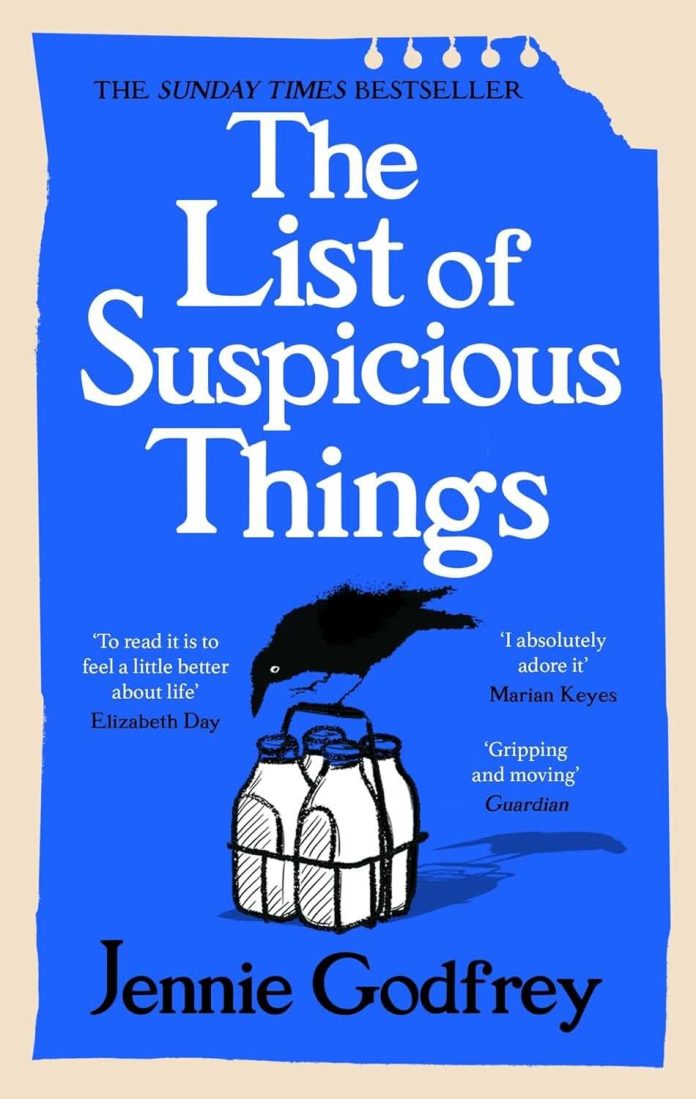
Jennie Godfrey’s debut novel arrives like a carefully preserved photograph from a childhood most would rather forget. Set against the backdrop of the Yorkshire Ripper’s murderous rampage between 1979 and 1981, The List of Suspicious Things captures something profoundly unsettling about growing up when innocence itself becomes a luxury no one can afford.
When Fear Becomes Ordinary
The novel introduces us to twelve-year-old Miv, a sharp-eyed observer living in a small Yorkshire town where the chimneys of closed mills puncture a perpetually grey sky. Her mother has retreated into a silence that no one quite understands, leaving Miv in the capable but rigid hands of Aunty Jean, a woman whose opinions arrive in numbered lists and whose view of the world divides neatly into “right” and “not right.” Into this landscape of domestic dysfunction and industrial decline comes the constant drumbeat of news reports about another woman murdered, another family destroyed.
What makes Godfrey’s approach remarkable is how she refuses to sensationalize the horror. The Yorkshire Ripper exists as background noise, a permanent hum of dread that seeps into every corner of daily life. Women change their routes home. Conversations stop when children enter rooms. The murders are discussed in the same breath as Margaret Thatcher’s election and the price of fish and chips, creating a chilling portrait of how violence against women becomes normalized, woven into the fabric of ordinary existence.
The Architecture of Investigation
When Miv makes a desperate wish to catch the Ripper and prevent her family from leaving Yorkshire, she enlists her best friend Sharon in creating the titular list. What follows is part detective story, part meditation on how children process adult fears they cannot fully comprehend. The list grows to include various townspeople: Mr. Bashir, the Pakistani shopkeeper with a Ford Corsair; Mr. Ware, their emotionally volatile teacher; Brian Lockwood, the strange man in overalls who never makes eye contact.
Godfrey handles this central conceit with remarkable delicacy. The girls’ investigation could easily have tipped into twee whimsy, but the author grounds it in the specific texture of 1970s Yorkshire. Their methods feel entirely authentic to children of that era and place – eavesdropping, making notes in cheap exercise books, conducting “bob-a-job” schemes to gain entry to suspects’ homes. The writing captures the peculiar logic of childhood, where genuine observation mingles with wild speculation, and where the boundary between play and deadly seriousness remains porous.
The novel’s treatment of prejudice deserves particular attention. Mr. Bashir becomes a suspect largely because of racist assumptions about “foreignness,” and Godfrey never lets us forget this uncomfortable truth. She shows how fear can curdle into xenophobia, how desperation for answers can make a community turn on its most vulnerable members. The characterization of Mr. Bashir – revealed gradually as kind, patient, and deeply embedded in the community despite its suspicions – serves as a quiet rebuke to the girls’ investigation and, by extension, to the reader’s own assumptions.
A Friendship That Breathes
At its heart, this is a novel about friendship, and Godfrey renders the bond between Miv and Sharon with exquisite precision. Sharon is all curves and blonde curls where Miv is straight lines and mousy hair; Sharon has the confidence to knock on doors where Miv schemes elaborate plans. They are George and Anne from the Famous Five, a friendship that works precisely because of its asymmetries.
The author captures the specific tenor of pre-adolescent female friendship – the way it can feel like the most important relationship in the world, the sudden self-consciousness when one friend starts wearing lipstick, the hurt of discovering your best friend has done something without you. When Sharon begins spending time with Ishtiaq, Mr. Bashir’s son, Miv’s jealousy and confusion feel achingly real. These are the small violences of growing up, the ways we wound each other while learning who we are.
The Shadow Side: Where the Novel Falters
For all its considerable strengths, The List of Suspicious Things occasionally stumbles under the weight of its ambitions. The novel attempts to juggle multiple narrative threads – Miv’s investigation, her mother’s mysterious illness, her father’s secretive behavior, various townspeople’s interconnected stories – and not all of them receive equal development. Some plot points feel rushed in their resolution, while others dangle without sufficient exploration.
The pacing, particularly in the middle section, can feel uneven. Certain investigative episodes run long without advancing either the mystery or Miv’s character development, creating a sense of narrative wheel-spinning. When Godfrey attempts to tie together all her various subplots in the final act, some connections feel forced rather than organic, as if the author was working from a checklist rather than letting the story breathe.
There are also moments where the novel’s nostalgia for 1970s Yorkshire – the corner shops, the fish and chips wrapped in newspaper, the specific brands of sweets – threatens to overwhelm the forward momentum of the story. While this period detail grounds the narrative beautifully, occasional passages read more like cultural preservation than storytelling, slowing the pace when tension should be building.
The adult characters, particularly the men, sometimes feel more like types than fully realized individuals. Mr. Ware’s character arc, while emotionally affecting, follows a somewhat predictable trajectory. The revelation of certain character secrets in the latter half of the book occasionally lacks the nuance of the earlier sections, trading the novel’s careful ambiguity for more straightforward emotional beats.
A Voice Worth Hearing
Despite these reservations, Godfrey’s prose remains one of the novel’s chief pleasures. She writes in a style that mirrors Miv’s observational acuity – detailed without being fussy, emotionally honest without sentimentality. The Yorkshire dialect appears sparingly but effectively, grounding conversations in place without becoming inaccessible. There’s a particular skill in how Godfrey renders the experience of being twelve – that awkward age when you’re not quite a child but not yet a teenager, when the world of adults seems simultaneously fascinating and deeply suspicious.
The novel’s structure, framed as Miv’s retrospective account of these events, allows for occasional moments of adult reflection that deepen the narrative. These glimpses of an older Miv looking back create a poignant double vision: we see both the child making sense of her world and the adult understanding what that child could not.
Memory as Resistance
The List of Suspicious Things ultimately works as both historical document and coming-of-age story. Godfrey, who notes in her author’s note that her own father knew Peter Sutcliffe, has written what she calls a “love letter to God’s Own Country” – but it’s a complicated love, one that acknowledges the darkness alongside the fish and chips, the xenophobia alongside the community spirit, the ways violence becomes background music to childhood.
For readers seeking a tidy mystery, this novel may disappoint. The Yorkshire Ripper investigation provides the framework, but Godfrey is ultimately more interested in how fear shapes childhood, how children create narratives to make sense of incomprehensible adult violence, and how communities protect themselves through suspicion even as that same suspicion tears them apart. This is a book about the stories we tell ourselves to survive, and the price we pay for those stories.
For Readers Who Appreciated
Readers who connected with The List of Suspicious Things will find resonance in:
- My Name Is Leon by Kit de Waal – Another British novel about childhood during a turbulent historical moment, featuring a young protagonist navigating adult complexities
- Lightless by C.A. Higgins – For those drawn to the mystery elements and atmospheric tension
- The Essex Serpent by Sarah Perry – Shares the historical setting and exploration of how fear shapes communities
- The Making of Us by Lisa Jewell – Explores family secrets and the long shadow of the past
- Midwinter Break by Bernard MacLaverty – For readers who appreciated Godfrey’s precise rendering of working-class British life
- Speak No Evil by Uzodinma Iweala – Another coming-of-age novel that tackles difficult subjects with similar delicacy
Final Thoughts
Jennie Godfrey has crafted a debut that announces a significant new voice in British fiction. While not without its flaws – occasional pacing issues and some underdeveloped plot threads prevent it from achieving greatness – The List of Suspicious Things succeeds in its primary aim: to capture what it meant to grow up in the shadow of the Yorkshire Ripper, to be a child when childhood itself felt like a luxury, to try to make sense of a world where women disappeared and no one seemed able to stop it.
This is a novel that honors both the resilience of children and the weight of trauma they carry. It’s a reminder that historical events aren’t just dates and statistics – they’re the background noise of someone’s childhood, the reason a twelve-year-old girl makes lists of suspicious people, the shadow that falls across even the brightest summer day. In preserving this particular slice of Yorkshire’s past, Godfrey has created something that feels urgent and necessary: a story that insists we remember not just the headlines, but the children who grew up reading them.







