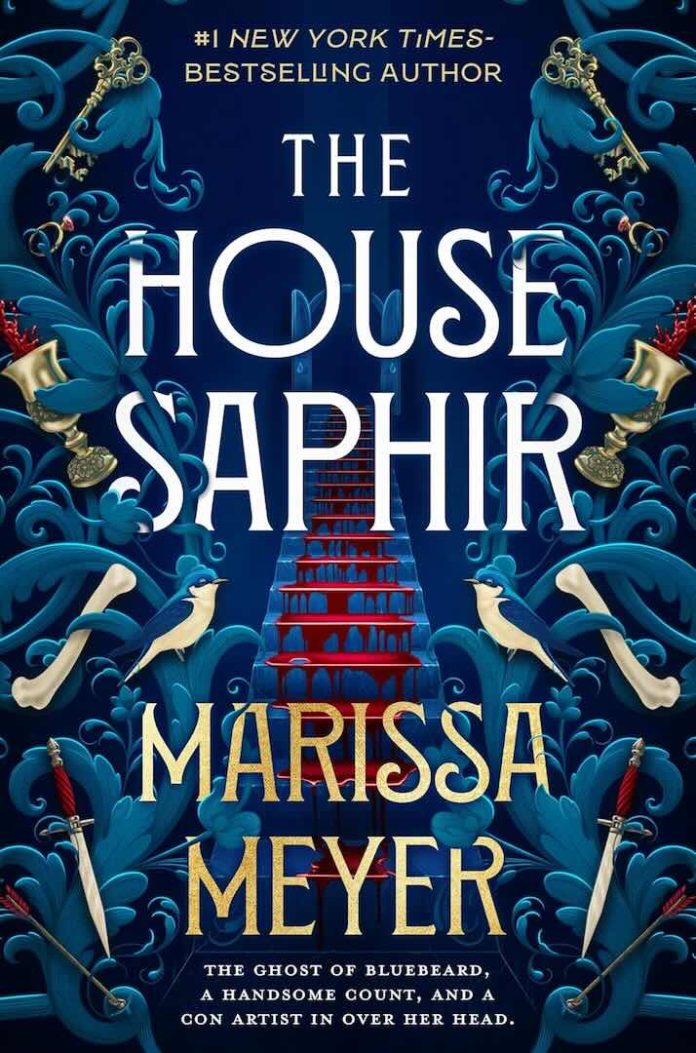
Marissa Meyer, the mastermind behind beloved series like The Lunar Chronicles and Heartless, ventures into her most haunting territory yet with The House Saphir. This Gothic romantasy breathes fresh, chilling life into the classic Bluebeard tale, proving once again why she’s earned the title “Queen of Fairytale Retellings.” But unlike her previous work with Cinderella robots and sympathetic villains, Meyer leans fully into the macabre here, crafting a story where ghosts walk halls, monsters lurk in armoires, and trust becomes the most dangerous gamble of all.
The premise hooks immediately: Mallory Fontaine is a fraud masquerading as a powerful witch, running ghost tours of the infamous House Saphir where Count Bastien Saphir murdered three of his wives over a century ago. When Armand Saphir, the current lord and Bastien’s great-grandson, offers her three thousand lourdes to exorcise his ancestor’s vengeful spirit, Mallory sees an opportunity too lucrative to refuse. There’s just one problem—she has no real magic beyond seeing ghosts, and Bastien Saphir proves far more dangerous dead than he ever was alive.
A Con Artist Who Steals Hearts (And the Show)
Meyer’s greatest achievement in The House Saphir is Mallory herself. Where many romantasy heroines stumble through their narratives with wide-eyed innocence, Mallory strides in with cynicism, dark humor, and an artist’s fascination with the morbid. She sketches gravestones for fun, quotes statistics about familial murder with casual ease, and maintains a running internal commentary that oscillates between wickedly funny and genuinely insightful. Her voice crackles with personality from the opening pages, immediately distinguishing this novel from Meyer’s lighter previous works.
What makes Mallory particularly compelling is her fundamental honesty about her dishonesty. She knows she’s a con artist. She embraces it. Yet Meyer skillfully layers vulnerability beneath Mallory’s sardonic exterior, revealing a young woman grappling with inadequacy in a family of genuinely magical women. Her ability to see ghosts—the one “gift” she possesses—feels more like a curse, a constant reminder of the power she lacks. This internal conflict grounds the story’s more fantastical elements, making Mallory’s journey feel genuinely earned rather than predetermined by destiny or prophecy.
Gothic Atmosphere Meets Contemporary Wit
Meyer excels at world-building throughout her oeuvre, and The House Saphir showcases a particularly immersive setting. The Saphir estate itself becomes a character—its crumbling grandeur, overgrown gardens, and blood-red fountain creating an atmosphere thick with dread and history. Meyer’s post-veil world, where magic returned seventeen years prior and monsters now inhabit the mortal realm alongside humans, provides a rich backdrop that feels both familiar and freshly imagined.
The author populates this world with creatures drawn from French folklore—from the cheval mallet with flaming eyes to the lou carcolh hiding in armoires—each adding texture and danger to the narrative. These aren’t merely decorative fantasy elements; they serve the plot, heighten tension, and create genuine threats that keep readers on edge. The glossary of monsters at the book’s beginning proves both charming and functional, showcasing Meyer’s thorough research while maintaining her trademark playful tone.
Where the novel truly shines is in balancing Gothic horror with contemporary sensibilities. The prose carries weight and elegance appropriate to the genre, yet never feels stuffy or inaccessible. Mallory’s observations cut through potential melodrama with sharp wit, creating a reading experience that honors classic Gothic literature while remaining thoroughly modern and engaging.
The Romance: Swoon-Worthy or Suspicious?
The romantic development between Mallory and Armand walks a delicious tightrope between genuine connection and potential danger. Armand initially appears as the archetypal Gothic hero—handsome, wealthy, slightly mysterious, haunted by family tragedy. Meyer plays with reader expectations brilliantly, allowing both Mallory and readers to question every romantic gesture. Is that tender moment genuine, or is the ghost of a serial killer manipulating events from beyond the grave?
This uncertainty elevates what could have been a standard romantasy courtship into something far more engaging. Every kiss carries potential peril. Every declaration of affection demands scrutiny. The chemistry between Mallory and Armand burns authentically, built through witty banter, shared vulnerability, and genuine intellectual connection. Their interactions sparkle with the kind of verbal sparring that makes enemies-to-lovers (or strangers-to-lovers-to-maybe-he’s-dangerous) dynamics so satisfying.
However, the romance occasionally overwhelms the mystery elements in ways that may frustrate readers seeking more consistent Gothic horror. The tonal shifts between swooning romantic moments and genuine terror don’t always land smoothly, sometimes undercutting the story’s darker atmosphere.
Mystery and Murder: Keeping Readers Guessing
Meyer structures The House Saphir as both a Gothic romance and a murder mystery, and the whodunit elements provide genuine intrigue. When a new murder occurs at the estate, Mallory must determine whether the killer is Bastien’s ghost or someone very much alive. The investigation unfolds methodically, with Mallory conducting interviews and piecing together clues while trying to maintain her fraudulent witch persona.
The mystery plotting demonstrates solid craftsmanship, planting clues while avoiding obviousness. Meyer creates multiple viable suspects and maintains ambiguity about supernatural versus mortal culpability. The possession angle—the possibility that Bastien controls Armand’s body—adds psychological horror to traditional mystery elements, creating scenes where readers genuinely cannot trust their perceptions or the protagonist’s safety.
That said, seasoned mystery readers may find some reveals predictable, and the pacing occasionally stutters as Meyer balances multiple plot threads. The resolution, while emotionally satisfying, relies somewhat heavily on exposition and could have benefited from more showing rather than telling in its final sequences.
Supporting Cast: From Delightful to Underdeveloped
Mallory’s sister Anaïs provides a wonderful counterbalance to the protagonist’s cynicism. Where Mallory sees darkness, Anaïs finds light and romance. Their sisterly dynamic feels authentic and warm, grounded in genuine affection despite their different approaches to life. Anaïs’s role as both accomplice in their cons and moral compass gives her depth beyond simple supporting character status.
The monster hunters Fitcher and Constantino inject welcome energy into the narrative’s second half, bringing both comic relief and competence. Their banter and partnership adds levity without diminishing stakes. However, like several secondary characters, they remain somewhat thinly sketched—charming enough to serve their plot functions but lacking the development that would make them truly memorable.
The estate’s small staff—particularly the housekeeper Yvette and maid Julie—exist primarily to advance plot rather than as fully realized individuals. This proves particularly noticeable with Julie, whose death drives much of the mystery yet whose characterization remains minimal. While this serves Meyer’s purpose of keeping readers uncertain about motivations and connections, it occasionally makes emotional beats land with less impact than intended.
Where The House Saphir Stumbles
Despite its many strengths, the novel isn’t without flaws. The pacing wavers in the middle section, where Mallory’s attempts to maintain her witch facade while investigating Julie’s murder sometimes feel repetitive. Certain plot conveniences—characters appearing exactly when needed, information revealed at dramatically perfect moments—occasionally strain credibility.
The magic system, while atmospheric, remains somewhat vague. Readers seeking the hard magic structures found in books like Brandon Sanderson’s work or even the more defined rules in Meyer’s Renegades trilogy may find this frustrating. The distinction between different types of magic, the mechanics of ghost possession, and the rules governing Bastien’s power never fully crystallize, leaving some plot developments feeling arbitrary.
Additionally, while the novel’s climax delivers emotional satisfaction and ties up major threads, it arrives somewhat abruptly after extensive build-up. The final confrontation resolves faster than the careful pacing of earlier sections might suggest, and some readers may find the ending slightly rushed despite its overall effectiveness.
Themes That Resonate
Beneath the Gothic trappings and romantic tension, The House Saphir explores substantive themes about trust, identity, and the stories we tell ourselves. Mallory’s journey from con artist to genuine heroine parallels her evolution from someone who trusts no one to someone learning when trust is warranted. Meyer examines how we perform versions of ourselves—Mallory as powerful witch, Armand as untroubled nobleman—and what happens when those masks slip.
The novel also grapples with legacy and family curses, both literal and metaphorical. Bastien’s crimes cast long shadows, affecting not just his direct descendants but everyone connected to the Saphir name. This exploration of inherited trauma and the possibility of breaking destructive cycles adds depth to what could have been merely a supernatural thriller.
For Fans Of…
Readers who loved these books will likely enjoy The House Saphir:
- The Invisible Library series by Genevieve Cogman (for clever, book-loving heroines in fantastical settings)
- A Dowry of Blood by S.T. Gibson (for Gothic atmosphere and reimagined vampire/Bluebeard tales)
- Sorcery of Thorns by Margaret Rogerson (for romantic fantasy with witty banter and library magic)
- The Shadows Between Us by Tricia Levenseller (for morally gray heroines pursuing wealthy, dangerous men)
- House of Salt and Sorrows by Erin A. Craig (for dark fairytale retellings with mystery elements)
Meyer’s previous readers will find The House Saphir markedly darker than The Lunar Chronicles or even Heartless, positioning it closer in tone to Gilded and Cursed but with heightened Gothic sensibilities. Those who enjoyed the atmospheric worldbuilding of her previous work while craving something moodier will find much to love here.
The Verdict: A Bewitching Addition to Meyer’s Canon
The House Saphir represents Marissa Meyer at her most atmospheric and daring. While not perfect—its pacing issues and occasionally convenient plotting prevent it from achieving masterpiece status—it succeeds brilliantly at what it attempts: a Gothic romantasy that honors its source material while crafting something uniquely Meyer’s own. The novel earns its place among quality fairytale retellings through sharp characterization, genuine romantic chemistry, and a willingness to embrace darkness without sacrificing hope.
This is Meyer’s most mature work to date, tackling themes of manipulation, possession, and murder with greater seriousness than her previous novels while maintaining the warmth and wit her fans cherish. Mallory Fontaine deserves to stand alongside Cinder and Cath as one of Meyer’s most memorable protagonists—perhaps even surpassing them in complexity and relatability.
For readers seeking escapist romance with genuine stakes, clever protagonists who solve problems through wit rather than magical destiny, and Gothic atmosphere dripping from every page, The House Saphir delivers handsomely. It’s a book best enjoyed on dark autumn evenings, preferably in an old house with creaking floorboards, where every shadow might hide secrets and every romantic gesture demands careful scrutiny.
Meyer proves once again why she remains one of the most reliable voices in young adult fantasy, crafting stories that honor their inspirations while remaining distinctly her own. The House Saphir may not be flawless, but it’s undeniably enchanting—and sometimes, in the realm of fairy tales reimagined, that’s precisely the magic required.
- Recommended for: Fans of Gothic romance, clever heroines, morally complex love interests, French folklore, and anyone who’s ever wanted to explore a haunted mansion with a con artist who jokes about murder statistics.
- Content considerations: Violence (including murder), possession, some sensual content (no explicit scenes), themes of manipulation and abuse in backstory.







