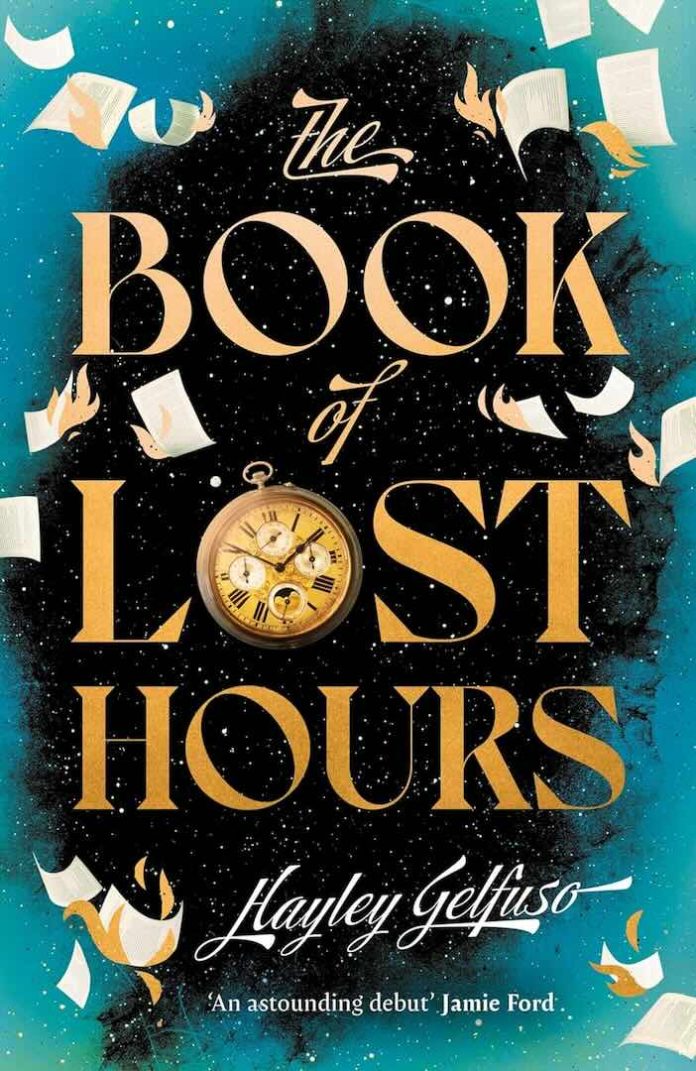
In an era where fantasy literature often gravitates toward familiar tropes, Hayley Gelfuso’s debut novel “The Book of Lost Hours” emerges as a breathtakingly original meditation on memory, time, and the stories we choose to preserve—or destroy. This ambitious work weaves together multiple timelines and characters in a narrative that feels both intimately personal and sweepingly historical, delivering a story that lingers long after the final page.
A World Where Time Becomes Tangible
Gelfuso constructs a universe where the abstract concept of time transforms into a physical realm—the time space—a soaring library filled with books containing the memories of the dead. This isn’t merely a clever fantasy premise but a profound exploration of how history is shaped by those who control the narrative. The time space serves as both sanctuary and battlefield, where government agents armed with specially crafted watches enter to curate which memories survive and which are burned away.
The novel’s central conceit feels remarkably prescient in our current age of information warfare and historical revisionism. When Nazi timekeepers destroy Jewish memories, or when American and Russian agents battle over historical narratives during the Cold War, Gelfuso isn’t just crafting fantasy scenarios—she’s illuminating the very real ways that power structures attempt to control collective memory.
Characters Who Breathe Across Decades
Lisavet Levy: The Heart of Resistance
The character of Lisavet Levy stands as one of the most compelling protagonists to emerge from recent fantasy literature. Trapped in the time space at eleven years old when her father fails to return, she grows up among the dead, becoming something unprecedented—a living person who exists outside normal temporal constraints. Gelfuso’s portrayal of Lisavet’s development from frightened child to determined preservationist feels both magical and heartbreakingly real.
What makes Lisavet extraordinary isn’t just her supernatural abilities but her moral clarity. As she witnesses Nazi timekeepers destroying Jewish memories, she begins her work of salvage—rescuing fragments of burned books and hiding them in her own volume. This act of resistance, born from personal loss but growing into universal purpose, drives the novel’s emotional core.
The Duquesne Legacy: Ernest and Amelia
Ernest Duquesne represents the moral complexity at the heart of the timekeeper program. Initially a dutiful agent following orders, his encounters with Lisavet gradually awaken his conscience. Gelfuso skillfully traces his transformation from compliant operative to someone willing to risk everything to protect the memories others would destroy. His relationship with Lisavet develops with exquisite restraint—romantic but never overshadowing the larger themes.
Sixteen-year-old Amelia Duquesne, Ernest’s niece, serves as our window into the 1965 timeline. Mourning her uncle’s death while being recruited by the very organization that killed him, Amelia embodies the next generation forced to reckon with inherited violence. Her journey from grieving teenager to temporal anomaly capable of changing history itself provides the novel’s most satisfying character arc.
The Complexity of Memory and Truth
Perhaps the novel’s greatest strength lies in its exploration of memory as both personal and political. Gelfuso doesn’t present memory as objective truth but as something inherently subjective, shaped by perspective and time. When Lisavet wonders whether memories can ever truly capture reality as it was experienced, she’s articulating one of the book’s central philosophical questions.
The author’s handling of historical trauma proves particularly nuanced. The Holocaust serves not as mere backdrop but as a crucial examination of how systematic erasure works—first through physical violence, then through the destruction of memory itself. The Nazi timekeepers who burn Jewish memories represent the continuation of genocide through other means, making the preservation of these fragments an act of profound resistance.
Prose That Captures the Rhythm of Time
Gelfuso’s writing style adapts beautifully to her material, shifting between the ethereal quality needed for time space sequences and the grounded realism of Cold War espionage. Her descriptions of the time space itself—with its swirling stars containing living thoughts and shelves stretching into infinity—create a sense of wonder without descending into overwrought fantasy prose.
The author demonstrates particular skill in handling temporal displacement, making scenes where characters move between different time periods feel both magical and logical within the story’s rules. Her ability to capture distinct historical periods through brief but vivid details shows considerable research and craft.
The Romance That Transcends Time
The central romance between Lisavet and Ernest unfolds with remarkable patience and sensitivity. Their relationship develops across meetings separated by years, growing from mutual wariness to deep understanding. Gelfuso avoids the trap of instalove while still creating genuine chemistry between characters whose circumstances make traditional romance impossible.
The relationship serves the larger narrative without overwhelming it, representing the human connections that make the preservation of memory meaningful. Their love story becomes another form of resistance against forces that would reduce people to statistics or ideology.
Structural Ambitions and Minor Stumbles
The novel’s dual timeline structure generally works well, though some transitions between 1938-1949 and 1965 feel abrupt. The complexity of the time space rules occasionally requires extensive exposition, and some readers may find certain sections—particularly early explanations of timekeeper operations—somewhat dense.
The book’s length, while generally justified by the scope of its narrative, sometimes works against the pacing. Certain sequences in the middle section could have been trimmed without losing impact. Additionally, some of the government intrigue subplot involving Jack Dillinger and the CIA feels less compelling than the more personal story threads.
A Meditation on Our Current Moment
While set primarily in the mid-20th century, “The Book of Lost Hours” speaks directly to contemporary concerns about truth, memory, and the manipulation of historical narrative. In an age of “alternative facts” and systematic disinformation campaigns, Gelfuso’s exploration of who gets to decide which stories survive feels urgently relevant.
The novel’s treatment of how governments use and abuse power to shape collective memory offers uncomfortable parallels to current debates about historical education, book banning, and the politicization of historical scholarship. Without being heavy-handed, Gelfuso demonstrates how the personal becomes political when power structures attempt to control narrative.
Similar Reads and Literary Connections
Readers who appreciate “The Book of Lost Hours” will find kinship with several other works exploring similar themes. Kate Atkinson’s “Life After Life” shares the temporal complexity and historical grounding, while Alix E Harrow’s “The Ten Thousand Doors of January” offers comparable magical realism focused on the power of stories. Matt Haig’s “The Midnight Library” explores similar questions about memory and possibility, though with less historical weight.
For those drawn to the historical elements, Anthony Doerr’s “All the Light We Cannot See” provides comparable attention to preserving beauty and knowledge in wartime, while Kim Michele Richardson’s “The Book Woman of Troublesome Creek” examines the political nature of preserving literature and memory.
Final Verdict
“The Book of Lost Hours” announces Hayley Gelfuso as a significant new voice in speculative fiction. While the novel occasionally struggles with the ambitious scope of its narrative, it succeeds brilliantly in its central mission: creating a story that honors the power of memory while examining the forces that would destroy it.
This is the rare fantasy novel that manages to be both escapist entertainment and serious examination of how societies remember and forget. Gelfuso has crafted something genuinely original—a love story that doubles as historical meditation, a fantasy that illuminates real-world concerns, and a debut that promises even greater things to come.
For readers seeking intelligent fantasy that grapples with serious themes without sacrificing emotional resonance, “The Book of Lost Hours” deserves a place on your shelf. It’s a book about the importance of preserving stories that itself demands to be preserved.
Similar Books You Might Enjoy:
- The Ten Thousand Doors of January by Alix E Harrow
- The Midnight Library by Matt Haig
- Life After Life by Kate Atkinson
- The Ministry of Time by Kaliane Bradley
- The Invisible Bridge by Julie Orringer
- All the Light We Cannot See by Anthony Doerr
- The Time Traveler’s Wife by Audrey Niffenegger
- Station Eleven by Emily St. John Mandel







