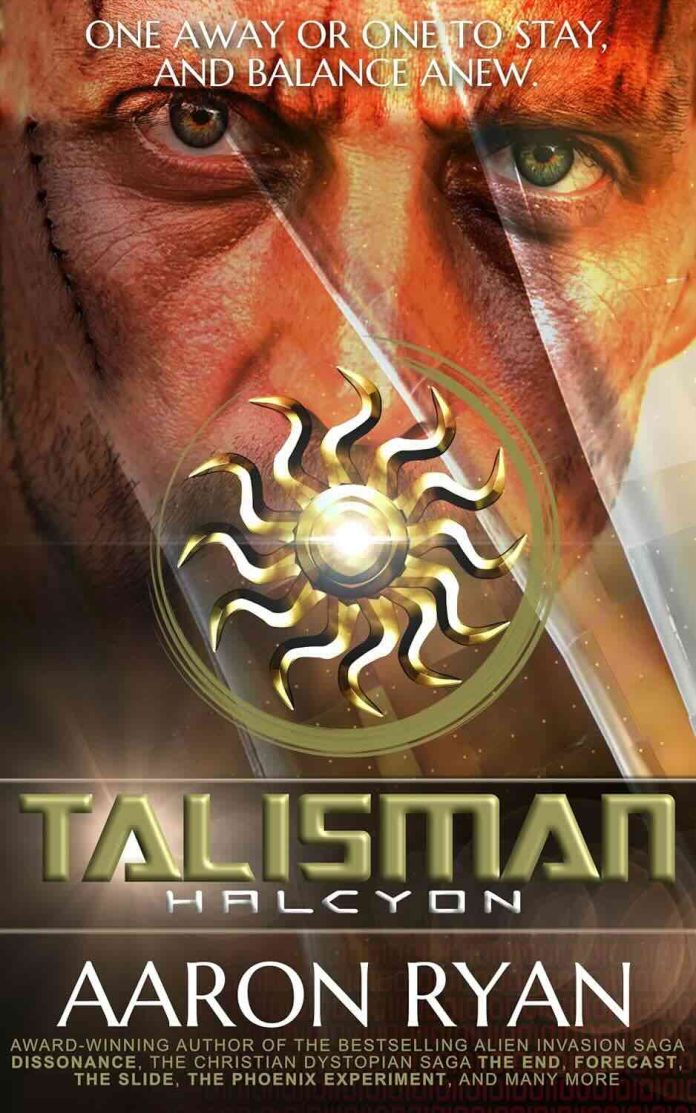
There is a particular dread that accompanies the final volume of any beloved trilogy. Will it land? Will the threads bind together or fray? Or will the author have the courage to follow the story where it actually wants to go, even if that destination is unexpected and costly? Talisman: Halcyon by Aaron Ryan answers all of those questions with a resounding and emotionally devastating yes. This is a finale that earns its tears, and there are many.
Following the revelations of Talisman: Subterfuge — where Liam “Foxy” Mayfield first accepted the impossible burden of his cosmic bargain — and the seismic shifts of Talisman: Nexus — where alliances inverted, enemies became brothers, and Onyx Sleater transformed into the luminous Soteria — Halcyon launches its three protagonists into the deepest reaches of the multiverse and asks them to pay for everything they have ever wanted. The currency, as it has always been in Aaron Ryan’s universe, is grief.
A Story That Expands Without Losing Its Soul
The scope of Halcyon is staggering. Where the first two books largely confined themselves to Earth and its immediate orbit, this concluding volume catapults readers across galaxies, through the multiverse, and into an omniverse where time bends and mirrors shatter into a thousand reflections of yourself. Ryan navigates this expansion with surprising dexterity. He introduces new alien civilizations, enchanted sorcerers, convocations of over seven hundred warriors from disparate star systems, and monstrous guardians — yet the story never loses its emotional center of gravity.
That center remains, as it always has, Liam Mayfield. Talisman: Halcyon by Aaron Ryan finds him further from home than he has ever been, training under his former enemy Arion Peridifyca, grappling with the reality that his wife will never return, and yearning for his sons with an ache that no supernatural power can cure. The opening chapters, set on a lonely asteroid near the distant star Earendel, are among Ryan’s finest work in the entire trilogy: intimate, muscular, and thick with the tension of two former adversaries learning to coexist while both are silently in love with the same woman.
The Architecture of Character
Ryan structures Halcyon in three parts — Searching, Intersection, and Halcyon — and each section performs a distinct narrative function while maintaining the emotional throughline that has defined this series. The first section deepens the trio’s dynamics and introduces a sprawling cast of Iskanders from across the galaxy. The second plunges them into battle, betrayal, and a devastating loss that reshapes the entire quest. The third delivers revelations that recontextualize everything readers thought they knew.
What makes this structure work is Ryan’s commitment to character even amid escalating spectacle. Consider these elements that anchor the novel’s vast cosmic machinery:
- Arion’s confession at the Great Convocation — a scene of extraordinary vulnerability where a three-thousand-year-old warrior stands before the very beings whose predecessors he murdered, begging forgiveness. Ryan writes it without sentimentality, letting the silence of the crowd speak louder than any absolution.
- The Onyx-Liam-Arion triangle — handled with a maturity that avoids melodrama. The jealousy between the two men is not petty; it is the residual ache of cosmic manipulation, and Ryan treats it with the gravity it deserves.
- Kyras Portiux Radasgabel — a late-arriving character who becomes the conscience of the story. His introduction as a second former Zorander is a master stroke, providing Arion with a mirror and the reader with a fresh perspective on redemption.
- Soteria’s growing power — Onyx’s evolution into something beyond human is rendered with both awe and humor. She remains recognizably herself — craving a cold beer, delivering withering one-liners — even as she splits nebulas and commands ancient energies.
Ryan’s Prose at Full Velocity
Talisman: Halcyon by Aaron Ryan reveals an author writing at the absolute outer edge of his ambition. The battle sequences are rendered with a cinematic ferocity that recalls the best of military science fiction, yet they never become mere noise. Every casualty registers. Every loss hits. Ryan names them, gives them moments of individuality, and then takes them away — and the reader feels each absence like a missing tooth.
The quieter passages, meanwhile, carry a different kind of power. Liam standing alone on an alien planet, whispering a final goodbye to his dead wife, releasing her not because he wants to but because he must — these are the scenes that linger long after the book is closed. Ryan’s ability to toggle between operatic cosmic warfare and whispered, heartbreaking intimacy is the hallmark of a storyteller who has fully come into his own.
The prose itself adapts to each perspective. Arion’s chapters maintain that formal, archaic cadence established in Nexus, dripping with millennia of accumulated dignity. Onyx’s voice remains sharp, self-deprecating, and warmly human. Liam’s sections carry the weariness of a soldier who has fought too many wars and is beginning to understand that the last one might not have a winner.
The Trilogy as a Whole
To appreciate what Talisman: Halcyon by Aaron Ryan accomplishes, it helps to see the trilogy as a single arc. Subterfuge was the setup — a taut, Earth-bound thriller about a man bargaining with forces he did not understand. Nexus was the pivot — a story of shattered illusions and unexpected alliances. Halcyon is the payoff and the reckoning, the moment where every promise made across two previous volumes is either fulfilled or redeemed in ways the reader could not have predicted.
Ryan is a prolific author whose broader bibliography — including the six-book Dissonance alien invasion saga, THE END Christian dystopian trilogy, and standalone thrillers like Forecast, The Slide, and The Phoenix Experiment — demonstrates an author drawn to stories about ordinary people thrust into extraordinary circumstances. The Talisman trilogy represents the apex of that trajectory, the point where his thematic preoccupations with grief, faith, sacrifice, and the stubborn persistence of love find their fullest and most ambitious expression.
Who Will Love This Book
Talisman: Halcyon by Aaron Ryan is not for the faint of heart. It demands investment — in the characters, in the mythology, in the emotional stakes — and it repays that investment handsomely. Readers who began the journey in Subterfuge will find here a conclusion worthy of everything that came before. Those drawn to science fiction that treats the heart with the same seriousness as the cosmos will find a kindred spirit in Aaron Ryan.
This is a story about seeing what you want to see, and about the courage it takes to finally see what is real. It is about breathing freely. And by the time you reach the final page, you will understand why those two words carry the weight of an entire omniverse.
Similar Books to Explore
If the Talisman trilogy resonated with you, these titles share its blend of cosmic grandeur and emotional depth:
- The Expanse series by James S.A. Corey — sprawling space opera with deeply human stakes
- Hyperion by Dan Simmons — a tale of pilgrimage, sacrifice, and cosmic mystery
- A Wrinkle in Time by Madeleine L’Engle — interdimensional adventure driven by love
- The Long Way to a Small, Angry Planet by Becky Chambers — character-driven sci-fi about found family
- Old Man’s War by John Scalzi — military sci-fi with heart and humor
- Dissonance by Aaron Ryan — the six-book saga that built the universe from which Talisman was born