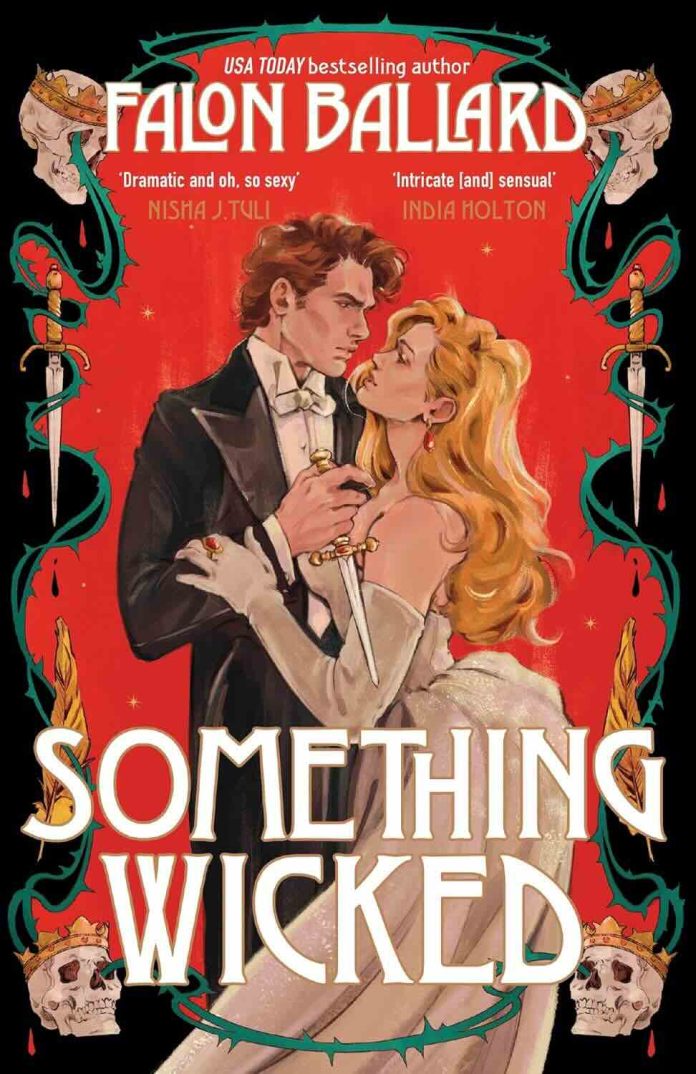
When USA Today bestselling author Falon Ballard announced her departure from contemporary romance to venture into romantasy territory, readers familiar with her signature blend of wit and heat were understandably curious. With “Something Wicked,” Ballard delivers a politically charged fantasy romance that reimagines Macbeth through the lens of desire, betrayal, and revolution—though the execution occasionally stumbles in its ambition.
Where Prophecy Meets Pleasure
The country of Avon teeters on the precipice of transformation. The Uprising has shattered centuries of monarchical rule, replacing hereditary power with a startling decree: aspiring presidential candidates must assassinate their province’s former monarch. It’s a brutal entry fee into democracy, one that asks the unthinkable of Callum Reid, son of Scota’s recently dethroned king.
Ballard crafts a morally complex premise that refuses easy answers. The revolution positioning murder as a qualification for leadership immediately raises questions about justice, power, and the cyclical nature of violence. This isn’t a world of clear heroes and villains—at least not initially—but rather one where survival demands impossible choices and where the line between liberation and tyranny blurs with discomforting ease.
Enter Lady Caterine, a courtesan at La Puissance whose Gift allows her to manipulate the emotions of anyone experiencing orgasm in her presence. The setup could easily veer into exploitation, but Ballard handles the power dynamics with surprising nuance. Cate isn’t a victim of her circumstances; she’s a survivor who has weaponized her sexuality and Gift to protect herself and her prophetic twin sister, Andra, in a society that views the Gifted as both dangerous and expendable.
The Architecture of Desire and Distrust
The romance between Callum and Cate unfolds with deliberate pacing, each interaction layered with mistrust and magnetic attraction. Callum carries deep-seated prejudices about the Gifted, viewing their abilities as inherently threatening to social order. Meanwhile, Cate approaches their arrangement as purely transactional—he needs her services to commit patricide without drowning in guilt; she needs his coin to escape increasingly exploitative contracts at La Puissance.
What elevates their relationship beyond a simple enemies-to-lovers arc is Ballard’s willingness to let them challenge each other’s worldviews. When Callum accompanies Cate to the Gifted orphanage where she once suffered, the scene crackles with tension as his comfortable assumptions about Scotan benevolence crumble. These moments of reckoning—where characters confront their complicity in systemic injustice—give the romance genuine stakes beyond physical attraction.
In Something Wicked, the sensuality is rendered with confidence, each intimate scene revealing emotional vulnerability alongside physical pleasure. Ballard understands that desire is a language, one her characters speak fluently as they negotiate trust in increments. The tango lesson sequence, in particular, demonstrates how eroticism can exist in restraint, in the space between bodies that both want and fear connection.
However, the introduction of the “Bond”—a mystical connection that forms between certain pairs—occasionally undermines the earned development of their relationship. While it provides narrative momentum, it also raises uncomfortable questions about agency and authentic emotion. Are Callum and Cate truly choosing each other, or are they chemically compelled? Ballard addresses this tension but never fully resolves it, leaving some readers potentially unsatisfied with the foundation of the central romance.
The Seductive Dangers of La Puissance
La Puissance emerges as one of the novel’s most compelling creations—a pleasure club that serves as sanctuary, prison, and marketplace for the Gifted. Ballard populates it with vivid supporting characters: Bianca with her telepathy, Andra with her prophetic visions, and Harold MacVeigh, the club’s owner who occupies complicated moral terrain as both protector and profiteer.
The world-building succeeds most when grounded in the club’s baroque details: the hierarchy of performers and courtesans, the carefully cultivated atmosphere of sensual spectacle, the way the Gifted have carved out precarious safety within its walls. You can practically smell the perfume mingling with whisky, hear the brass instruments competing with laughter echoing through crimson-carpeted hallways.
Where the world-building falters is in its broader scope. Avon’s four provinces remain somewhat indistinct beyond Scota, their political differences sketched rather than fully rendered. The mechanics of how Gifts work, why they manifest, and the extent of their capabilities could benefit from clearer definition. These gaps don’t derail the narrative but do limit its immersive potential.
Prophecies and Poisoned Ambitions
The true antagonist reveals herself slowly, manipulating events from the shadows with chilling calculation. Without venturing into spoiler territory, Ballard crafts a villain whose motivations stem from legitimate grievances—discrimination against the Gifted, systematic disenfranchisement, the violence of revolution—even as her methods become increasingly monstrous. It’s a nuanced approach to antagonism that reflects the novel’s Shakespearean influences.
The Macbeth parallels run deeper than surface-level plot mechanics in Something Wicked. Questions of prophecy and fate, the corrupting influence of ambition, the weight of blood guilt—all resonate throughout the narrative. Yet Ballard isn’t simply transposing the Scottish play into a fantasy setting. She interrogates the original’s themes, asking what prophecy means in a world where the future can literally be Seen, and whether murder in service of political change can ever be justified.
The pacing occasionally suffers under the weight of political maneuvering in the middle section. Scenes of characters strategizing and gathering information sometimes stall the momentum, particularly when separated from the central romance. A tighter focus during these sequences might have maintained narrative drive without sacrificing the intrigue.
From Contemporary to Fantastical: An Author’s Evolution
For readers familiar with Ballard’s contemporary romances like “Lease on Love” or “Just My Type,” “Something Wicked” represents a significant departure while retaining her signature style. The witty banter, the emotional intelligence in her character work, the sex-positive approach—these elements translate successfully into the fantasy genre. What’s new is the higher stakes, the darker tone, and the willingness to let characters make genuinely destructive choices.
The shift isn’t entirely seamless. Occasional anachronistic dialogue reminds readers of Ballard’s contemporary roots, pulling them momentarily from the fantasy setting. These instances are infrequent but noticeable, like hearing modern slang in a period piece.
Verdict: A Promising Fantasy Debut with Room to Soar
“Something Wicked” succeeds as both a sensual romance and a politically intricate fantasy, even if it doesn’t fully master either genre. The central relationship compels, the villain fascinates, and the exploration of power—sexual, magical, and political—offers genuine insight. The novel’s ambitions occasionally exceed its execution, particularly in world-building breadth and pacing consistency.
For readers seeking romantasy that prioritizes character chemistry over elaborate magic systems, that asks uncomfortable questions about justice and vengeance, and that isn’t afraid of morally complicated protagonists, “Something Wicked” delivers a satisfying experience. It’s a book that trusts its readers to navigate gray areas, to sit with discomfort, to question whether love can truly conquer systemic oppression.
Similar Reads:
- Credence by Penelope Douglas – For dark romance with power dynamics
- The Shadows Between Us by Tricia Levenseller – Political intrigue and romance
- House of Earth and Blood by Sarah J. Maas – Urban fantasy with found family
- A Court of Thorns and Roses by Sarah J. Maas – Enemies-to-lovers with political stakes
- From Blood and Ash by Jennifer L. Armentrout – Duty versus desire in fantasy settings
Falon Ballard’s foray into romantasy announces an author unafraid of transformation, willing to risk the comfortable success of contemporary romance for darker, more complex storytelling. While “Something Wicked” doesn’t achieve perfection, it establishes Ballard as a voice worth watching in the rapidly evolving romantasy landscape. Like Callum and Cate themselves, the novel earns its place through determination, vulnerability, and the courage to demand more from familiar formulas.







