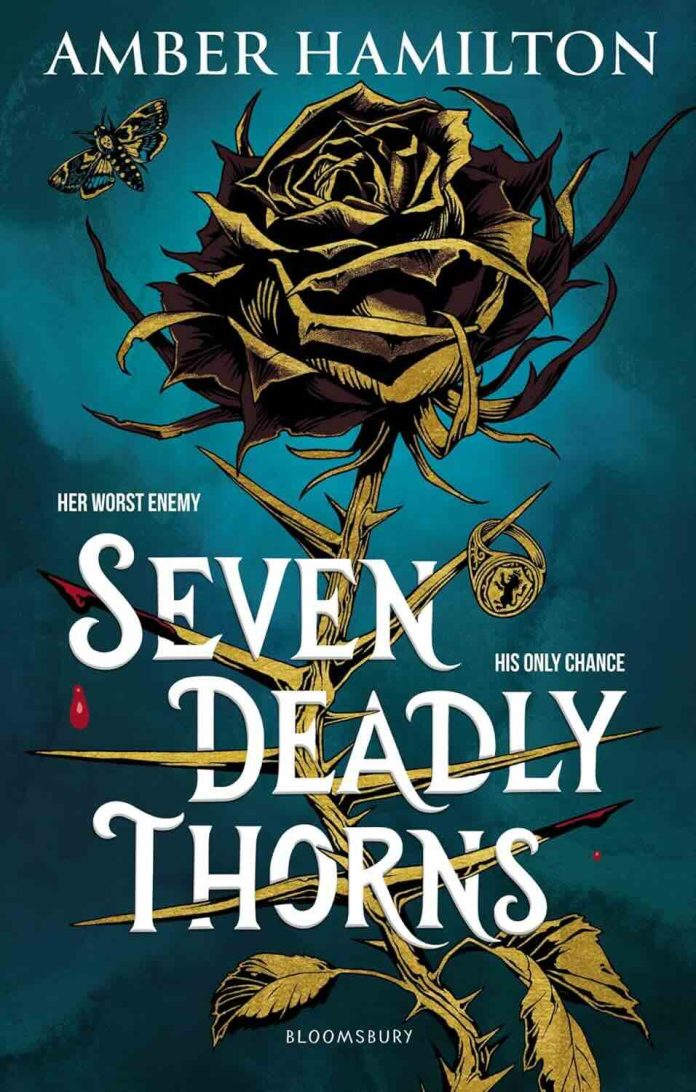
Amber Hamilton’s debut novel Seven Deadly Thorns arrives like a tempest in the crowded romantasy landscape, offering readers a deliciously dark academia romance wrapped in lethal magic and impossible attraction. This is Hamilton’s first published work, marking her entrance into the genre with ambitious world-building and a heroine who must learn that her greatest weakness might be her most powerful strength.
Set in the cursed Kingdom of Aragoa, where deadly Mists trap the entire population within castle walls and magic carries a death sentence, the novel follows Viola Sinclair—a scholarship student at the prestigious Vandenberghe Academy who harbors a dangerous secret. When her shadow magic is discovered, the Queen orders her execution, assigning the task to her own son: Roze Roquelart, the white-haired assassin prince with poison in his touch and seven days to complete his deadly mission.
The Architecture of Attraction: Character Development
Hamilton constructs her protagonist with careful attention to emotional authenticity. Viola embodies the struggle of self-acceptance in a world that has taught her to fear her own power. Raised in the caverns beneath the castle after accidentally causing her brother’s death as a child, she arrives at the story already wounded, already convinced of her own monstrosity. This internal conflict drives much of the narrative tension, and Hamilton excels at portraying Viola’s gradual journey from self-loathing to self-acceptance.
The character work shines brightest in quiet moments rather than dramatic confrontations. When Viola finally allows her shadows to flow freely, forming them into a cape, crown, and twin swords of pure darkness, the moment resonates because Hamilton has earned it through hundreds of pages of internal struggle. The author understands that true transformation happens not in a single revelatory moment but through accumulated small choices to stop apologizing for existence.
Roze Roquelart proves equally compelling as the archetypal morally gray love interest. His characterization walks a delicate line—he’s genuinely dangerous, genuinely cruel at times, yet Hamilton provides enough glimpses beneath his aristocratic mask to justify Viola’s attraction. The revelation that he secretly protects meigas while maintaining his reputation as their executioner adds satisfying complexity. However, some readers may find his initial cruelty difficult to reconcile with his later tenderness, despite Hamilton’s efforts to contextualize his behavior through his abusive upbringing.
The supporting cast provides both strength and weakness to the narrative. Cerise, Viola’s loyal friend, offers necessary grounding and genuine friendship without overshadowing the central romance. The Queen and her daughters function effectively as antagonists, though they occasionally veer toward caricature. Kole’s betrayal lands with emotional weight, serving as a painful counterpoint to Roze’s acceptance, though his character development feels somewhat rushed in service of plot mechanics.
World-Building: Beauty in Suffocation
Hamilton creates a world that feels simultaneously claustrophobic and vast. The Kingdom of Aragoa, trapped beneath deadly Mists for nearly two decades, provides an atmospheric pressure cooker setting. The author skillfully conveys the psychological weight of a society imprisoned within castle walls, where class divisions have intensified and resources grow scarce. The caverns housing the lower classes, Vandenberghe Academy’s halls, and the mysterious Crypt of the Grimmstones all possess distinct textures.
The magic system, built around the balance between shadow and light, proves thematically rich even if mechanically underdeveloped. Hamilton wisely prioritizes emotional resonance over rigid rules, allowing the magic to function as metaphor for self-acceptance and the danger of suppressing essential parts of oneself. The historical conflict between Aragoa and Castelle, rooted in competing magical philosophies, provides satisfying depth to the political intrigue.
Where the world-building occasionally stumbles is in its density. Hamilton packs considerable lore into the narrative—ancient runes, forbidden books, the history of the war, the nature of the Mists—and while most proves relevant, some readers may find themselves overwhelmed by information dumps, particularly in the middle sections. The pacing suffers when research sequences in libraries and crypts stack too heavily without sufficient action or character development to balance them.
The Dance of Enemies to Lovers
The romantic arc between Viola and Roze follows familiar enemies-to-lovers beats yet manages to feel fresh through Hamilton’s attention to power dynamics and consent. Their fake engagement setup provides natural opportunities for forced proximity, and Hamilton wisely allows their attraction to develop through accumulated small moments rather than sudden reversals.
The chemistry crackles in their verbal sparring, and Hamilton demonstrates considerable skill in building sexual tension despite Roze’s inability to touch skin without his gloves. The physical barrier created by his poisonous touch becomes a compelling metaphor for emotional vulnerability and trust. When he removes his gloves in moments of crisis, the gesture carries weight.
However, the romance occasionally overwhelms the plot. The seven-day time limit creates urgency, but the investigation into the King’s death sometimes feels secondary to romantic development. Some readers seeking more balanced plot-to-romance ratio may find themselves wishing for tighter focus on the central mystery.
Prose and Atmosphere: Gothic Elegance with Modern Accessibility
Hamilton’s prose style blends gothic atmosphere with contemporary accessibility. She demonstrates particular strength in sensory detail—the smell of old parchment in libraries, the texture of shadows against skin, the suffocating presence of the Mists beyond glass. The writing feels most assured when embracing darkness rather than explaining it.
The fairy tale framing device, with chapter breaks marked by retellings of Snow White twisted through a darker lens, provides effective structural rhythm and thematic reinforcement. These interludes remind readers that Hamilton deliberately engages with fairy tale archetypes while subverting their traditional morals.
Where the prose occasionally falters is in repetition and over-explanation. Certain emotional beats receive multiple restatements, and Hamilton sometimes tells readers what they’ve already shown. The tendency toward melodrama in internal monologue may test some readers’ patience, though others will find it fits the gothic aesthetic.
Critical Analysis: Strengths and Stumbling Blocks
Seven Deadly Thorns succeeds most impressively in its thematic coherence. The book consistently explores questions of identity, acceptance, and the danger of defining oneself solely through others’ perspectives. Viola’s journey to embrace her shadows rather than suppress them provides satisfying emotional catharsis, and the ultimate revelation about her heritage and the true nature of the conflict between kingdoms reframes earlier events with new significance.
The book’s treatment of found family and chosen allegiance over blood loyalty resonates strongly. The Grimmstones, despite their secretive nature, represent a community built on protection and acceptance rather than judgment and fear.
However, the novel struggles with pacing in its middle third. The investigation into the King’s death meanders through research sequences that, while atmospheric, don’t always advance plot or character with sufficient efficiency. The reveal of the murderer, while thematically appropriate, may feel somewhat predictable to experienced genre readers.
The ending embraces fairy tale logic over strict realism, which will delight some readers while frustrating others seeking more concrete resolutions. Hamilton commits fully to her gothic-romantic vision, prioritizing emotional truth over pragmatic problem-solving.
Final Verdict: A Promising Debut with Bite
Seven Deadly Thorns announces Amber Hamilton as a voice to watch in dark romantasy. While the novel exhibits some debut roughness—occasional pacing issues, information dumps, and melodramatic moments—its emotional core beats strong and true. Readers who loved The Cruel Prince by Holly Black and Powerless by Lauren Roberts will find much to appreciate in Hamilton’s gothic world and morally complex romance.
The book works best for readers who prioritize atmosphere, character development, and romance over plot intricacy. Those seeking fast-paced action or complex political maneuvering may find themselves impatient with the deliberate, introspective pace. However, readers willing to sink into Hamilton’s shadowy world will discover a story that truly does tattoo itself onto the heart.
Similar Reads for Seven Deadly Thorns Fans
If Seven Deadly Thorns captured your imagination, consider these companion reads:
- The Cruel Prince by Holly Black – For morally gray fae princes and enemies-to-lovers tension in a dark academic setting
- Powerless by Lauren Roberts – For forbidden romance between a heroine hiding her difference and a dangerous elite
- Belladonna by Adalyn Grace – For gothic atmosphere, personified Death as a love interest, and shadow magic
- Divine Rivals by Rebecca Ross – For epistolary elements and enemies-to-lovers romance during wartime
- House of Salt and Sorrows by Erin A. Craig – For dark fairy tale retellings with mystery and atmospheric tension
Seven Deadly Thorns may be Hamilton’s debut, but it reads like the work of someone who understands the romantasy genre’s beating heart. For all its imperfections, this is a book that knows what it wants to be—a dark, lush, romantic tale about learning to stop apologizing for taking up space in the world. Sometimes that’s exactly the story readers need.