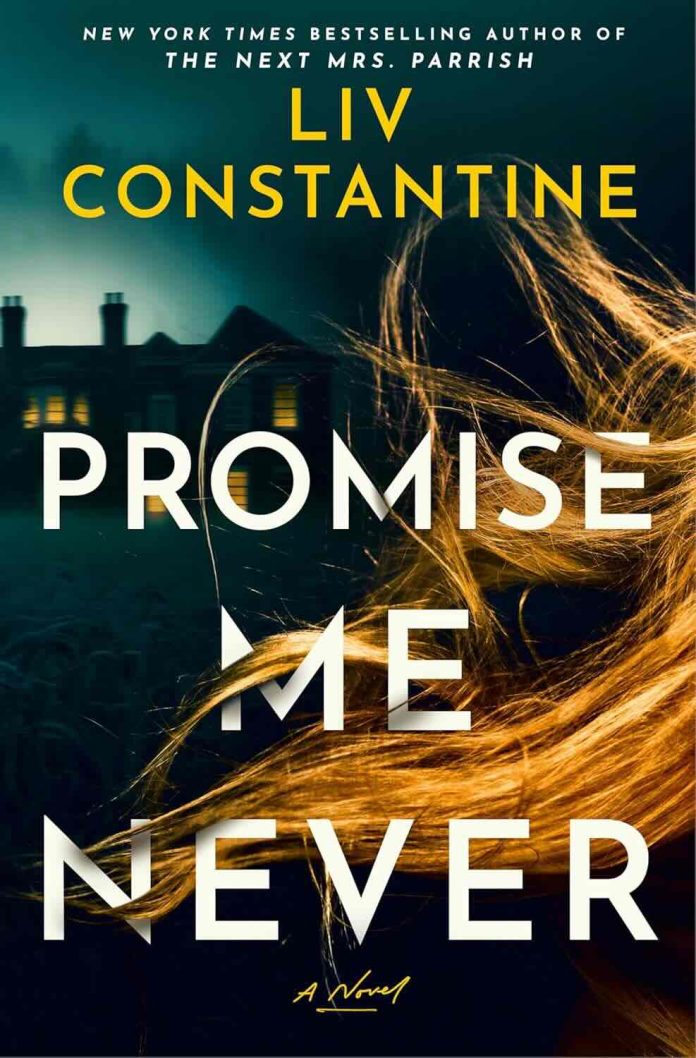
Halfway through dinner, a bestselling novelist orders the entree for his wife without asking what she wants. The waiter takes it down. She looks at him and says, plainly, never do that again. He apologises, charmingly, and means none of it. It is the third chapter of Promise Me Never by Liv Constantine and it passes in under a page.
Two hundred pages later the same man performs the same move on a different wife, in a different restaurant. She feels the flicker of annoyance, decides it would be ungracious to make a scene, and thanks him for being thoughtful.
That doubling is the engine of the book, and it is the cleverest thing in it. Same husband, same script, two women. One of them is still alive.
How Promise Me Never Works
Bennett Bryson is a horror novelist whose debut sold in the millions and whose every book since has sold a little less. He lives on fourteen acres in Bedford, New York, in a colonial with a twenty-seat dining room he never eats in, a housekeeper who was once his nanny, a harlequin Great Dane, and an office he keeps deadbolted against everyone.
Savannah is thirty, works as a reader at the literary agency that represents him, and has three finished manuscripts nobody wants. She is not a passive heroine and the novel is refreshingly blunt about it: she engineers her proximity to Bennett, runs a dating-manual playbook on him, and bluffs him into marrying her in weeks rather than months.
The structure runs three narrators. Savannah in the present. Bennett in short chapters that hand the reader his interiority a little too freely. And Poppy, the first wife, in first person, in a timeline marked Before, walking steadily toward the night she went off a yacht and did not come back.
Everything else is misdirection, and it is well built.
Two Wives, One Script
What lifts Promise Me Never by Liv Constantine above a stack of very similar covers is that the Poppy chapters are not atmosphere. They are a control experiment.
Poppy is loud, funny, sexually confident, and entirely unbothered by displeasing people. She refuses the dinner order. She names his possessiveness out loud. When he buys his way into a gallery so she can have a show, she is furious rather than grateful, because she can see the purchase for what it is. She has a best friend who tells her the truth and a job she does not need.
Savannah has none of that. No friends within an hour’s drive, no income, no car of her own at first, and a mother’s voice in her head telling her she is too sensitive. So when Bennett tells her the karate class is embarrassing at her age, that her protagonist is a cliché, that she has been sedentary, that a real writer would not need a job, she folds every time. The reader watches a woman being dismantled by a man who is only ever helping.
The book is not subtle about this. It does not need to be. Anyone who has read a checklist of coercive control will recognise the sequence: isolate, undermine, subsidise, repeat. Watching it land on the woman who cannot push back, immediately after watching it bounce off the woman who could, is genuinely uncomfortable in the way the genre usually only pretends to be.
What Works
Four things Promise Me Never by Liv Constantine does better than most of its shelf.
- The publishing detail is excellent. Advance bands, conference headliner slots bundled to guarantee sales, the book-a-year treadmill, blurb requests, pantser versus outliner. Constantine writes this world from the inside and it is the freshest material in the novel.
- The clueing is fair. A scarf on a coat hook, a scratch on a ring, a bottle of medicine nobody would leave behind. Everything that matters is on the page well before it pays off.
- Savannah is allowed to be unpleasant. She is envious of other writers’ deals, contemptuous of her predecessor’s art, and running a con of her own. The novel never asks the reader to like her.
- The locked-room-in-a-marriage setup earns its Bluebeard. Savannah names the fairy tale herself on the house tour, which is a risk, and the book is confident enough to say the quiet part and still surprise you later.
Where Promise Me Never Gives Ground
For all its control, Promise Me Never by Liv Constantine carries four real weaknesses.
- The prose is functional at best. Constantine writes to move, not to linger. Feelings get named rather than rendered, and cheeks burn with humiliation more than once. Readers who want sentences will not find many here.
- Bennett’s chapters give away too much too early. Access to his interiority is meant to unsettle, and mostly it just tips the scale before the novel is ready.
- The middle repeats itself. Another walk with the dog, another cup of tea with the housekeeper, another round of notes on the manuscript. Twenty pages could come out of the second act without anyone noticing.
- The final stretch turns talky. Motive gets explained at length, out loud, by a character with a gun, which is the oldest furniture in the genre.
Read It If
Reach for Promise Me Never by Liv Constantine under these conditions.
- You want a domestic thriller that is actually about something, and can live with plain prose to get it.
- You like a puzzle where the reveal reframes scenes you have already read rather than inventing new ones.
- Writers and publishing insiders will find the industry satire worth the ticket alone.
Skip It If
- You need beautiful sentences or a slow literary burn.
- Depictions of coercive control, including an unasked-for choking during sex, are something you would rather not read. The scene is not eroticised and the novel treats it as the alarm it is, but it is on the page.
- You have read a great deal of this shelf and have low tolerance for a villain who monologues.
Read These Next
- Don’t Open Your Eyes by Liv Constantine. The closest neighbour in her own catalogue for domestic menace built out of small domestic detail.
- The Next Mrs. Parrish by Liv Constantine, if the second-wife-in-a-dead-woman’s-house arrangement is the part that grips you.
- The Wife Between Us by Greer Hendricks and Sarah Pekkanen. Still the benchmark for a thriller that makes you reread its own first half.
- My Lovely Wife by Samantha Downing, for a marriage novel that is nastier and funnier about what spouses keep from each other.
The Verdict on Promise Me Never by Liv Constantine
This is a machine, and it has been assembled with real care. The three timelines lock together, the clues are planted early and honestly, and the reveal does the thing the best twists do, which is to make an ordinary earlier scene turn cold in memory.
Promise Me Never by Liv Constantine is not beautiful and it is not deep. What it is, is disciplined. Constantine knows precisely which door she wants the reader staring at, and keeps them there for three hundred pages while the actual work goes on somewhere else in the house.
The book’s final trick is quieter than its loudest one. It suggests that the most dangerous thing a man can say to an aspiring writer is that he would be happy to read her pages.







