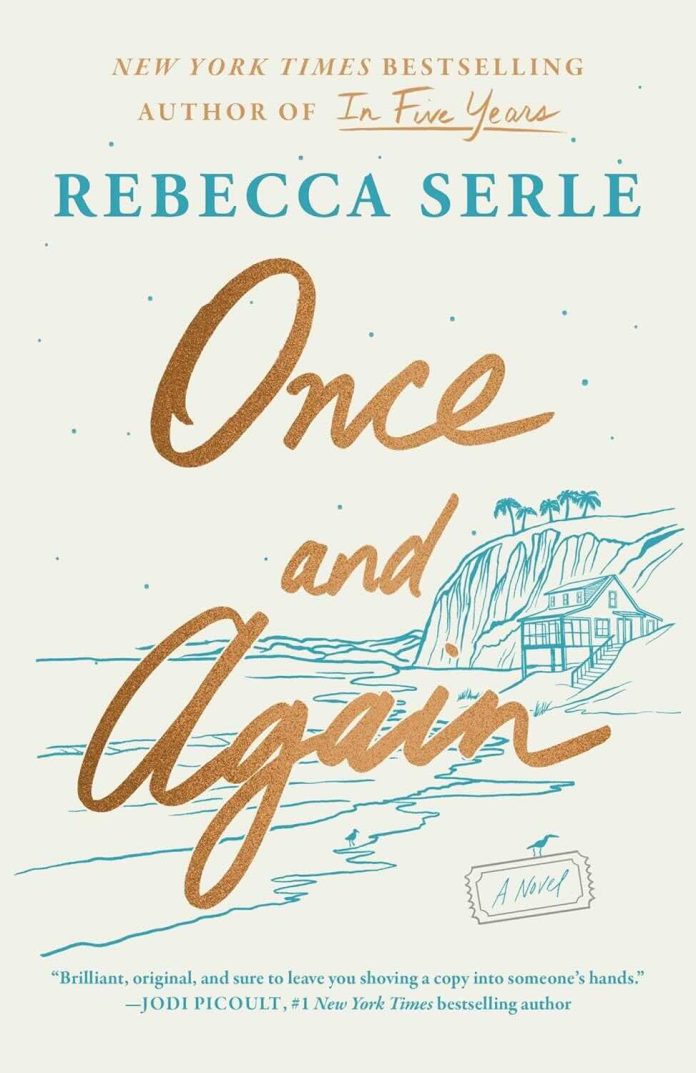
There is a certain kind of novel that refuses to sit comfortably inside a single genre, and Once and Again by Rebecca Serle is precisely that kind of book. It carries the premise of a fairy tale — every woman in the Novak family is born with a silver ticket, a single-use do-over capable of rewinding time — yet wraps that conceit so tightly around the tender, bruised reality of marriage, infertility, ageing parents, and first loves that the magic feels almost secondary. Serle, the New York Times bestselling author of Expiration Dates, In Five Years, and One Italian Summer, has built a career on blurring the boundary between speculative premise and emotional realism. Here, she pushes even further, crafting a novel that reads less like fantasy and more like a meditation on the cost of choice itself.
The story follows Lauren Novak, a thirty-seven-year-old accountant whose husband Leo has just landed a cinematography job in New York. With their West Hollywood bungalow headed to Airbnb and summer stretching out ahead, Lauren returns to 31382 Broad Beach Road — her childhood home on the Malibu shore — where her father Dave still surfs, her mother Marcella still worries, and her grandmother Sylvia still refuses to lock the gate at night. What Lauren does not anticipate is the return of Stone, the boy next door and the first love she never quite got over.
The Architecture of a Family in Four Voices
One of the most striking structural choices in Once and Again by Rebecca Serle is the rotating perspective. Lauren narrates her own chapters in first person — intimate, slightly guarded, the voice of a woman accustomed to managing risk. But Marcella’s chapters arrive in close third person, and the shift is revelatory. We see a mother who is not cold but cautious, not withholding but terrified. Through Marcella, Serle asks a question that runs like an underground river beneath the entire novel: what happens to a person after they spend their miracle? If you have saved the love of your life once and know you cannot do it again, how do you breathe?
Sylvia, the grandmother, operates almost entirely through dialogue and implication. She is the free spirit, the woman who never used her ticket at all, and the novel treats her restraint not as cowardice but as a kind of radical philosophy. The interplay between these three women — the one who spent her gift in terror, the one who hoarded hers in freedom, and the one still waiting — gives the book a layered, almost mythic quality that elevates it beyond a standard domestic drama.
Dave, Lauren’s father, rounds out the family with warmth that is almost painful to read. He is the kind of man who knows the name of every barista and every mailman, who arrives at his daughter’s door at four in the morning because he knew she would be awake. He is also the man everyone in this house is trying to keep alive.
Salt Water, First Loves, and the Undertow of the Past
Serle writes Malibu the way other authors write characters — with specificity, affection, and a willingness to show the cracks in the paint. The Pacific Coast Highway, Paradise Cove, the Trancas Country Mart, Cross Creek shopping centre — these are not set dressing but a sensory world that Lauren carries in her body. The prose shifts register when Lauren enters the water, becoming looser, more rhythmic, as though the ocean unlocks something language alone cannot reach.
Stone’s reappearance draws Lauren backward, and Serle handles the gravitational pull of a first love with uncomfortable honesty. The surfing scenes between Stone and Lauren vibrate with an energy that is equal parts nostalgia and danger, and Serle never pretends that what Lauren is feeling is simple. Their history is physical and wordless, a language built on shared waves and silent mornings, and the novel does not rush to condemn or excuse what unfolds between them. It simply observes, with the patient clarity of someone watching a wave they know is going to break.
The subplot of Bonnie, Stone’s stepmother, dying of cancer, adds a quiet devastation to the romantic tension. It is Bonnie’s illness that draws Stone home and Bonnie’s death that catalyses the novel’s most consequential scene. Serle weaves grief into attraction with a skill that feels earned, never manipulative.
Fertility, Marriage, and the Absence That Shapes Everything
Perhaps the novel’s greatest achievement is how it treats Lauren and Leo’s infertility. Serle does not sentimentalise the experience or reduce it to a plot device. The failed retrievals, the trigger shots that linger too long, the positive tests that turn out to be chemical ghosts — all of it lands with the dull, specific weight of lived knowledge. The tension between Lauren and Leo over when to stop trying is one of the most honest depictions of reproductive grief in recent fiction.
Key emotional threads the novel balances with care:
- The way infertility quietly corrodes a marriage from the inside, turning sex into obligation and hope into a kind of addiction
- The asymmetry of suffering when one partner bears the physical burden and the other watches, helpless
- How the desire for a child can become so consuming it obscures the life already being lived
- The complicated relief of surrender, and the courage it takes to say “let’s give up” and mean it as an act of love
Leo himself is drawn with generosity. He is warm, present, frustratingly unavailable by phone, and deeply in over his head when it comes to the clinical vocabulary of fertility treatment. Serle allows him to be both a good man and an insufficient one, which is exactly what makes the marriage feel real.
The Ticket as Metaphor — and Its Limits
The silver ticket is Once and Again by Rebecca Serle‘s engine and its central metaphor. What Serle understands, and what makes this novel smarter than its premise might suggest, is that the ticket’s power lies not in its use but in its existence. Marcella’s anxiety, Lauren’s vigilance, Sylvia’s nonchalance — each woman’s relationship to the ticket defines her personality more than any action she takes with it.
When Lauren finally spends her do-over, she does so not to prevent a catastrophe or save a life but to erase a personal betrayal — a choice that is messy, selfish, and devastatingly human. The novel does not punish her for this, not exactly, but it does insist that consequences do not vanish just because the event that caused them has been unwound. The truth lives in the body even when the timeline disagrees.
The moment when Dave refuses the ticket from his hospital bed is the novel’s emotional apex. His reasoning is simple and shattering: going back would erase the decade they have already lived, and he loved that decade. He loved his life. It is a statement about the value of time that no amount of magic can improve upon.
Where the Spell Wavers
For all its emotional precision, Once and Again by Rebecca Serle occasionally stumbles in pacing. The middle chapters, particularly during Lauren’s early weeks back in Malibu, cycle through similar beats — surf, eat, almost talk to Marcella, don’t — and the repetition, while thematically intentional, can feel like the narrative treading water. Some readers may wish the novel trusted them to feel the stagnation without quite so many scenes that demonstrate it.
The rules of the ticket itself remain deliberately vague, which serves the mythic quality but occasionally frustrates the logic-minded reader. How far back can one travel? Are there physical limitations? The novel handwaves these questions, and while that is consistent with the fable-like origin story of Hinda and Irina, it does leave a few structural seams visible.
Additionally, Stone as a character never quite achieves the dimensionality of the Novak family. He is beautiful, grief-stricken, magnetically present — but he functions more as a catalyst for Lauren’s choices than as a fully independent person. We learn relatively little about his interior life beyond loss and regret.
A Final, Perfect Gesture
The novel’s closing image — Lauren using Sylvia’s preserved ticket not to reverse tragedy but to rescue a burned birthday cake — is the kind of ending that either makes or breaks a book. It works, beautifully, because it reframes the entire novel. The ticket was never about preventing disaster. It was about choosing where to put your attention, what moments deserve a second chance. Sometimes it is a father’s life. Sometimes it is a first birthday, a kitchen full of smoke, and the simple desire to get it right.
Once and Again by Rebecca Serle is a novel that asks whether the power to undo the past is a gift or a cage, and answers: it depends entirely on who is holding it. It is imperfect in the way that deeply felt things often are — a little long in places, a little thin in others — but its emotional core is undeniable. For readers who loved Serle’s In Five Years or Expiration Dates, this is a natural and moving progression.
Books That Shimmer in Similar Waters
If Once and Again by Rebecca Serle resonated with you, consider reaching for these titles:
- The Midnight Library by Matt Haig — Another novel built on the architecture of regret and second chances, where a woman gets to sample the lives she might have lived
- In Five Years by Rebecca Serle — Serle’s earlier exploration of fate, love, and the terrifying certainty of a single premonition
- The Time Traveler’s Wife by Audrey Niffenegger — The original modern romance tangled in the cruelty and beauty of displaced time
- Oona Out of Order by Margarita Montimore — A woman lives her life out of sequence, discovering that love and identity persist regardless of chronology
- Malibu Rising by Taylor Jenkins Reid — For readers drawn to the Malibu setting, family secrets, and the weight of legacy carried by siblings on the California coast







