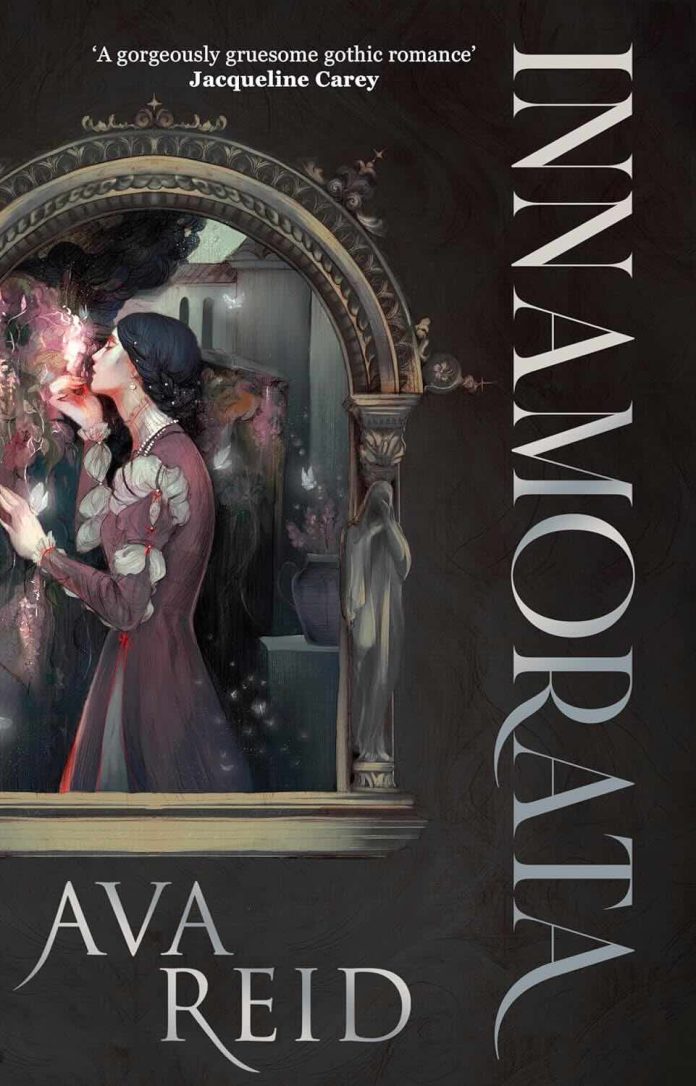
The island of Drepane is not a place where sunlight tends to linger. Its castles rise from marshes and sheer cliff faces, the old magic of necromancy beaten underground by a conqueror’s blade a century past, its seven noble houses yoked into submission by a treaty that parcels out the dead like livestock. This is the world into which Innamorata by Ava Reid deposits its reader — not gently, but with the certainty of a stone dropped into deep water.
The novel opens at a corpse’s side. Adele-Blanche, iron-willed matriarch of the House of Teeth, is dead, and the leeches have arrived to divide what remains of her. This opening — methodical, grotesque, precise — announces the register of everything that follows. Ava Reid, already celebrated for A Study in Drowning and Lady Macbeth, has constructed here a world that does not apologize for its darkness or its demands on the reader’s patience. It is the first volume in The House of Teeth duology, and it moves with the unhurried authority of a book that trusts its own architecture completely.
The Weight of an Inherited Silence
At the heart of Innamorata by Ava Reid is Agnes — cousin, shadow, and secret strategist of a dying noble house. For seven years, she has not spoken a single word. This is no trauma-induced fugue, no magical affliction imposed from outside. Agnes chose her silence, deliberately and deliberately maintained it, as a weapon more formidable than any speech. She writes to communicate. She nods, refuses, threatens — all without sound. Her voice lives in the negative space around other people’s assumptions, and Ava Reid makes this constraint one of the most genuinely original narrative devices in recent fantasy.
Agnes carries the true burden of the book’s central mission: to infiltrate the forbidden library of Castle Crudele, recover the death magic that the conqueror Berengar erased a century ago, and restore the glory of the House of Teeth. To achieve this, she must arrange a betrothal between her luminously beautiful cousin Marozia and Liuprand, golden-haired heir to the conqueror’s throne. Agnes must become the architect of someone else’s romance while denying herself any such thing. Her grandmother, Adele-Blanche, left instructions carved literally into Agnes’s body: never seek the pleasures of the body. She must not fall in love.
She falls in love.
Marozia and Liuprand: Two Instruments of Destruction
Marozia glitters like a character designed to be dismissed, but Reid refuses that. She is the Mistress of Teeth in name, groomed for charm and calculated seduction, and she possesses a sharp-eyed perception of others’ desires that cuts through social performance with startling precision. Her love for Agnes is real, entangled, and at moments almost predatory in its tenderness — one of the novel’s more quietly unsettling relationships.
Liuprand, heir to a throne built on his great-grandfather’s conquest, is the most unexpected pleasure of Innamorata by Ava Reid. He is called golden, beautiful, almost absurdly luminous — and yet Reid resists using him as mere symbol. He is principled, quietly horrified by his father’s cruelty, and drawn to Agnes not because she is enigmatic but because he perceives the disciplined, vivid creature beneath her visible withdrawal. Their romance develops with a restraint bordering on the agonizing, which suits the novel’s gothic gravity perfectly.
Doom as a Design Principle
The Collision of Duty and Desire
The central tension of the novel is not whether Agnes and Liuprand will fall in love — that outcome arrives with the inevitability of a tide — but what love will cost them both. Innamorata by Ava Reid is preoccupied with the collision between inherited purpose and individual will. Agnes is a woman whose body has been mapped into a set of rules by her grandmother’s blade. Her physical self is a document of someone else’s ambitions. The novel asks, quietly and then with increasing force, what it means to reclaim authorship of one’s own life when that life has been entirely scripted.
The political architecture of Drepane lends the personal drama enormous structural weight:
- The Septinsular Covenant — the conqueror’s treaty that divided and neutered the old magic, parceling death itself between seven noble houses
- The House of Teeth — isolated, reviled, and stubbornly alive at the edge of a mountain
- The forbidden library — a repository of burned knowledge, its secrets the only path to reclaiming what was taken
- The desecration rites — the grotesque ceremonial division of every corpse on the island, a system designed to prevent necromantic power from ever consolidating again
These are not decorative details. They are the medium through which the love story is told, and they give it genuine political and moral heft.
A Prose That Does Not Hasten
Reid’s writing in Innamorata is baroque in the best sense: heavily ornamented, precise, and completely committed to its atmosphere. Sentences accumulate with the density of stone on stone. The library of Castle Crudele is gold as the inside of a vault; the garden of Castle Peake is a vicious thing of wisteria and sea holly, its thorns tearing skirt hems from the unwary. The world is rendered with the obsessive detail of an illuminated manuscript — one in which beauty and harm are thoroughly intermixed.
This richness is also, in fairness, the book’s sharpest critique. The pacing of the first third is measured to the point of deliberateness, and the necromantic magic system — while atmospherically compelling — remains more evocative than mechanically defined in this opening volume. Readers accustomed to propulsive fantasy may find the entry cost steep. Reid is writing for those who find pleasure in the texture of a scene as much as in its forward motion, who are willing to follow Agnes through a library, a dream, a funeral ritual, trusting that the architecture of patience is serving a larger design. The three-part structure — each section titled and weighted distinctly — mirrors the progression of Agnes’s interiority, and the ending earns its cliffhanger.
Reid’s Voice in Context
Readers who admired A Study in Drowning and Lady Macbeth will recognize Reid’s distinctive strengths: the unreliable intimacy of a singular female perspective, the use of negative space as emotional architecture, the refusal to make her antagonists comfortably legible. Innamorata by Ava Reid is more ambitious in political scope and world-building than either previous novel, and correspondingly more demanding — but also more rewarding for readers willing to meet it on its terms.
The second book in The House of Teeth duology cannot arrive soon enough.
If This Book Found You
- Gormenghast by Mervyn Peake — the epigraph is not accidental
- Kushiel’s Dart by Jacqueline Carey — dark, morally complex, beautiful cruelty
- A Study in Drowning by Ava Reid — same author’s gothic precursor
- Lady Macbeth by Ava Reid — Reid’s gift for interiority and feminine power
- The Bear and the Nightingale by Katherine Arden — folklore-drenched atmosphere
- The Witch’s Heart by Genevieve Gornichec — mythic, devastating, quietly defiant
- The Bone Season by Samantha Shannon — intricate world-building, political darkness
- Mexican Gothic by Silvia Moreno-Garcia — dread sustained through prose alone







