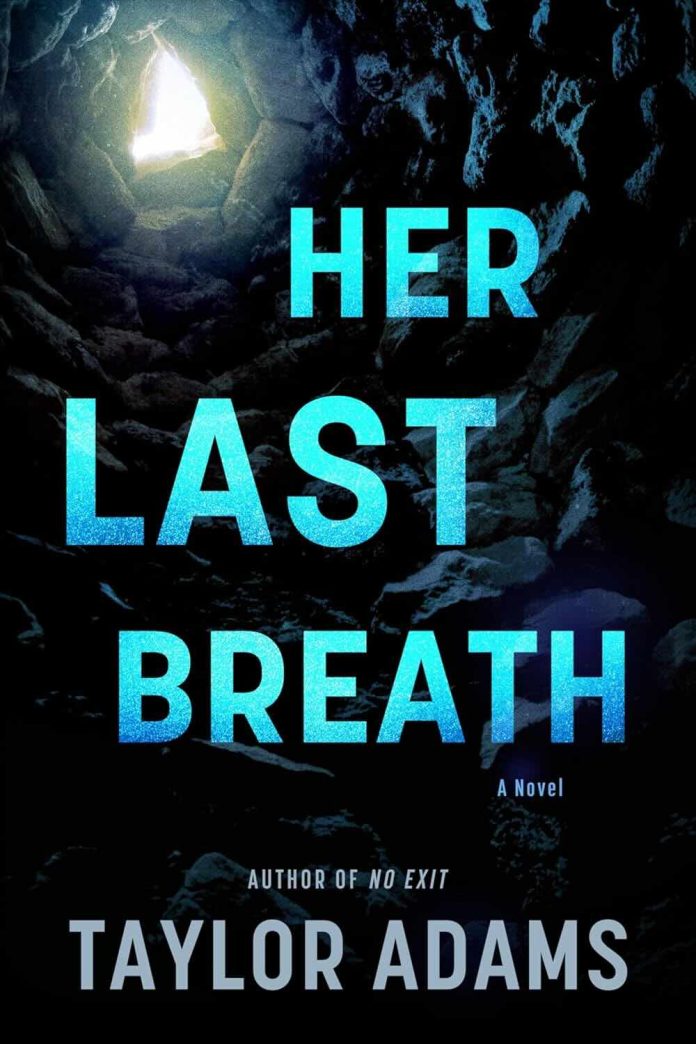
Taylor Adams returns to the thriller landscape with a masterclass in psychological manipulation and claustrophobic terror. Her Last Breath by Taylor Adams plunges readers into the Devil’s Staircase cave system, where two friends descend into limestone tunnels—and into a carefully orchestrated nightmare that will test the limits of survival, friendship, and truth itself.
The premise reads deceptively simple: Tess DeWater, a shy legal assistant struggling with claustrophobia, finally agrees to go caving with her adventurous best friend Allie Merritt, a successful travel influencer. What begins as an overdue bonding experience quickly transforms into a harrowing fight for survival when a stranger attacks them hundreds of feet underground. But Adams, known for his breakout success No Exit and subsequent thrillers Hairpin Bridge and The Last Word, knows that simplicity is merely the surface. Like the cave itself, this narrative contains hidden passages, unexpected drops, and deadly secrets waiting in the dark.
A Narrative That Breathes in Four Parts
Adams structures Her Last Breath by Taylor Adams through alternating perspectives—Tess, Jacob (the attacker), Allie, and Ethan (Allie’s boyfriend)—each voice adding layers to a puzzle that Detective Layla Washington must piece together from a hospital bedside interview. This multi-perspective approach creates a narrative rhythm that mirrors the descent into the cave: methodical, increasingly claustrophobic, and punctuated by sudden, breathtaking drops.
The author’s decision to frame the story through Washington’s interrogation of the “survivor” provides an ingenious structural backbone. As Tess recounts her harrowing tale from a hospital bed, readers experience dual timelines—the past horror underground and the present unraveling in an interrogation room. This technique generates constant tension as Washington’s detective instincts detect inconsistencies, forcing readers to question everything they’ve been told.
Adams demonstrates remarkable technical proficiency in his cave descriptions, clearly drawing from extensive research. The progression from the Upper Vault through the Drainpipe, the Great Wall, and into the impossibly beautiful yet terrifying Razor Alley feels authentic and visceral. The author’s rendering of helictites—those gravity-defying formations that science still struggles to explain—provides moments of genuine wonder amid the terror.
Character Development: Shades of Gray Underground
The characterization in Her Last Breath reveals Adams’s evolution as a thriller writer. Tess emerges as a complex protagonist whose anxiety disorder and history of abuse create a sympathetic foundation—until cracks begin appearing in her narrative. The author excels at creating an unreliable narrator whose very vulnerability becomes weaponized. Her transformation from timid legal assistant to someone capable of calculated deception unfolds with chilling believability.
Allie Merritt, the globe-trotting influencer, could have been a shallow archetype but instead becomes the novel’s beating heart. Through Tess’s envious observations and Jacob’s underestimations, readers witness a woman who refuses victimhood. Her expertise in caving, combined with street-smart survival instincts honed through international travel, makes her resourcefulness feel earned rather than convenient. The author’s decision to reveal her perspective later in the narrative creates a satisfying subversion of expectations.
Detective Washington represents Adams’s most nuanced supporting character to date. An aging investigator facing cognitive decline and professional marginalization, she brings gravitas and lived experience to the investigation. Her determination to prove herself while battling both a cunning suspect and her own colleagues’ dismissiveness adds emotional weight beyond the central mystery.
Where Light Struggles to Penetrate
Despite its considerable strengths, Her Last Breath by Taylor Adams occasionally stumbles under the weight of its ambitions. The pacing, while generally propulsive, suffers from uneven distribution across the four-part structure. The middle section, focused on Jacob’s perspective, sometimes feels repetitive as he pursues Allie through increasingly narrow passages. While this mirrors the grinding monotony of being trapped underground, it risks losing reader momentum during crucial story development.
The novel’s greatest weakness lies in its final act reveal. Without venturing into spoiler territory, the ultimate truth behind the cave assault requires readers to accept several convenient coincidences and character decisions that strain credulity. Adams works hard to justify these through psychological explanations, but the foundation feels slightly unstable—much like the rusted anchor bolt Allie warns about in Razor Alley.
Additionally, some secondary characters remain frustratingly underdeveloped. Ethan, Allie’s physician boyfriend, exists primarily as a plot device rather than a fully realized person. His scenes, while serving important narrative functions, lack the psychological depth Adams brings to his primary cast. The relationship between Allie and Ethan, referenced frequently but rarely shown in meaningful depth, would benefit from more textured development to strengthen the emotional stakes.
The technical aspects of cave rescue, while fascinating, occasionally overwhelm the human drama. Adams clearly conducted extensive research into confined-space rescue operations, and his enthusiasm sometimes results in overly detailed procedural sequences that momentarily stall narrative momentum. Thriller readers seeking pure adrenaline may find these passages testing their patience.
Technical Craftsmanship and Atmospheric Mastery
Where Her Last Breath by Taylor Adams truly excels is in creating an atmosphere of sustained dread. The author understands that darkness in fiction isn’t merely the absence of light—it’s a presence, a character in itself. His descriptions of the cave’s hostile geography read like body horror; tunnels that compress ribs, rocks that scrape skin raw, and water cold enough to induce hypothermia within hours. The psychological effects of sensory deprivation—the “prisoner’s cinema” hallucinations, the distortion of time, the erosion of sanity—feel researched and authentic.
Adams’s prose style has matured since No Exit. He employs shorter, more urgent sentences during action sequences, then expands into more contemplative rhythms during character reflection. The technique effectively modulates tension without sacrificing momentum. His dialogue crackles with authenticity, particularly in Tess and Allie’s interactions, which capture the complex dynamic of long friendship strained by unspoken resentments.
The author also demonstrates impressive control over his thriller mechanics. He plants clues with subtlety, allowing attentive readers to piece together aspects of the deception before the full reveal while maintaining enough ambiguity to keep multiple interpretations viable. The use of Allie’s helmet camera as both a plot device and a symbol of truth versus perception shows sophisticated thriller construction.
Thematic Resonance: What Lies Beneath
Beyond its surface-level thrills, Her Last Breath by Taylor Adams explores deeper questions about toxic friendship, jealousy, and the performance of victimhood. Adams examines how society’s tendency to underestimate certain people—women, those with anxiety, the physically unassuming—can become both burden and weapon. The cave serves as an apt metaphor for the hidden depths of human relationships, where what appears simple at the surface conceals complex, dangerous passages below.
The exploration of memory and truth through Detective Washington’s investigation raises compelling questions about whose story gets believed and why. In an era obsessed with true crime narratives, Adams interrogates the seductive power of survivor stories and our willingness to accept them at face value.
For Readers Who Crave Similar Depths
Fans of Her Last Breath by Taylor Adams should explore Riley Sager’s The Last Time I Lied, which similarly examines betrayal within female friendships against an isolated setting. Paul Tremblay’s The Cabin at the End of the World offers comparable claustrophobic tension and moral ambiguity. For those fascinated by the cave setting specifically, Jeff Long’s The Descent provides deep-underground horror, while Ted the Caver’s legendary internet story captures similar primal fears of confined spaces. Readers drawn to the unreliable narrator aspect will appreciate Gillian Flynn’s Gone Girl and its manipulation of reader sympathy.
Final Verdict: Descending Into Darkness
Her Last Breath by Taylor Adams solidifies the author’s reputation as a thriller writer willing to push boundaries and subvert expectations. While not without flaws—uneven pacing, occasionally strained plotting, underdeveloped supporting characters—the novel delivers where it matters most: sustained tension, atmospheric dread, and a willingness to challenge reader assumptions about heroism and villainy.
The cave setting provides both literal and metaphorical depth, forcing characters and readers alike to confront what lies hidden beneath familiar surfaces. Adams’s technical research grounds the fantastic premise in uncomfortable reality, while his character work ensures emotional investment beyond mere plot mechanics.
This is thriller writing that respects its audience’s intelligence while delivering the visceral pleasures the genre promises. For readers who enjoyed Adams’s previous work or who crave psychologically complex survival thrillers, this descent into the Devil’s Staircase offers rewards worth the claustrophobic journey. Just remember: when you emerge from these pages, the entire world becomes new again.
Recommendations: Books That Share Similar DNA
- The Descent by Jeff Long – For those captivated by the underground setting and existential horror
- The Last Time I Lied by Riley Sager – Explores female friendship betrayal with unreliable narration
- The Ruins by Scott Smith – Isolation, survival, and the gradual unraveling of group dynamics
- No Exit by Taylor Adams – Adams’s breakout thriller for those new to his work
- Gone Girl by Gillian Flynn – Masterful unreliable narration and marriage/friendship as minefield
- My Lovely Wife by Samantha Downing – Domestic thriller with shocking reveals about who people really are







