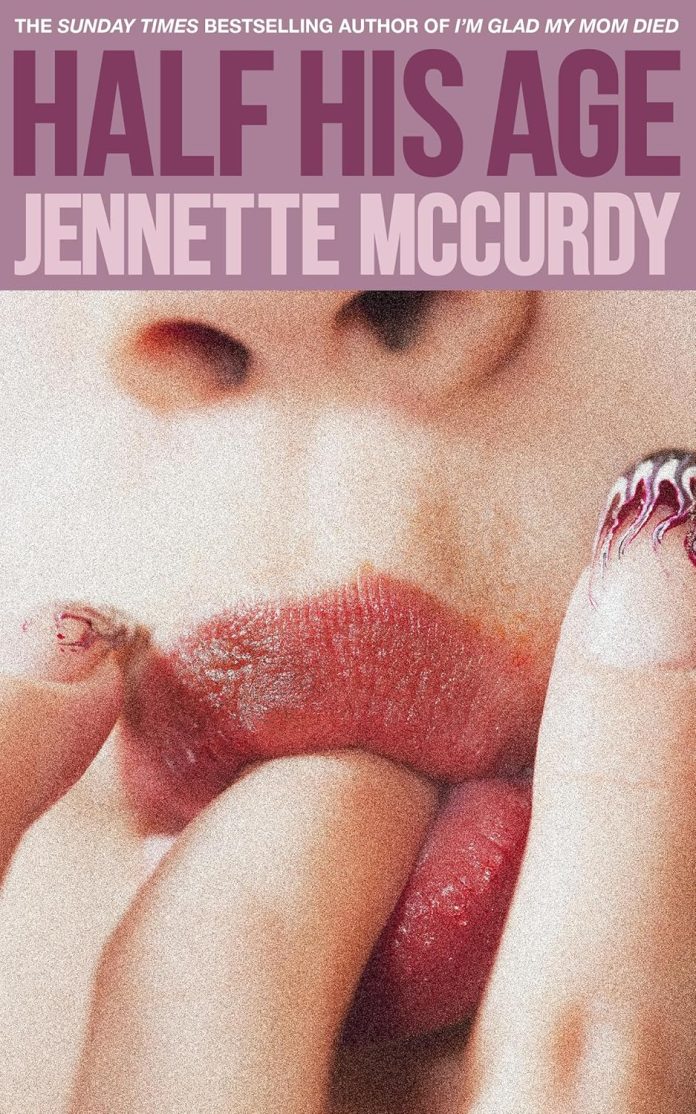
Jennette McCurdy’s debut novel arrives with the same unflinching honesty that made her memoir I’m Glad My Mom Died a cultural phenomenon. But where her memoir dissected the toxic machinery of child stardom and maternal abuse, Half His Age by Jennette McCurdy turns its sharp gaze toward a different kind of forbidden territory: the consuming, complicated landscape of a seventeen-year-old’s desire for her middle-aged teacher. This is not a love story—it’s an autopsy of one.
The Raw Truth of Wanting
Set against the stark backdrop of Anchorage, Alaska, the novel follows Waldo, a working-class senior whose life oscillates between Victoria’s Secret shifts, frozen dinners, and late-night shopping binges. When Mr. Korgy—a disillusioned 39-year-old creative writing teacher with thinning hair, a paunch, and dead dreams—tells her she has “a voice,” something ignites. What follows is a relationship that McCurdy refuses to sanitize or simplify, presenting instead a layered examination of power, loneliness, and the terrifying gap between fantasy and reality.
The premise alone invites judgment, but McCurdy’s genius lies in her refusal to moralize. She doesn’t ask readers to condone Waldo’s choices or absolve Mr. Korgy of his responsibility. Instead, she presents the relationship with such granular psychological precision that we understand exactly how two profoundly lonely people convince themselves that this collision is inevitable, even necessary.
A Voice That Cuts Through
McCurdy’s prose in Half His Age by Jennette McCurdy mirrors the jagged honesty of her memoir work. Waldo’s first-person narration crackles with the kind of uncomfortable observations that make you laugh and wince simultaneously. She catalogs the minutiae of consumer culture—the desperate ritual of online shopping, the taxonomy of cheap makeup, the way women try to purchase their way into worthiness—with anthropological precision. Her voice captures something essential about what it means to be young, female, and perpetually hungry for something just out of reach.
The writing style adapts McCurdy’s trademark blend of dark humor and devastating insight. Sentences are lean and muscular, occasionally erupting into longer, spiraling passages that mirror Waldo’s racing thoughts. There’s a rhythm to the prose that feels distinctly contemporary—fast, fragmented, brutally self-aware. When Waldo describes her period sex scene or the mechanics of preparing for a date she doesn’t want to go on, the details are so visceral they border on uncomfortable, which is precisely the point.
Character Study in Gray Tones
Waldo is not likable in any conventional sense. She’s manipulative, impulsive, and often cruel in her assessments of others. She uses people—Nolan, Frannie, even her mother—and barely pretends otherwise. Yet McCurdy renders her with such psychological complexity that judgment gives way to recognition. Waldo’s ravenous need for validation, her compulsive shopping as emotional regulation, her inability to want what’s good for her—these aren’t character flaws so much as survival mechanisms developed in the ecosystem of neglect and poverty.
Mr. Korgy receives equally nuanced treatment. He’s neither predator nor victim but a man drowning in the mediocrity of his own choices who mistakes a student’s attention for salvation. McCurdy brilliantly captures how he oscillates between genuine care for Waldo and transparent self-interest, how his “mentorship” seamlessly bleeds into grooming without him ever acknowledging the shift. The novel’s most uncomfortable achievement is making us understand his perspective without excusing it.
The supporting characters—Waldo’s relationship-addicted mother, religious friend Frannie, puppy-like boyfriend Nolan—are sketched with the same sharp-eyed precision. Each represents a different escape route Waldo considers and rejects.
Themes That Resonate and Disturb
At its core, Half His Age by Jennette McCurdy examines the difference between wanting something and having it, between fantasy and reality. McCurdy structures the novel in distinct phases: the chase, the capture, the disillusionment. The first third crackles with sexual tension and forbidden possibility. The middle section explores the mechanics of an actual relationship stripped of danger. The final act confronts what happens when you get exactly what you thought you wanted and realize it was never really about that thing at all.
The novel also serves as a pointed critique of consumer culture and how it colonizes female desire. Waldo’s compulsive shopping—the endless carts loaded with fast fashion and beauty products—isn’t separate from her pursuit of Mr. Korgy but another expression of the same underlying hunger. McCurdy draws explicit parallels between romantic pursuit and consumer behavior, suggesting both are fueled by manufactured lack and the promise that the next purchase, the next relationship, will finally fill the void.
Class consciousness threads throughout the narrative. Waldo’s acute awareness of her “white trash” origins—the flickering lamps from Marshall’s, the ripped pleather couch, the Dollar Zone shopping trips—contrasts sharply with Frannie’s vaulted ceilings and Gwen’s Diptyque candles. This isn’t merely set dressing; McCurdy explores how class shapes desire itself, how Waldo’s hunger for Mr. Korgy intertwines with longing for the cultural capital he represents.
What Works Brilliantly
- The psychological realism: McCurdy captures the obsessive quality of infatuation with uncomfortable accuracy—the compulsive phone-checking, the reading and rereading of text messages, the elaborate preparations for brief encounters.
- The humor: Despite the dark subject matter, the novel is genuinely funny. Waldo’s observations about Mormon culture, her mother’s failed relationships, and the ecosystem of mall retail are wickedly sharp.
- The ending: Without spoiling it, McCurdy sticks the landing by resisting both tragic collapse and redemptive transformation. The conclusion feels earned and honest.
- Consumer culture critique: The shopping sequences could feel indulgent, but McCurdy uses them to illuminate character and theme, showing how capitalism shapes and exploits female insecurity.
Where It Stumbles
The novel’s greatest strength—its commitment to granular detail—occasionally becomes its weakness. Some shopping sequences and sexual encounters run long past the point of insight, testing reader patience. The middle section, once Mr. Korgy has left his family, sags under the weight of domestic mundanity, though this may be intentional—mimicking Waldo’s own boredom and disillusionment.
McCurdy’s refusal to moralize is admirable but may leave some readers frustrated. The novel doesn’t offer easy answers or clear condemnation. Some may find the lack of explicit reckoning with the relationship’s inappropriate nature troubling, though McCurdy seems more interested in exploring why and how such relationships happen than in delivering judgment.
The peripheral characters, while well-drawn, occasionally feel functional rather than fully realized. Frannie and Nolan exist primarily in relation to Waldo’s journey rather than as independent presences.
Evolution from Memoir
Where I’m Glad My Mom Died was necessarily retrospective—a survivor looking back with hard-won clarity—Half His Age by Jennette McCurdy inhabits the confusion of the present moment. Fiction allows McCurdy to resist the temptation toward neat resolution or wisdom-through-suffering. Waldo doesn’t emerge transformed or particularly enlightened; she simply moves forward, slightly freer than before.
Both books share McCurdy’s gift for uncomfortable honesty and dark humor, her ability to find absurdity in trauma without diminishing its impact. The voice that made her memoir so distinctive translates powerfully to fiction, proving her talent extends beyond the confessional mode.
Who Should Read This
This novel will resonate with readers who appreciate:
- Unvarnished, psychologically complex coming-of-age narratives
- Sharp social commentary embedded in character study
- Fiction that refuses easy moral categories
- Contemporary voices that capture the specific texture of being young now
It may not suit readers seeking:
- Conventional romance or satisfying love stories
- Clear moral frameworks or redemption arcs
- Comfortable reading experiences
Similar Explorations Worth Reading
If Half His Age by Jennette McCurdy speaks to you, consider these companion reads:
- My Dark Vanessa by Kate Elizabeth Russell – Perhaps the most obvious parallel, exploring a teacher-student relationship with similar psychological nuance and moral complexity.
- Tampa by Alissa Nutting – A provocative examination of female desire and predation that similarly refuses easy categorization.
- The Secret History by Donna Tartt – For its examination of charismatic teachers and the students drawn into their orbits, though in a very different register.
- Convenience Store Woman by Sayaka Murata – Shares McCurdy’s interest in characters who refuse societal expectations and find freedom in unexpected places.
- Breasts and Eggs by Mieko Kawakami – Another novel exploring female desire, body autonomy, and consumer culture with unflinching honesty.
Final Verdict
Half His Age by Jennette McCurdy announces the arrival of a significant fiction writer. While not without its flaws—occasional pacing issues, perhaps too much commitment to the uncomfortable—it succeeds in its primary ambition: to render desire in all its messiness without judgment or sentimentality. McCurdy understands that we don’t always want what’s good for us, that getting what we want often reveals we wanted something else entirely, and that freedom sometimes looks less like triumph and more like simply driving away.
This is a novel that trusts its readers to sit with discomfort, to resist the urge to categorize and condemn, to recognize the complicated humanity in people making terrible choices. In an era of simple narratives and clear villains, McCurdy offers something rarer and more valuable: the messy, uncomfortable truth of how we actually live.







