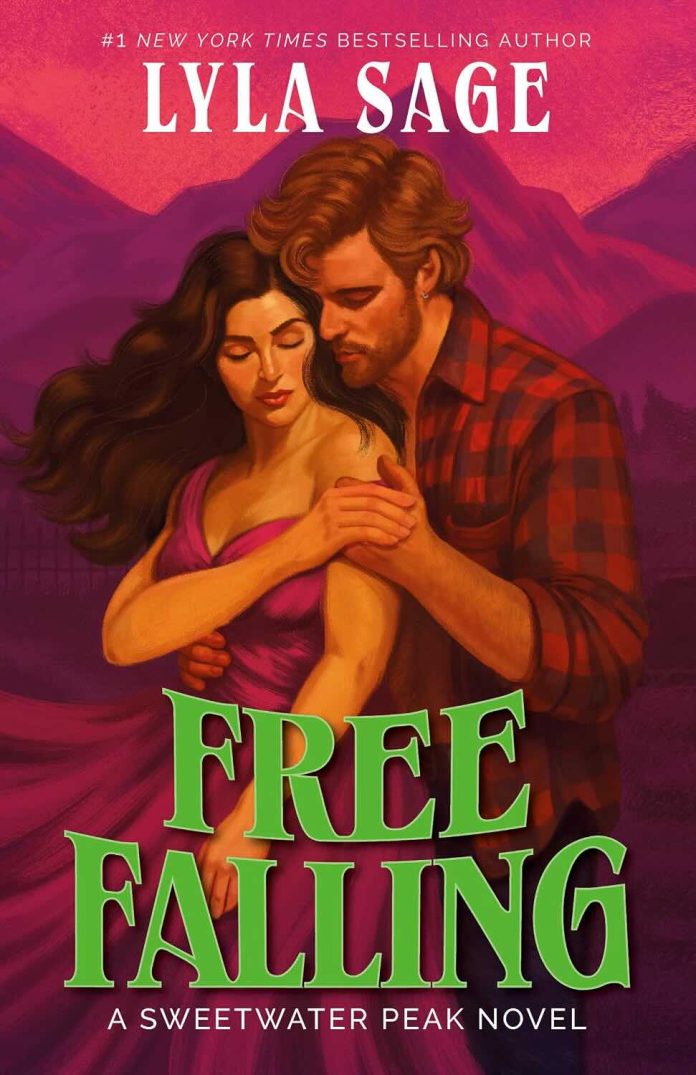
A woman walks home from work in the dark, seven minutes, not long enough to finish one song. She is going to eat stovetop macaroni, drink the cheapest boxed wine available and cry at videos of elderly dogs. This is not presented as a joke at her expense, and it is not rock bottom either. It is a Friday, and she has had a lot of them. Free Falling by Lyla Sage spends four hundred pages on what is actually wrong with Clarke Cartwright, and the fake engagement everyone will pick the book up for turns out to be the least interesting thing in it.
What Lyla Sage Says Before the Book Starts
There is an author’s note here, and it changes how the novel reads. Sage writes that she has been feeling blue, that Clarke is too, that she covered depression in an earlier book and still failed to spot it when it returned, and that neither of them noticed it coming: exhaustion arrived first and took the habits down with it. She addresses the note to anyone who has ever stood between hope and hopelessness.
That is a declaration of subject, and Free Falling by Lyla Sage honours it. Clarke is a woman whose competence has quietly stopped working. She refreshes her inbox for a roofing estimate that is not coming. She cannot make herself deep-clean a house she normally cleans with a toothbrush. She fixed the label maker and offers that up as the last fun thing she did. The things she used to love still spark and the spark keeps going out before it catches. Anyone who has been through burnout will recognise the shape of it before any character names it.
The Thread Holding Free Falling Together
Here is the structural move that makes the book work. Clarke and her twin Collins can both see and hear the dead, but not in the same way. Collins gets one clear voice at a time, like a conversation. Clarke gets frequencies: ringing, hums, a static that rises with every extra spirit in the room. Three decades of practice have taught her to turn the dial down, and she has built a set of rules around it that she treats as load-bearing.
The headaches that flatten her are not a side effect of the ability. They are a side effect of the suppression. The harder she pushes the dead away, the harder they press back. It takes most of Free Falling by Lyla Sage and one very bad night for anybody to say this out loud, and when Collins finally does, the line that lands has nothing to do with ghosts: she cannot understand why her sister finds so much value in suffering when she could be looking for it in joy.
That is the braid, and it is why the book earns its premise. Because the two mechanisms are one mechanism, no cure is available. What Clarke gets instead is a therapist she can only reach by video from two hours away, a diagnosis she resents, and the right to stop bracing the door with her shoulder. Free Falling by Lyla Sage is careful to leave her unfixed. Some days good, some days not, and awake for both.
Leith Wilkes and the Angry Kind of Grief
The romance is the other reason to read this. Leith is the town’s golden boy, a farmer who loves farming and hates owning a farm, and a man who talks constantly because silence frightens him. He turns up on Clarke’s porch with no plan, and the two of them commit a mild felony inside the first fifty pages.
What makes him more than a charm delivery system is his father. Leith’s last real conversation with Wilder Wilkes was a screaming match in which he said that if the man died tomorrow he would run the farm into the ground to spite him. Wilder died the next day. Leith has been carrying that for five years and has never once described the feeling as sadness, because it is not: it is rage, and he is ashamed of that. Clarke’s answer is the best line either of them gets, that grief can be soft and melancholy and it can also come in with its fists up.
There is also Ali, the ex, and the single most surprising scene in Free Falling by Lyla Sage belongs to her. She arrives expecting to be cast as the other woman and refuses the part. She tells Clarke she will not be pitted against another woman over a man, that the timeline is not actually blurry, and that she hopes it works out. Romance novels almost never give the ex-girlfriend that scene, and this one gives her the moral high ground on her way out.
Where Free Falling Falls Down
- The plot machinery is preposterous. An inheritance clause requiring marriage, a five-year deadline, a lawyer on the wrong payroll, a forged document to steal a day, and finally an obscure subsection nobody had read. Each piece works; assembled, it groans.
- The climax is a rescue from outside the story. The thing that resolves the central crisis is not something either protagonist does, and it arrives in the last few pages carried by a minor character.
- The villains are cardboard. The cousin spits tobacco, grins yellow and calls the farm his gold mine. The developer is described as resembling a Bond villain, appears once, and is disposed of by post.
- The biggest set piece is redundant. A long sequence in an abandoned car wash exists to break Clarke, which it does effectively, but the information it uncovers is information the reader already has.
- The two voices blur. Leith is chattier and more self-deprecating, but the cadence of the alternating chapters is often indistinguishable, which undercuts the point of alternating them.
- The tense slips. Several of the later intimate scenes drift from past into present mid-paragraph. It may be deliberate immediacy. It reads like something missed.
Not one of those complaints is fatal, and Free Falling by Lyla Sage knows where its real interest lies, which is why it keeps cutting back from the inheritance nonsense to two people working out what they are allowed to need.
Content Notes
Free Falling by Lyla Sage needs a real list. Depression and burnout written from the inside, including a passage about not caring whether she goes over the edge; repeated collapse and loss of consciousness from pain; grief; a son whose father dies the day after a vicious argument; parental neglect; an absent biological father who menaces his teenage daughter; several explicit open-door sex scenes including oral and temperature play; breaking and entering; drinking, including spiking punch at a school dance. The elderly dog survives, in case that is your line.
Read These Next
- Soul Searching by Lyla Sage. Sweetwater Peak book one, and you will want it first. Collins, Brady, the antiques shop and the developer all come from it.
- Done and Dusted by Lyla Sage. Where the Sage habit started, and the series this book quietly borrows its cavalry from.
- Wild and Wrangled by Lyla Sage. Her best-built couple to date, for readers who want the romance carrying more of the weight.
- Lost and Lassoed by Lyla Sage. Friends to lovers, bigger laughs, less of the ache.
If it is the trope rather than the author you are chasing, our guide to romance book tropes maps where fake dating sits among its neighbours.
Worth Your Shelf
Judged strictly as a plot, Free Falling by Lyla Sage is held together with string. The obstacles are contrived, the antagonists are thin, and the ending is handed to the heroes rather than earned by them.
Judged as what it is trying to be, it is the best thing Sage has written. It takes a woman whose entire identity is being the reliable one, the easy one, the one nobody has to worry about, and it makes her admit out loud that she has nobody to call. Then it gives her a man who notices, a sister who says the hard thing, and a diagnosis instead of a miracle. The last gesture in the book is not the proposal or the rescue. It is Clarke finally asking the ghost who has been sharing her house for years what her name is.
That is the whole novel in one question, and it is why the creaking plot is worth putting up with.







