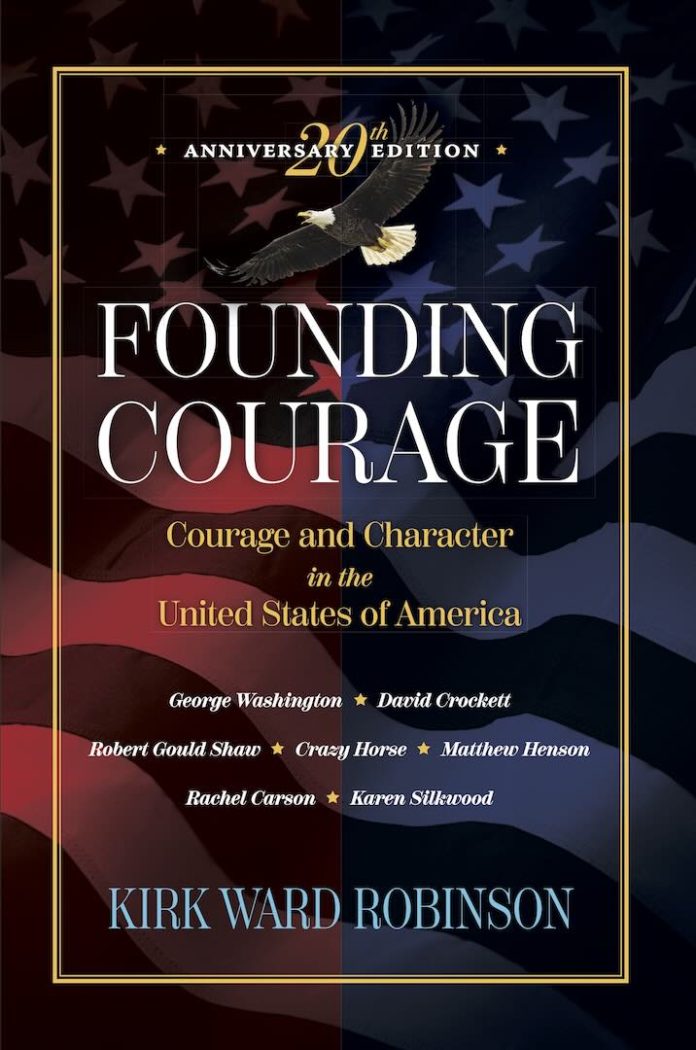
When the Space Shuttle Challenger exploded on January 28, 1986, Kirk Ward Robinson experienced more than grief—he felt a creeping despair about whether American courage had reached its end. Years later, hiking the Appalachian Trail on September 11, 2001, those feelings resurfaced as he learned of the terrorist attacks. These twin moments of national trauma became the genesis of Founding Courage, Robinson’s ambitious exploration of what courage truly means in the American context and whether it still burns bright in the national character.
This twentieth anniversary edition arrives at another crucial moment in American history, offering readers a deeply researched, thoughtfully constructed work that moves far beyond simple hero worship to examine the very nature of courage itself across seven successive generations since the Founding.
Building a Framework for Understanding Courage
Robinson structures his work brilliantly, opening with “Of Courage,” a section that establishes philosophical and biological frameworks before diving into historical narratives. He takes readers through contemporary examples—from a teenage girl facing a shark attack on the Texas Gulf Coast to a climber trapped by a boulder in a Utah canyon—demonstrating that courage manifests in countless forms across human experience.
What makes this approach particularly effective is Robinson’s engagement with scientific research on altruism, evolutionary biology, and the neurological underpinnings of courageous behavior. Drawing from thinkers like Richard Dawkins and UCLA studies on altruism’s evolutionary roots, he grounds his work in empirical reality rather than romantic mythology. This intellectual rigor transforms the book into a serious meditation on human character that resonates across disciplines.
Robinson’s chapter “What Courage Is” proves especially valuable, dissecting distinctions between courage, bravery, recklessness, and mere survival instinct. He establishes that courage requires both the presence of fear and the conscious decision to act despite it—a nuance often lost in popular discourse about heroism. This framework becomes essential for understanding the seven Americans whose stories form the book’s heart.
Seven Lives, Seven Types of Courage
Robinson’s selection reveals sophisticated historical understanding: George Washington, David Crockett, Robert Gould Shaw, Crazy Horse, Matthew Henson, Rachel Carson, and Karen Silkwood. He deliberately chose figures who are either lesser-known or whose courageous acts have been overshadowed by other aspects of their legacies.
- George Washington emerges not as a marble monument but as a vulnerable young officer who faced repeated failures before his ultimate triumphs. Robinson portrays Washington’s greatest courage not in military victories but in his willingness to relinquish power twice—after the Revolutionary War and after his presidency—establishing precedents that would define American democracy. The author shows Washington’s gradual moral evolution regarding slavery, demonstrating moral courage alongside military valor.
- David Crockett’s chapter may be the book’s most revelatory. Robinson dismantles frontier mythology to reveal the Tennessee congressman whose true courage lay in standing against his own political party and Andrew Jackson when principle demanded it. The author elevates Crockett from cartoon character to genuine American hero whose political courage deserves recognition equal to his legendary frontier exploits.
- Robert Gould Shaw transforms from privileged youth into the colonel who led the first Black regiment in the Civil War. Robinson handles racial dynamics with sensitivity and historical accuracy, showing how Shaw’s courage inspired thousands of Black soldiers who enlisted after the 54th Massachusetts Infantry’s assault on Fort Wagner, fundamentally changing the Civil War’s course.
- Crazy Horse represents a different kind of American courage—defending his people’s way of life against impossible odds. Drawing from Win Blevins’ Stone Song for accurate Lakota terminology, Robinson demonstrates genuine respect for Native American culture while presenting Crazy Horse as neither villain nor victim but as a man of extraordinary courage facing tragic inevitability.
- Matthew Henson’s chapter significantly contributes to popularizing this forgotten explorer’s story. Robinson’s meticulous research reconstructs Henson’s twenty-two-year partnership with Robert Peary, documenting not just his extraordinary Arctic skills but his remarkable perseverance in pursuing exploration despite racial barriers. The narrative builds steadily toward the climactic 1908-1909 journey that reached the North Pole, with Robinson adding psychological depth by exploring the complex Peary-Henson relationship.
- Rachel Carson emerges as multi-dimensionally courageous: morally, to challenge the pesticide industry; intellectually, to present complex science to general audiences; and physically, to continue working while battling cancer. Robinson’s account of Carson writing Silent Spring while undergoing radiation therapy transforms our understanding of the book’s creation from academic exercise into an act of profound will.
- Karen Silkwood brings the narrative to the contemporary era, examining an ordinary person who chose to speak truth to power despite mounting threats. Robinson handles complex conspiracy theories with journalistic care while honoring Silkwood’s memory, showing how her father’s years-long fight for truth illustrated courage inherited and sustained across generations.
Exceptional Writing and Accessibility
Robinson writes with clarity and restraint that serves his material exceptionally well. His prose becomes lyrical when describing landscapes—particularly vivid in the Crazy Horse chapter’s Great Plains depictions and the Matthew Henson chapter’s Arctic sequences—yet stylistic flourishes never overshadow historical content. The book reads accessibly for general audiences while maintaining scholarly rigor.
The author’s background as a four-time Appalachian Trail thru-hiker infuses the book with an outdoorsman’s appreciation for physical endurance and the courage required to push through discomfort and danger. This perspective particularly enriches the chapters on Henson’s Arctic expeditions and Crockett’s frontier experiences, lending authenticity to descriptions of similar ordeals.
Robinson’s commitment to accuracy extends to detailed source listings and transparent acknowledgment of gaps and contradictions in historical records. This intellectual honesty strengthens the work, showing readers that rigorous history-writing involves wrestling with uncertainty while still drawing meaningful conclusions.
Connecting Past Courage to Present Need
What elevates Founding Courage beyond typical historical biography is Robinson’s consistent effort to connect past courage to present need. The book’s framing—written in the shadow of 9/11 and revised during another period of national division—never feels forced. Instead, Robinson trusts readers to draw their own connections between these historical figures’ courage and the courage demanded by contemporary challenges.
The twentieth anniversary edition includes a preface reflecting on how America has changed since the original 2007 publication, with Robinson being vulnerable about his own journey from idealism through despair and back to cautious hope. This candor demonstrates the author’s own courage in sharing his evolving perspective with readers.
Educational and Thematic Value
Beyond engaging historical narrative, Founding Courage serves excellently as an educational resource. Each biographical chapter functions as a self-contained unit that can be assigned independently or as part of the larger whole. The variety of courage types examined—military, political, moral, cultural, pioneering, intellectual, and whistleblowing—allows educators to explore courage from multiple angles and connect it to different curriculum areas.
Several powerful themes emerge across Robinson’s seven biographical chapters:
- The Courage to Stand Alone: From Crockett defying his party to Carson challenging powerful industries to Crazy Horse resisting the reservation system, true courage often means standing alone against prevailing currents.
- The Evolution of Courage: Washington’s transformation from impetuous young officer to measured leader, and Shaw’s growth from privileged youth to selfless commander, demonstrate that courage can be developed through experience.
- The Cost and Legacy of Courage: Robinson shows what courage cost his subjects—reputation, career, health, life itself—while his epilogue traces how each subject’s courage influenced subsequent events, demonstrating that courageous actions create lasting change even when immediate results seem disappointing.
For Readers of Similar Works
Those who appreciated these books will find much to value in Founding Courage:
- David McCullough’s 1776 and John Adams – character-driven American history
- Stephen Ambrose’s Undaunted Courage – exploration narratives
- Erik Larson’s The Splendid and the Vile – accessible history through individual stories
- Douglas Brinkley’s Silent Spring Revolution – more on Rachel Carson’s legacy
- Hampton Sides’ Blood and Thunder – American West and Native American perspectives
- Win Blevins’ Stone Song – historical novel on Crazy Horse
- John F. Kennedy’s Profiles in Courage – classic work on political courage
A Testament to Enduring Values
Founding Courage succeeds admirably in its stated purpose: to document courage as it has manifested across American history and demonstrate that this quality remains deeply embedded in the American character. Robinson’s seven biographical chapters present nuanced portraits of flawed humans who nevertheless rose to meet extraordinary challenges.
Robinson’s fundamental insight—that courage is not the absence of fear but action in spite of it—echoes throughout these seven stories. Whether facing musket balls at Fort Wagner, Arctic temperatures forty degrees below zero, corporate retaliation for whistleblowing, or defending a disappearing way of life, these seven Americans demonstrated that courage takes many forms but springs from a common human capacity for principled action despite terrible odds.
The book serves multiple audiences effectively: general readers seeking engaging historical narratives will find Robinson’s storytelling compelling; students of American history will appreciate the research and contextual analysis; those grappling with questions about American identity in troubled times will find the book thought-provoking and ultimately hopeful.
For readers seeking to understand not just American history but the human capacity for courage itself, Founding Courage offers insights that transcend national boundaries while remaining deeply rooted in the American experience. Robinson has crafted a work that educates, inspires, and challenges in equal measure—a book that rewards multiple readings and leaves readers believing in human potential for goodness and bravery, even in the face of overwhelming odds.
About the Author: Kirk Ward Robinson is a versatile writer whose work spans historical nonfiction, novels, and travel writing. His notable works include The Appalachian, Life in Continuum, the Speaks Saga series, Priscilla Speaks, and Founding Character: Documents that Define the United States of America and its People. A four-time Appalachian Trail thru-hiker, Robinson brings physical endurance experience and literary craftsmanship to his examination of courage and character. His wide-ranging career—from chief operating officer to National Park Service educational non-profit director—informs his nuanced understanding of leadership and human behavior under pressure.