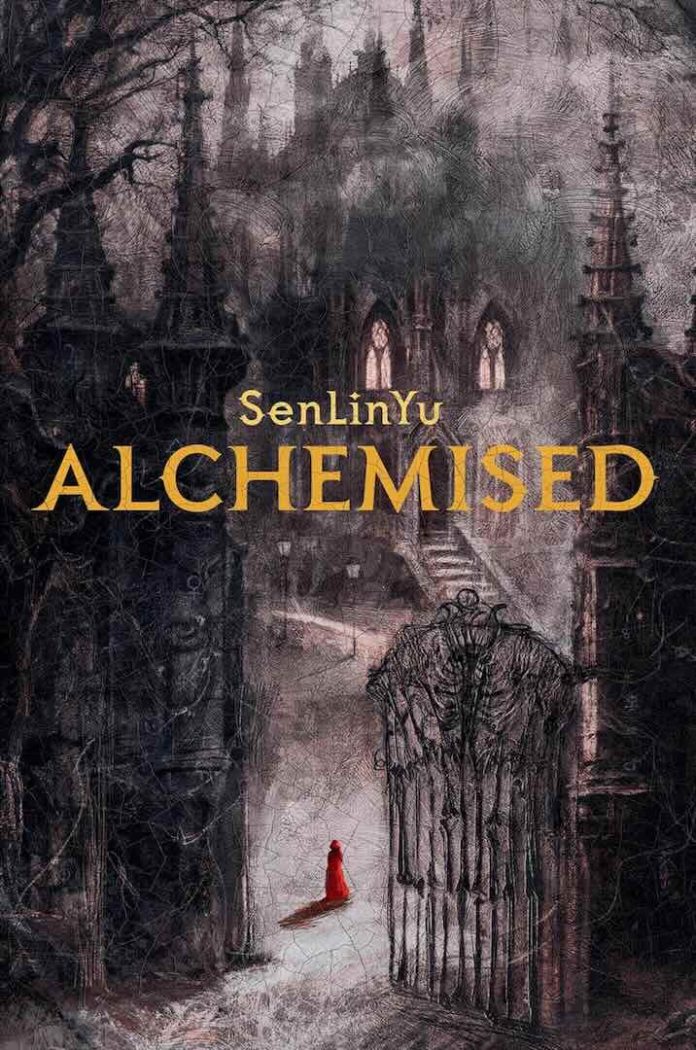
SenLinYu’s debut novel, Alchemised, opens in blackout and wakes into pain—electric, procedural, logged like data. From the first pages, the book announces its priorities: a rigorous magic system, an ethical spine, and a protagonist whose mind has been turned into a locked laboratory. It’s the kind of dark fantasy that treats craft as cartilage; you feel the structure in every scene. For a first novel, it arrives startlingly assured, benefiting from the author’s long apprenticeship online and carrying the poise of someone who knows exactly how their worlds are wired.
The Set-Up: A Healer with Missing Months
Helena Marino, once a prodigy of vivimancy and alchemy, now lives inside a problem: her enemies can’t decide whether she is insignificant—or the final cipher in a toppled revolution. The official record says she was a minor healer. Her brain says otherwise, not with words but with structures: elegant, illicit barriers threaded through memory, the kind of work that suggests design rather than accident. When Helena is delivered to the High Reeve—necromancy’s razor and the new regime’s tool—she becomes both evidence and experiment. The war is over; the war inside her is not.
The premise works because the magic is anatomy and policy at once. Resonance arrays, nullifiers, reliquaries, and lumithium aren’t window dressing; they are supply chains and laws, the physics of a necrocracy in which bodies power bureaucracy. The prose remains close, clinical, and sensuous, letting readers experience magic as touch, temperature, and torque rather than abstract sparkle. Early chapters render stasis, extraction, and revival with surgical clarity—tense, visceral, and deeply embodied.
Voice & Style: Surgical Intimacy, Controlled Heat
What distinguishes Alchemised by SenLinYu is its control. Sentences move like a scalpel: economical, precise, capable of sudden luminosity when sensation spikes. The book inhabits a close third that never lets you forget Helena’s training as a healer; observation is her defense, and language follows suit. Even world history is tactile—the grit of industrial steel, the preservative reek of necrothralls, the deadened nerves when lumithium nulls a channel. When the text turns toward intimacy, it does so with the same procedural literacy, attending to consent, restraint, and agency as if they were components in a carefully balanced array.
Worldbuilding That Bleeds
Paladia—once held in check by the theocratic Holdfasts, now ruled by guild oligarchs and their necromancers—is a triumph of consequential worldbuilding. Politics is never scenery: it’s procurement, logistics, and messaging. A newspaper’s execution column tells you more about the state than a dozen infodumps; a dilapidated estate speaks simultaneously to class, propaganda, and peril. The lore has a satisfying metallurgy: eight traditional metals (lead, tin, iron, copper, quicksilver, silver, lumithium, gold), each tethered to celestial and practical associations, folded into industrial history so persuasively that the modern city feels forged by resonance.
Two design choices make the setting feel lived-in:
- Magic as infrastructure. Nullifiers constrain labor; reliquaries terrorize civilians; vivimancy’s ethics split from necromancy’s utility, and the rift becomes policy.
- History in materials. The Ferrons’ steel reshaped skylines and classes, rewriting what “noble” metal means in an era where quality control is god.
Characters: A Survivor Who Refuses to Be a Case Study
Helena is not a chosen one so much as a chosen witness. She can’t narrate what she cannot remember; she can narrate the cost of that lack with exactitude. This makes her both unreliable and profoundly trustworthy—she will not lie about pain. Her intelligence is practical, pattern-driven, and fearless in its moral math.
Opposite her, the High Reeve is menace made method: a hunter, an interrogator, and an intellectual equal whose presence complicates the novel’s emotional vector without softening its ethical steel. Their dynamic is the book’s dark-romance engine, powered not by tropey glamor but by the dangerous magnetism of two brilliant people trying to out-infer each other under the worst conditions. Secondary figures—guild heirs, vivimancer physicians, bureaucrats muttering about lift fares while the country starves—arrive already entangled in the regime’s compromises.
Structure & Pacing: Bottle Pressure, Earned Turns
Alchemised by SenLinYu prefers containment: wards, lifts, labs, a crumbling estate where power is proximate and escape is theoretical. The novel reads like a series of finely tuned “bottle” sequences in which interrogation, experiment, and conversation become combat by other means. The rhythm is steady—observe, test, revise, reveal—and the reveals feel earned because the book has taught you its rules and expects you to apply them. When the narrative widens, it does so only after building pressure with almost forensic patience.
Craft & Ethics
The book’s credibility rests on two pillars:
- Technical literacy. Procedures read like procedures. From stasis protocols and electric muscle surges to the geometry of mental barriers, scenes feel researched and internally consistent. The point-of-view discipline under physiological stress (light stabbing, nerves seizing, breath drowning in fluid) is notably strong.
- Ethical seriousness. Memory alteration, consent under coercion, and the uses of medical knowledge in oppressive systems are handled with gravity. The author’s content notes make that commitment explicit; depiction is not endorsement, and reader discretion is honored.
What Works Especially Well
- A rule-bound magic system that doubles as law and logistics, giving the plot mechanical inevitability.
- Embodied stakes where pain, healing, and limitation are never metaphorical; tools puncture, metals numb, recovery costs.
- A dark-romance arc built on intellect and negotiated agency, not on hand-waved power asymmetries.
- Prose control that toggles between restraint and sensory overload at decisive moments.
- World history in miniature, told through industry columns, family lineages, and the architecture of a failing estate.
Where It Could Be Stronger
- Onboarding density. Early terminology and system logic can feel like a graduate seminar. A few more breadcrumbs would smooth the climb without dulling the edge.
- Wider political air. The laboratory and manor are unforgettable, but a couple more street-level sequences would widen the social panorama implied by the newsprint and hunger lines.
- Mid-book emotional anchor. The slow burn is admirable; one additional moment of unfettered vulnerability could sharpen the romance’s center of gravity.
Who Will Love This Book
- Readers who want dark, intellectually rigorous fantasy with consequences baked into every spell component.
- Dark-romance fans who prefer consent-attentive, slow-negotiated chemistry to shortcuts that glamorize coercion.
- Mystery lovers who enjoy epistemic puzzles—the kind where the answer is buried inside the protagonist rather than the archives.
The Author’s Trajectory
This is SenLinYu’s first novel, but not their first rodeo; their online fiction has reached a vast audience across languages, and the confidence shows. The “About the Author” note frames a writer who learned to draft under real-life constraints and to command attention with economy—skills that translate cleanly to print.
Readalikes & Shelf Neighbors
If Alchemised by SenLinYu worked for you, try these next:
- The Poppy War by R.F. Kuang — militarized magic with ethical rot and academic rigor.
- Foundryside by Robert Jackson Bennett — logic-driven magic as code and capitalism.
- Nona the Ninth by Tamsyn Muir — necromancy, memory, and the strange tenderness of survival.
- A Dowry of Blood by S.T. Gibson — intimate voice, power analysis, and dark desire.
- The Library at Mount Char by Scott Hawkins — brutal, inventive cosmology with a ferocious heart.
Final Take (No Stars, Just Signal)
Alchemised by SenLinYu is a dark fantasy that understands bodies, systems, and the dangerous chemistry between people who might save or destroy each other depending on how the array is tuned. It is intellectually demanding, ethically serious, and emotionally precise. If the dense early pages ask for patience, the reward is a narrative of surgical clarity and hard-won tenderness. For readers who want fantasy that cuts—and a romance that respects intellect and agency—this belongs high on your list.
Content considerations include wartime violence, medicalized restraint, human experimentation, sexual violence, and other intense subjects; consult the book’s content notes before reading.







