Of Mice and Men (1937) is short enough to read in a sitting and tight enough to be mistaken for simple. It is neither. Steinbeck wrote it as what he called a play-novelette, a book constructed so that a company could stage it directly from the published text without an adaptation, and within months Broadway did exactly that. Everything readers find moving about it is a consequence of that constraint. Spoilers follow, including the last page.
The Form of Of Mice and Men Explains Almost Everything
Of Mice and Men runs to six chapters, with no breaks inside them, each a single continuous scene in a single location. The riverbank, the bunkhouse, the bunkhouse again, Crooks’s room, the barn, the riverbank. Nobody has an interior monologue. There is no access to anyone’s thoughts at any point, which for a 1930s American novel is a severe restriction.
Everything you learn, you learn from what people say and do in front of other people. When Steinbeck wants you to know that George is exhausted by responsibility, he cannot tell you; he has to let George say it to Lennie, in front of the fire, in words that give away more than George intends.
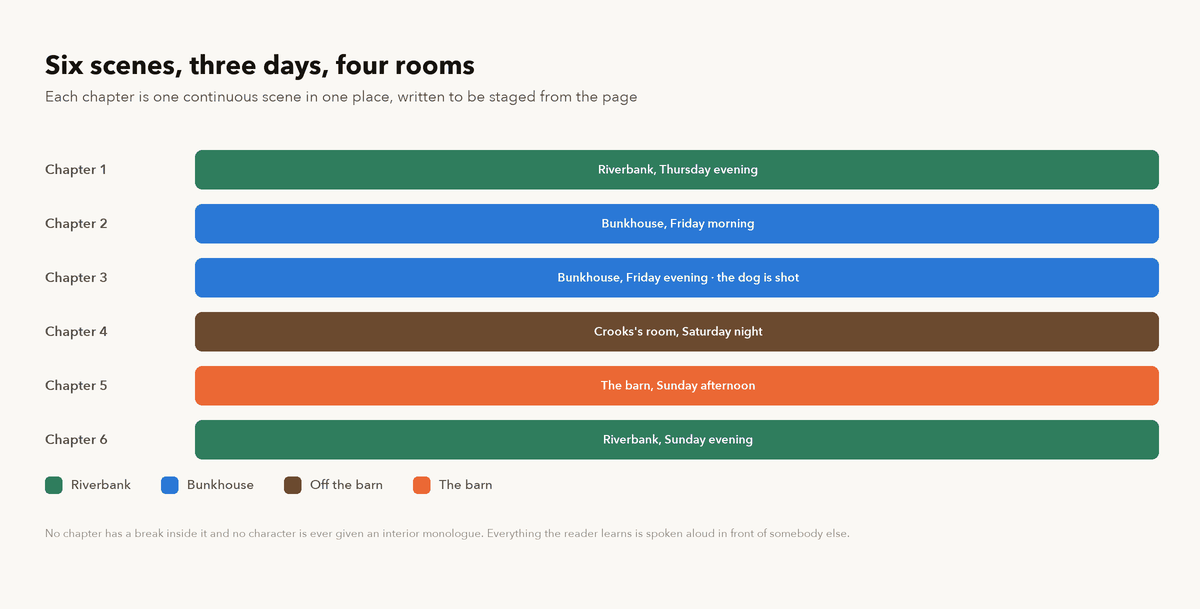
The same constraint produces the famous descriptive passages. Each chapter opens with what is effectively a stage direction written as prose: the pool and the sycamores, the bunkhouse with its apple boxes, the dark barn with the light failing. These are set descriptions, and they are there because a reader has to see the stage before the actors walk on.
How Of Mice and Men Closes Its Circle
Of Mice and Men begins and ends at the same place: a green pool a few miles south of Soledad, with the same sycamores and the same path beaten hard by boys and tramps. Steinbeck gives you the location twice and changes almost nothing in the description.
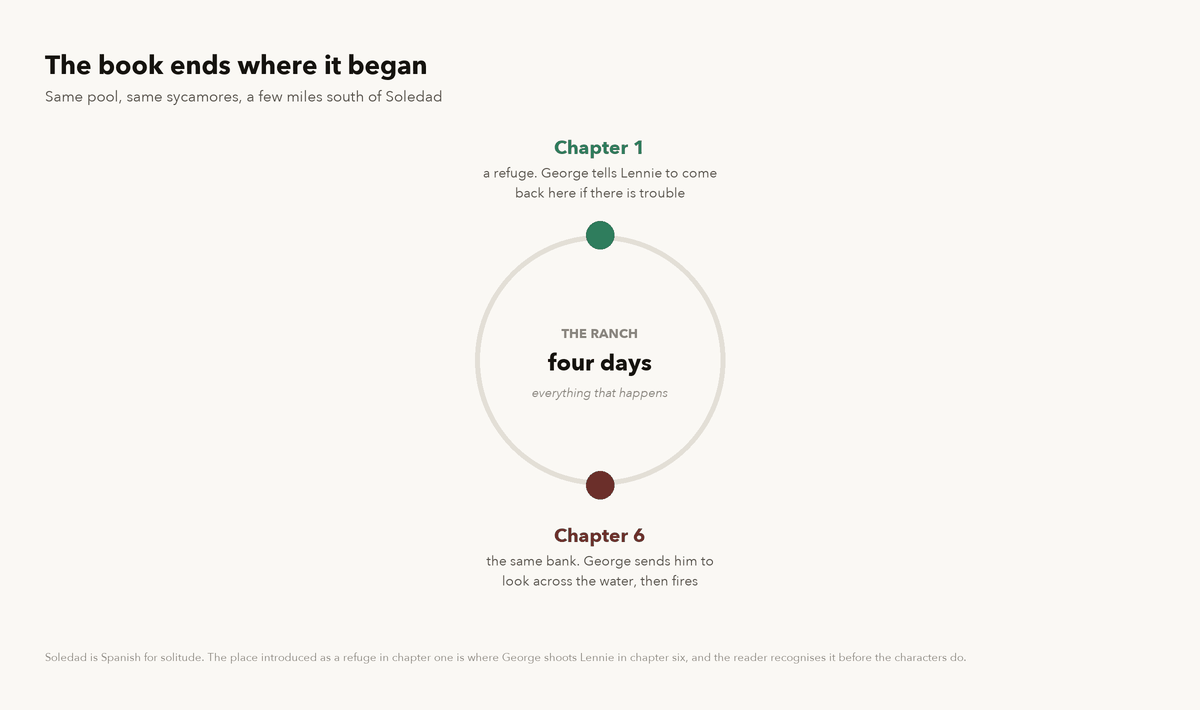
That return is the book’s single most important structural decision. Because the reader has been here before, the final scene carries a weight of familiarity that no new location could supply. George has told Lennie to come back to this spot if he gets into trouble, and Lennie remembers. The place that was introduced as a refuge becomes the place of execution, and the reader recognises it before the characters do.
The Spanish name is not accidental either. Soledad means solitude.
The Chain That Makes the Ending Inevitable
The ending of Of Mice and Men is often described as shocking. It is the opposite. Steinbeck spends the middle of the book installing a chain of precedents so that when George raises the Luger, every element of the act has already been demonstrated.
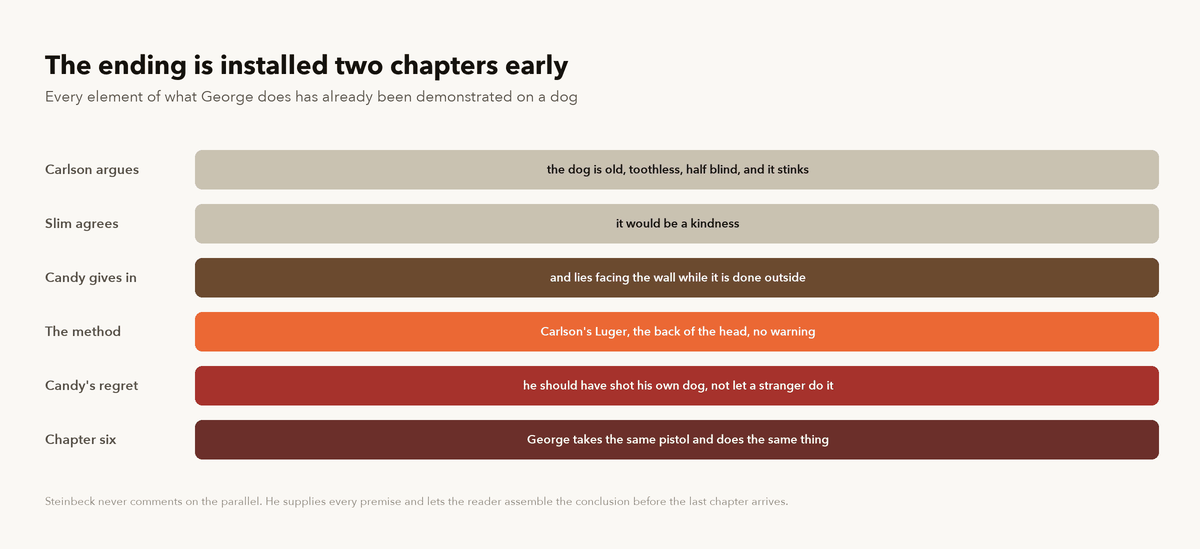
Carlson complains that Candy’s dog is old, toothless, half blind and stinks. He offers to shoot it. Slim agrees it is a kindness. Candy resists and then gives in, and lies on his bunk staring at the ceiling while it is done outside with Carlson’s Luger, aimed at the back of the head so the animal feels nothing. Afterwards Candy says the thing that detonates two chapters later: he should have shot the dog himself, and not let a stranger do it.
That sentence is the whole mechanism. When Lennie kills Curley’s wife and Curley sets out with a shotgun promising to make it slow, George’s options have already been laid out for him by an old man grieving a dog. He takes Carlson’s pistol. He fires at the back of the head. And he talks about the rabbits so that Lennie is looking across the river and feels nothing.
Steinbeck does not editorialise. He simply makes sure that by the time it happens you have been given every premise of the argument and have assembled the conclusion yourself.
The Dream and Its Function in Of Mice and Men
The farm with the rabbits and the alfalfa patch is usually read as a symbol of the American dream, which is accurate but slightly beside the point of how it works in the book.
Watch what it actually does. It is a story George tells on request, in a fixed form, with Lennie prompting the familiar parts like a child with a bedtime story. Lennie knows it by heart and insists George tell it anyway. It is liturgy, not a plan.
Then, in chapter three, something changes. Candy overhears, and asks how much the place costs, and he has three hundred and fifty dollars saved from the hand he lost in a machine. Suddenly the arithmetic works. The ritual becomes an actual proposal with a deposit and a timescale, and for about a page three men believe it.
The cruelty of the structure is that the dream only becomes real when it acquires money, and acquiring money is what makes its loss a genuine bereavement rather than a disappointment. Candy is the one who says afterwards that they could still do it, and George tells him they never would have.
Loneliness as the Stated Theme
Of Mice and Men does not make the reader dig for its subject. George says it directly: “Guys like us, that work on ranches, are the loneliest guys in the world.” They have no family, belong nowhere, and have nothing to look forward to. Then he gives the contrast: he and Lennie have each other, which is the one thing that makes them different.
Almost every subsequent conversation tests that claim. Candy has a dog and then does not. Crooks, segregated into a bunk in the little room off the barn, says that a man goes crazy without anybody and that he would not mind a companion. Curley’s wife tries to talk to anyone who will let her. The ranch is populated entirely by people who want company and have been taught that wanting it is a weakness.
The title’s source makes the same point from a different angle. It comes from Burns, where a mouse’s carefully built nest is destroyed by a plough through no fault of the mouse, and the best-laid schemes come to nothing. The poem is about the gap between planning and outcome, and about an animal that cannot see the plough coming.
Crooks, and the One Scene That Opens the Book Out
Chapter four is the only chapter that leaves the white men’s spaces, and it is the most uncomfortable passage in Of Mice and Men. Crooks, the stable buck, has a crooked back from a horse kick and sleeps alone in a shed by the barn because the bunkhouse is closed to him. He has books, including a battered copy of the California civil code, which tells you he has had reason to look up his rights.
When Lennie wanders in, Crooks first enjoys the rare power of having someone to turn away. Then he does something crueller: he invents a scenario in which George does not come back, purely to watch Lennie panic. It is the behaviour of a man who has been taught by years of exclusion to test whether kindness is real before accepting it.
For a few minutes the scene offers something better. Candy arrives, the farm is discussed, and Crooks asks, almost against his own judgement, whether there would be work for him there. Then Curley’s wife appears, and when Crooks tells her to leave she reminds him exactly how easily she could have him lynched. He goes silent, withdraws the request, and the chapter closes with him rubbing liniment into his back.
Steinbeck grants Crooks a name, an interior, a history and a reason for his bitterness, and then shows him being put back in his place by the one character with even less standing than he has. The scene demonstrates the book’s argument more efficiently than any speech: everyone here is isolated, and the isolated reliably turn on each other rather than combining.
Historical and Social Context
Of Mice and Men is set during the Depression on a ranch in the Salinas Valley, and the economic detail is exact. George and Lennie carry work cards from an employment agency in Murray and Ready’s. They sleep in a bunkhouse with an apple box nailed above each bed for personal possessions. A migrant worker’s entire life fits in that box.
Steinbeck had done the work. He had been a ranch hand and a labourer in this valley before he wrote about it, which is why the mechanics of the bindle stiff’s life are rendered without romance. The men are paid, blow their pay in town, and move on, and the pattern repeats until they are too old to be hired, which is what has already happened to Candy.
Of Mice and Men was published in 1937, two years before The Grapes of Wrath, and it is the smaller and more controlled of the two treatments of the same world.
Style: What the Restriction Costs and Buys
The prose of Of Mice and Men is deliberately plain, and the dialect is heavy. Steinbeck writes the dropped consonants and the contractions out phonetically, which some readers find laborious and which does real work: it marks the class and the region precisely, and it makes the small number of standard-English sentences in the book stand out sharply.
The restriction has costs. Nobody in the novella has a complicated inner life, because the form cannot show one. Curley’s wife is the clearest casualty. She is never given a name, referred to throughout as a possession of her husband’s, and although her final conversation with Lennie gives her a history and an ambition, it arrives in chapter five and she is dead before the chapter ends.
Whether that is a flaw or the point is the most productive argument the book offers. A reader can defend it as the novella enacting her erasure rather than committing it. A reader can also observe that Steinbeck gives Crooks a name, a back story and a room of his own, and declined to do the same for the only woman on the ranch.
Why the Ending of Of Mice and Men Earns Itself
George’s last exchange with Lennie is the dream story told one more time, with George prompting the parts Lennie usually asks for. He tells Lennie to look across the river and almost see the place. He says he is not angry, that he has never been angry, and that he wants Lennie to know it.
Then he fires, throws the gun away, and sits by the pool. Slim understands immediately and leads him off for a drink; Carlson, the man who shot the dog, cannot work out what the fuss is about.
The novella’s place on challenged-book lists is a subject of its own, and our review of Lula Dean’s Little Library of Banned Books covers what that machinery looks like now. For anyone put off by the reputation rather than the book, start with reading classics without feeling intimidated.
That last beat is the sharpest thing in the book. The novella ends not with grief but with a man who sees no difference between the two killings, standing in the same clearing, asking what is eating them. Of Mice and Men has spent five chapters building a reader capable of answering him, and then declines to do it on the page.
Edition cited: Penguin Books. Copyright John Steinbeck, 1937, renewed 1965. The title is from Robert Burns, “To a Mouse”, 1785.







