Steinbeck opened East of Eden with a letter to his editor, Pascal Covici, describing the book as a box with nearly everything he had inside it. He was not being modest. The 1952 novel runs to fifty-five chapters across five parts, braids an invented family against his own, and stakes the entire construction on a single verb in Genesis. It is far more deliberately engineered than its sprawling reputation suggests. This analysis discusses the whole novel, including the ending.
How East of Eden Opens: Geography as Argument
The novel begins not with a person but with a valley, and with two mountain ranges doing opposite work. The Gabilans to the east are light and sunlit, inviting enough that the narrator wants to climb into their foothills the way a child climbs into a mother’s lap. The Santa Lucias to the west stand dark and brooding, keeping the valley from the open sea. He admits to a dread of west and a love of east without being able to say where the feeling came from.
That is the book’s moral scheme laid out in its first pages, before a single character arrives. East is light and the possibility of return; west is the dark the day disappears into. The title places the Trask family east of Eden, which is where Genesis sends Cain after the murder, and the Salinas Valley is positioned to match. Steinbeck then spends six hundred pages testing whether anyone can walk back the other way.
The Cain and Abel Engine Driving East of Eden
The structural spine is Genesis 4, run twice, with the initials preserved so nobody can miss it.
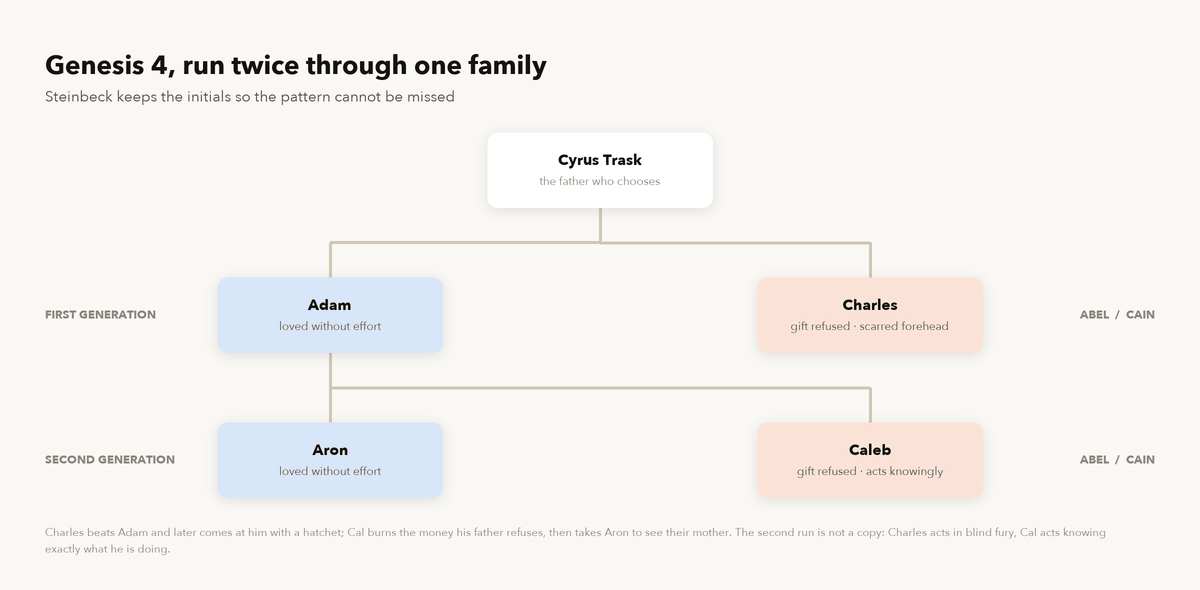
In the first generation, Cyrus Trask has two sons. Adam is loved without effort. Charles works for affection he never receives, and the rejection of his birthday gift, a knife bought with money he earned, is the hinge. He beats Adam nearly to death, and later comes at him with a hatchet in the dark. He carries a scar on his forehead afterwards, which is about as close to Cain’s mark as a novel can get without naming it.
In the second generation the pattern repeats with Aron and Caleb. Cal’s gift is fifteen thousand dollars made speculating on beans during the war, offered to a father whose refrigerated lettuce venture has collapsed. Adam refuses it, tells him to give it back, and compares it unfavourably to Aron’s achievement in getting to Stanford early. Cal burns the money note by note. Then he does something worse: he takes his brother to the house in Salinas and shows him the mother they had been told was dead.
What makes this an engine rather than a gimmick is that the second run is not identical. Charles acts in blind fury and barely remembers it afterwards. Cal acts knowing exactly what he is doing, loathing himself before, during and after. The pattern tightens as it repeats, which is why the book earns its ending rather than simply arriving at one.
Timshel: The Keystone of East of Eden
The novel’s central scene is three men talking in a kitchen. Samuel Hamilton, Adam Trask and Lee have been arguing for years about the sixteen verses of Genesis 4, and specifically about what God says to Cain concerning sin.
Lee has gone to extraordinary lengths. Four elderly Chinese gentlemen of his acquaintance, the youngest over ninety, engaged a learned rabbi and took up Hebrew from exercise books and grammars, writing it with a brush in Chinese ink. After two years they reached the verse. What they found is that the standard translations disagree, and the disagreement is not cosmetic.
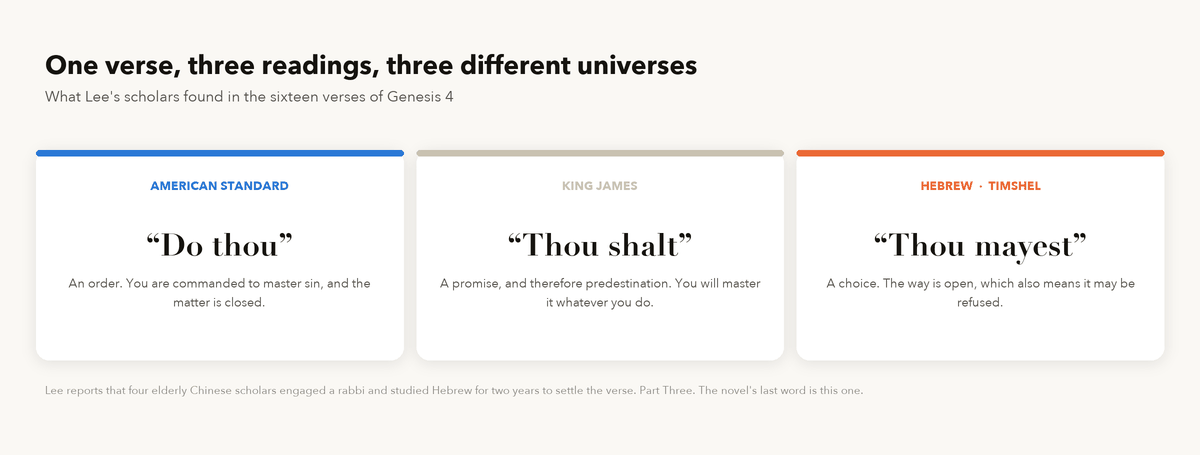
Lee lays it out precisely. The American Standard version orders men to triumph over sin. The King James makes a promise in “Thou shalt”, which amounts to predestination. But the Hebrew word timshel means “Thou mayest rule over sin.” He calls it possibly the most important word in the world, because it offers a choice rather than an order or a guarantee. “That throws it right back on a man.” And because thou mayest is true, thou mayest not is equally true.
This is the keystone. Remove it and East of Eden collapses into a grim determinist fable about bad blood running down a family line. With it, every repetition of the Cain pattern becomes a decision rather than an inheritance, and the book becomes an argument rather than a demonstration.
It also explains the structural choice to run the pattern twice. One generation proves nothing. Two generations, where the second knows the story of the first, is a controlled experiment in whether knowing changes anything.
Cathy Ames and the Limits of the Scheme
The most contested figure in East of Eden is the one who appears to sit outside its own argument. Chapter 8 opens with the narrator declaring his belief that monsters are born to human parents, and that just as a twisted gene produces physical deformity it might also produce a malformed soul. Cathy Ames, he says, was born without kindness or the potential of conscience.
If that is true, Cathy cannot choose, and timshel does not apply to her. A book arguing that every human being holds the great choice has placed at its centre a character explicitly exempted from it.
The usual defence is that the narrator is wrong, and the text supports this more than it is given credit for. Cathy is afraid of the dark. She is cornered by Ethel’s blackmail and visibly rattled by it. She keeps a vial of morphine as an exit, which is the behaviour of someone who can imagine being trapped. At the end she takes it, having first left everything she owns to Aron, which is not the act of a creature without inner life.
Whether that gap is a deliberate demonstration of an unreliable narrator or an author losing an argument with his own material is the real critical question, and both readings are defensible from the text. What is not defensible is treating chapter 8 as the book’s settled verdict, because nothing else in it behaves as though it were.
The Two Families, and What the Hamiltons Are For
Readers coming to East of Eden for the Trask story often ask why the Hamiltons are here at all. They are Steinbeck’s actual maternal family, the narrator is a Hamilton grandson who occasionally says “I”, and they take no part in the Genesis plot. Structurally they can look like an indulgence.
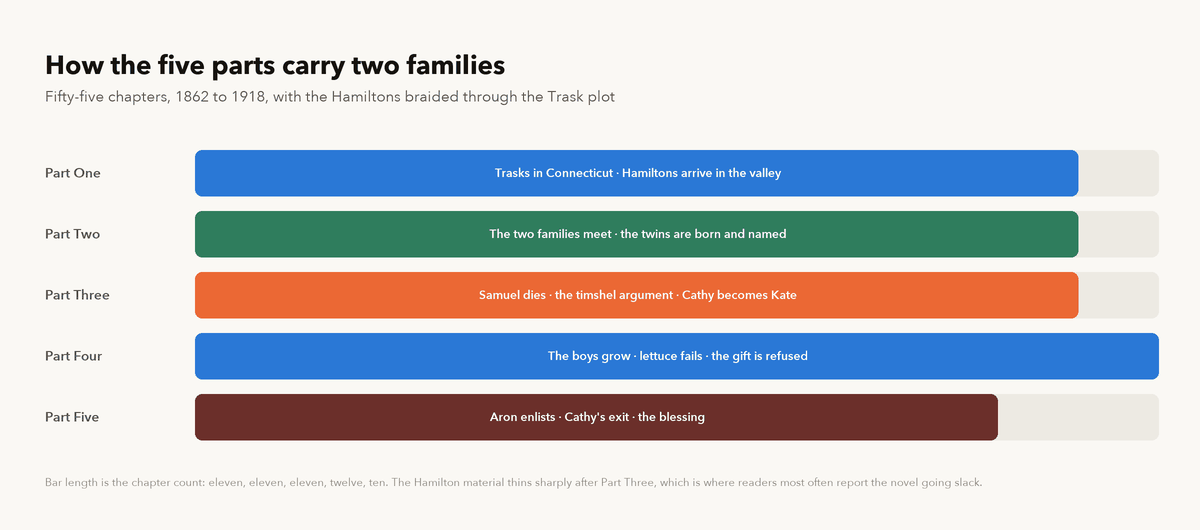
They are doing two jobs. The first is calibration. Samuel Hamilton is poor his whole life, drills wells and finds water for everybody except himself, and dies without money on land that never rewarded him. Set against Adam Trask, who inherits a fortune and is ruined by what he fails to notice, the Hamiltons establish that this novel’s scale of value is not material. The second job is to supply a voice that is neither Trask nor narrator. Samuel is the only person who can tell Adam the truth about his own life, and he does it by forcing him to name the twins, which Adam has not managed to do for more than a year.
Lee performs the same function from a different angle. He arrives speaking pidgin because that is what white Californians expect of a Chinese servant, and drops it the moment Samuel treats him as a person. The pidgin is a costume, and Steinbeck makes the point explicitly rather than leaving it for the reader to infer. Lee then does most of the book’s thinking, which in a novel published in 1952 is a decision worth noticing.
Historical and Social Context
The novel covers roughly 1862 to 1918, and it is specific about the period. The Trask fortune begins in Civil War pension fraud. The Salinas Valley fills with settlers taking up land that will not quite support them. Refrigerated rail transport arrives and ruins Adam. The First World War closes the book, and it closes it in the way the war actually reached small American towns: through a telegram.
Steinbeck wrote it in 1951, at fifty, after two decades in which he had been accused of propaganda for The Grapes of Wrath, investigated by the FBI, and dismissed by critics who thought his best work was behind him. East of Eden was his attempt at the large book, and he said as much while writing it. The timing matters to the reading: a novel insisting that inherited guilt is not binding, written by a man whose reputation had been fixed by his own past work.
The Chinese-American material is a product of its moment too. Lee discusses the laws that shaped his parents’ lives and his own position, and the novel treats his learning as genuine rather than decorative. It is not free of the period’s assumptions, but it sits further ahead of them than most American fiction of the early 1950s.
Style: The Intrusive Narrator
The prose of East of Eden alternates between close third-person storytelling and passages where the narrator steps forward to generalise about human nature, memory, the valley or the century. It is the same instinct behind the intercalary chapters of The Grapes of Wrath, though less formally separated here.
The risk is obvious. The narrator tells you what to think, and chapter 8 is both the clearest case and the clearest failure. But the method also produces the finest writing in the book, including the opening geography and the long reflection on what is left of a man once he dies.
The dialogue carries most of the argument. Steinbeck trusts conversation to do heavy philosophical work, which was unusual in American fiction of the period, and it is why the kitchen scene holds rather than stalling.
Why the Ending of East of Eden Works
Aron, told the truth about his mother, enlists and is killed in France. Adam has a stroke on reading the telegram. Lee then makes the hardest speech in the book, telling a dying man that his surviving son is marked with guilt almost more than he can bear, and asking him to give the boy his blessing rather than leave him alone with it.
Adam’s right hand lifts an inch and falls back. Then he gathers his breath and says one word: Timshel.
It is not absolution, and it is not a promise that Cal will be a good man. It is permission to choose, which is the only thing the novel has argued anyone can be given. The five-part structure, the doubled Genesis pattern, the two years of Hebrew and the whole weight of the Hamilton chapters exist so that one word means something when it finally arrives.
What a Close Reading Should Take Away
Treating East of Eden as a loose family saga misses how tightly it is wired. The valley is the moral scheme. The repeated initials are a signpost. The translation argument is load-bearing. The Hamiltons are the control group. Even the book’s largest apparent flaw is more interesting read as the place where the author’s thesis and his own storytelling instinct pull against each other.
If the length is what has kept you away, our guide to reading classics without feeling intimidated is the right place to start, and the case for going back to a book you have already read applies to this one more than most.
Steinbeck thought this was his best work. Critical consensus has usually preferred The Grapes of Wrath. On the evidence of its construction, his own view is more defensible than it is generally allowed to be.
Edition cited: Penguin Books, 1979 printing. First published by The Viking Press, 1952. Quotations are from Lee’s account of the Hebrew in Part Three.