Somewhere in the first week of January, a great many people type a number into a box. Twenty-four. Fifty. One hundred. It looks reasonable on New Year’s Day, when the year is still theoretical and every weekend is hypothetically free. By October the same number has turned into a quiet accusation delivered by an app. Most reading challenge ideas for adults begin with that box, and the box is where they go wrong.
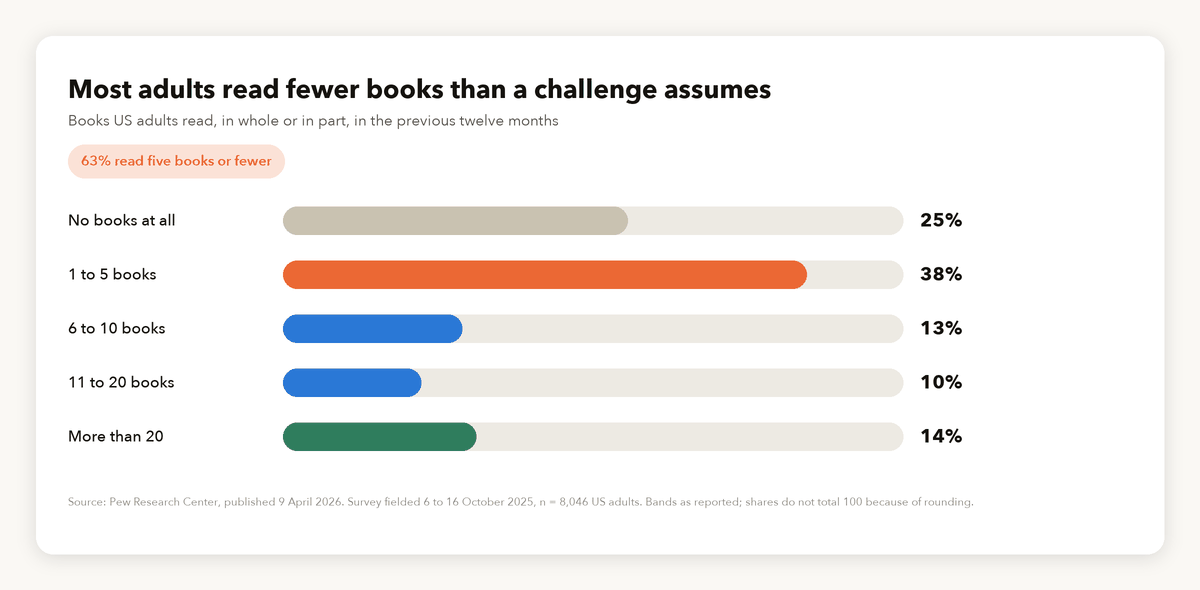
Start instead with the arithmetic. The Pew Research Center surveyed 8,046 American adults between 6 and 16 October 2025 and published the findings on 9 April 2026. A quarter had not finished a single book in the previous twelve months. The biggest group of all, 38%, got through somewhere between one and five. Just 14% read more than twenty. Combine the two lowest bands and 63% of American adults read five books or fewer in a year.
Some context on where this is written from. We publish book reviews on two sites daily, 4,392 on this one and 2,854 on our sister site, and every review is written after reading the whole book. That means the prompts further down are not invented to fill a listicle. Each one points at a category our own archive is deep in, so you can follow a prompt straight to something we have actually read.
Why Most Reading Challenge Ideas for Adults Fail by March
A count is a single point of failure. Miss three weeks in February to a house move or a bad flu and the tracker will tell you, every time you open it, that you are eleven books behind. There is no way to partially succeed at a number. You either hit it or you carry a deficit around for ten months.
The evidence for this is easier to find than you might expect, because some of the larger Goodreads groups publish their own running totals. On 3 October 2026 I read the stat posts for two of them. Clear the Shelves 2026, updated on 27 September, had 105 participants who between them pledged 3,202 books and had read 1,137. Eight people had finished. Let’s Turn Pages 2026, which counts pages rather than books, had 89 participants, 2,675,720 pages pledged and 1,285,448 read, also with eight finishers.
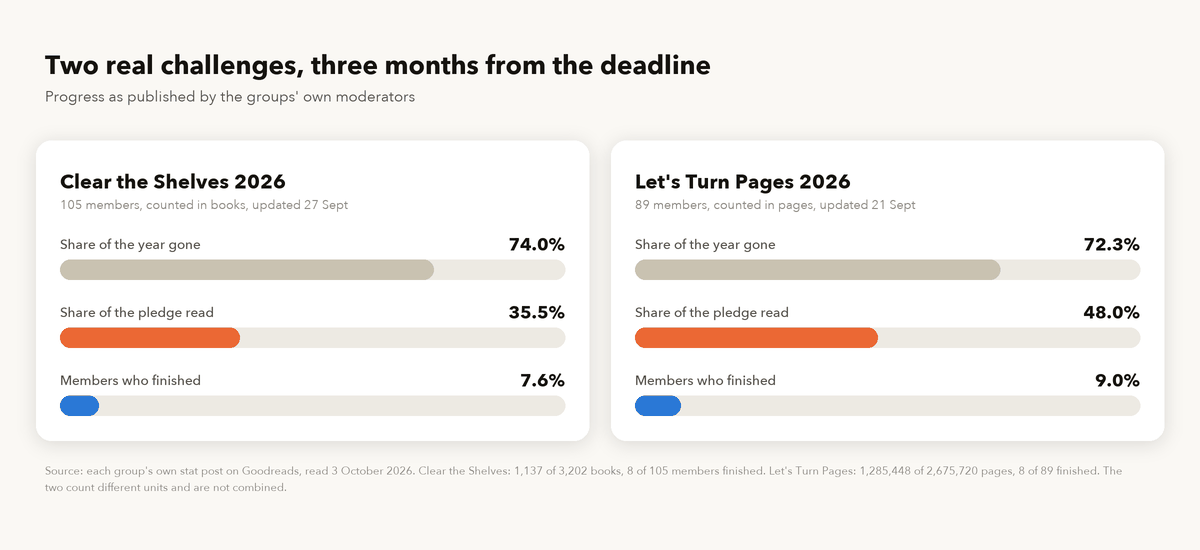
Three quarters of the year was gone. A third to a half of the reading was done. Fewer than one member in ten had finished. These are not casual sign-ups either; they are people who joined a dedicated challenge group and post monthly updates to a moderator.
One correction while we are dealing in numbers. You will see a claim that 41% of Americans did not finish a book last year. It circulates widely and traces back to nothing. Pew asked the question directly, with a published sample and field dates, and got 25%. The smaller figure is the one with a methodology attached, so it is the one used here.
The fix is not more discipline. It is removing the deadline arithmetic altogether. A prompt cannot put you behind schedule. It is either satisfied or it is still waiting, and waiting costs nothing.
How to Size Your Year Before You Choose a Single Book
If you want a number anyway, derive it rather than picking it. Count what you actually finished last year, including the ones you are faintly embarrassed by. Divide by twelve. Subtract a fifth for the months when work or family will take the evenings. Multiply back up. That figure is usually between half and two thirds of what people pledge.
Almost all reading challenge ideas for adults skip this step, which is why so many cards are built on a number nobody derived. Then find yourself in Pew’s bands. If you read seven books last year you are in the 13% who read six to ten, which is already well above the median adult. Pledging thirty will not move you into a different band; it will just guarantee a failure you can watch accumulate weekly.
The better book challenge ideas for adults start from last year’s real total and put the ambition into variety instead of volume. Twelve books you would never otherwise have picked up is a more interesting year than thirty you were going to read anyway.
24 Reading Challenge Ideas for Adults, Sorted by How Long They Take
Four groups of six, arranged by effort rather than theme, so you can see at a glance what is achievable in a given week.
- Six you could finish this month. A book under 150 pages. A novella. A single-sitting non-fiction. A re-read of something you loved at twenty. An audiobook under five hours. A book already on your own shelf, which is the prompt most likely to be ignored and most likely to work. Our account of a year without buying books covers what that last one is like in practice.
- Six that widen the shelf. Translated fiction. A debut. A book published before you were born. A genre you tell people you dislike. A short story collection. Poetry, which almost nobody puts on a card and which is the only prompt here you can satisfy in twenty minutes. Our diverse reading challenge and genre-hopping challenge both expand on this group.
- Six that use the calendar. Something seasonal. A prize longlist title. A book set where you are going on holiday. A book published this month. A banned or challenged book. A book you abandoned once before and have thought about since. The calendar group is the one that keeps a card alive in the dead months, because the prompt changes even when your mood does not.
- Six that involve other people. A friend’s favourite, which you must then discuss. A book club pick. A buddy read with one other person. A bookseller’s recommendation, asked for in person. A book off a library display. A book you will pass on to someone specific when you finish. Blind date with a book is the version of the fourth one that bookshops have already built for you.
If you want a square that is genuinely difficult, add an unplugged one: a book read in a session with the phone in another room. We wrote about what that does to attention and the honest answer is that it is harder than any of the other twenty-three.
Build the Last Three Months Into Something You Can Finish
It is October. A twelve-square card is realistic between now and New Year; a thirty-book sprint is not. The most useful 2026 reading challenge ideas for adults at this point in the year are the ones that reset the scoreboard rather than demanding you make up the shortfall.
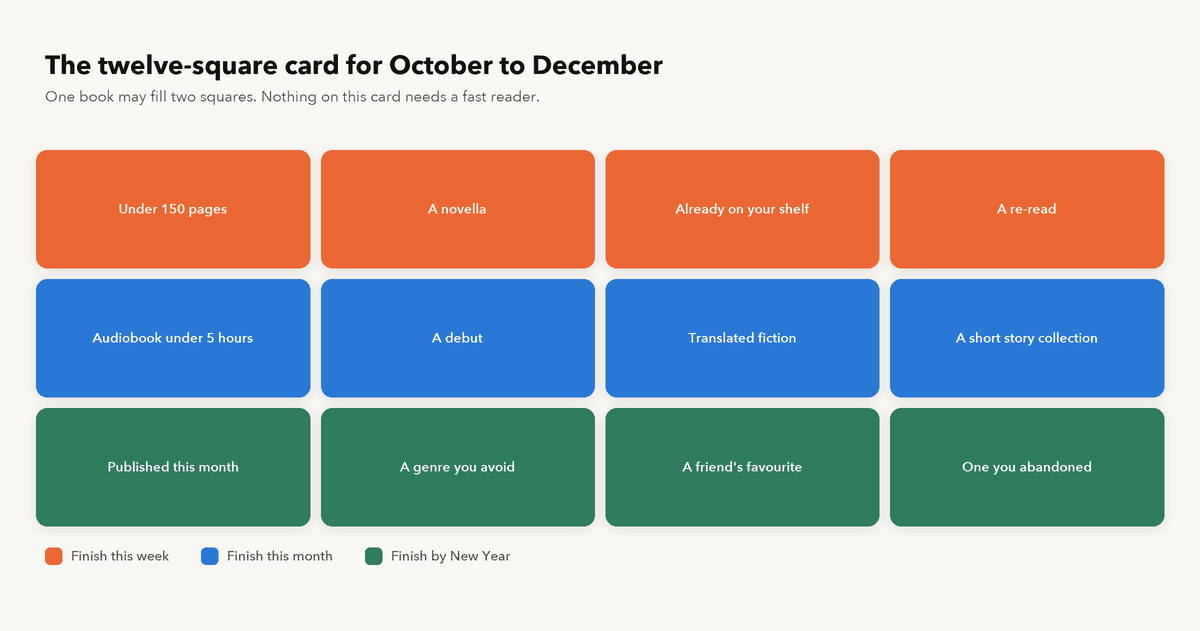
Four of those squares are short enough to clear in a few evenings, which is what separates workable 2026 reading challenge ideas for adults from a wish list. One book may fill two squares, which is the single rule that makes a card move. A re-read of a 140-page novella you already own fills three at once and takes an afternoon.
If the real problem is that you have not wanted to read since August, a card will not fix it. Start with why the slump happens and our practical guide to getting out of one, then come back to the squares. Our older roundup of ten reading challenges still has usable formats in it, though the framing dates from 2024.
Summer Reading Challenge Ideas for Adults, Borrowed From a Library
Public libraries worked this out years ago and give the answer away free. The Seattle Public Library runs Book Bingo with Seattle Arts & Lectures and the King County Library System. The 2026 edition opened on 22 May and closed to entries at 6pm on Tuesday 8 September, with 24 categories on the board.
The squares are better written than most of what you will find online. “Unplug.” “Soothing.” “A hard-to-love protagonist.” “Myth and legend.” “Under 150 pages.” “Outer space.” “Change is scary.” They are moods and shapes rather than genres, which is why they send people somewhere unexpected instead of back to the same shelf.
Three design decisions make it work. Squares rather than a count, so there is no schedule to fall behind. One book may fill more than one square. And a single completed line already wins something, with the full 24 reserved for the grand prizes. The strongest summer reading challenge ideas for adults are simply this structure, copied. Check your own library’s programme in May, because most of them publish a board and almost nobody outside the catchment ever looks at it. A board built by librarians beats most summer reading challenge ideas for adults written for an audience that will never use them.
Where to Keep the Card: Goodreads, StoryGraph or Paper
| Tool | What it can track | Abandoned books |
|---|---|---|
| Goodreads | A yearly book count, and nothing else | A Did Not Finish shelf arrived in March 2026. A DNF counts toward your goal only if you give it a read date |
| StoryGraph | Books, pages or hours, plus prompt challenges that any user can build | Handled natively, and has been for years |
| A notebook | Whatever you draw on it | Whatever you decide |
That Goodreads detail is worth knowing before you rely on it. The shelf exists now, which is a real improvement, but the read-date condition means an abandoned book is invisible to your challenge unless you remember to backdate it.
If your book challenge ideas for adults are built on prompts rather than a count, StoryGraph is the only one of the three designed for it, with around four million users and prompt-based challenges since early 2024. We have no commercial relationship with any tracker mentioned here, and our guide to reading apps covers the rest of the field. Paper has one advantage neither app can match: it does not compare you to anybody.
Three Rules That Decide Whether a Challenge Survives
- An abandoned book still counts. You read it, you formed a view, you stopped. That is a reading experience with an outcome. The alternative is the stuck-book problem, where one title you will not quit blocks the entire year. We have argued the case for putting a book down at more length.
- One book may fill two squares, never three. Two keeps a card moving. Three turns it into an optimisation puzzle and you stop reading for pleasure.
- The card is editable until the end of January, then frozen. Without a freeze date you will quietly rewrite the squares to match whatever you happened to read, which is not a challenge.
Reading Challenge Ideas for Adults Who Have Fallen Behind
If the count is already out of reach, convert the remainder into prompts and stop tracking the number. Twelve books behind becomes six squares, and six squares is a thing you can look at without flinching.
Two further moves. Count the audiobook, because the 2026 trackers do and there is no reason you should hold yourself to a stricter standard than the software. And stop benchmarking against the 14% who clear twenty books a year; they are a sixth of adults, and most of them have either a commute or a job that involves reading. Among the 2026 reading challenge ideas for adults circulating this autumn, the only ones worth your time are the ones that shorten the list rather than speeding up the reading.
Frequently Asked Questions
- How many books should an adult aim for? Last year’s real total, plus two. Pew’s data puts 63% of adults at five books or fewer, so anything above six is already unusual. Variety is the better place to be ambitious.
- Do audiobooks count? Yes. Goodreads and StoryGraph both count them, and the comprehension research does not support treating them as a lesser format.
- Do books I gave up on count? On a prompt card, yes. On Goodreads, only if you add a read date to the DNF shelf entry.
- What works for a slow reader? Page or hour targets instead of book counts, and a card weighted toward short forms: novellas, poetry, short stories, graphic novels.
- Are prompts better than numbers? For finishing, yes. A count has a schedule you can fall behind; a prompt does not.
- When should I plan next year? Late December, and give yourself until the end of January to change it.
The point of all this is not the total. Five books that took you somewhere you would not otherwise have gone is a better year than twenty-five off the same three shelves, and no tracker is built to tell you that. Good reading challenge ideas for adults widen what you reach for and then get out of the way. Write twelve squares, not a number, and leave room to change your mind in January.
Last updated 3 October 2026. Reading figures from the Pew Research Center, published 9 April 2026, survey of 8,046 US adults fielded 6 to 16 October 2025. Goodreads group totals read directly from the groups’ own stat posts on 3 October 2026. Book Bingo details from the Seattle Public Library news release of 22 May 2026. We have no affiliate or commercial relationship with Goodreads, StoryGraph or any retailer named here.







