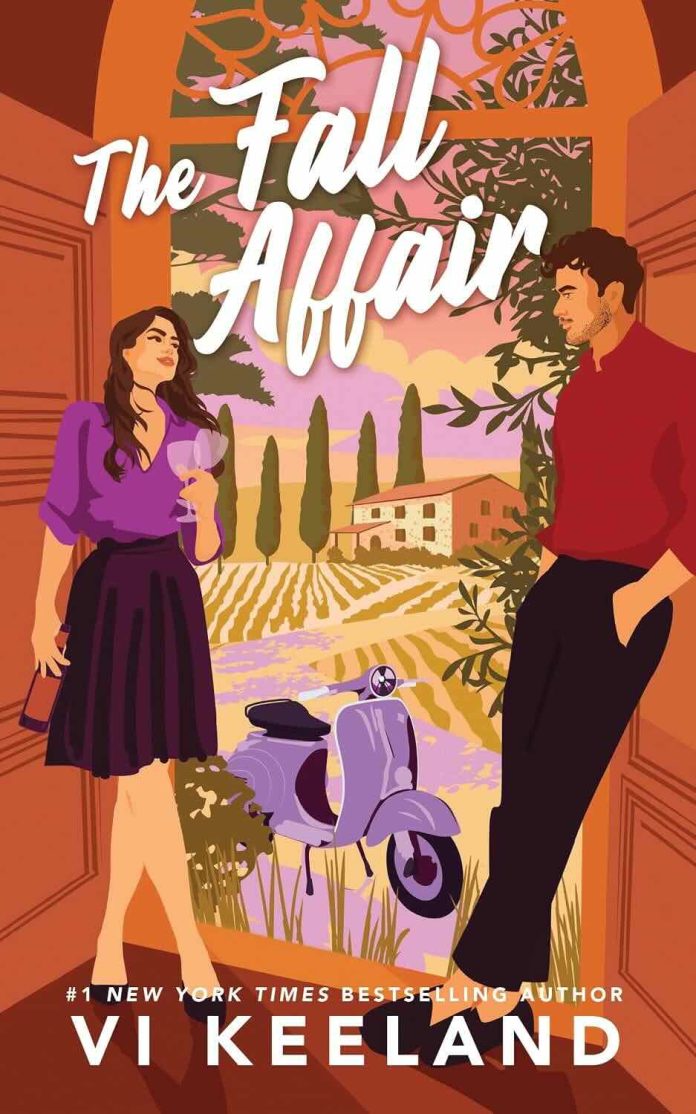
Somewhere in the first third of The Fall Affair by Vi Keeland, a man is standing in a ninety-year-old woman’s kitchen in Cortona, forced to read aloud a letter written by her late sister. The letter congratulates the recipient on outliving three husbands, two of whom were actually hers, notes that she is inheriting nothing, not even the unmatched Tupperware lids, and closes by explaining that her family burial plot has been donated to a more deserving stranger. The old woman sets the page on fire on her own front lawn and spits at the feet of the innocent granddaughter standing outside.
That is Sophia Bianchi, and she has been dead since January. She is also, comfortably, the best character in this novel.
The setup is efficient. Allegra Bianchi, thirty-one, bills more hours than anyone at her Manhattan firm, gets passed over for partner in favour of a colleague whose qualifications are not strictly legal, and resigns in the men’s room in a way she will be explaining for years. Days later a letter arrives from Italy. Her grandmother has left her an antique shop in Montepulciano, roughly a hundred acres of leased land, and one condition: live and work there for three months, or the whole thing evaporates.
A Dead Woman With a Filing System
What makes The Fall Affair by Vi Keeland better than its premise is the machinery Sophia left behind. Her lawyer holds a series of letters to be released at specific moments, and they arrive throughout the book like scheduled detonations. They contain instructions (post the racy letter to Massimo, deny all knowledge of the blue-eyed cat, do not eat too many of the cookies in the freezer), a running commentary on the granddaughter’s life choices, and advice delivered with the timing of a woman who has been workshopping this material for decades.
They also do real structural work. Each letter reframes what Allegra thinks she is doing in Italy, and the final one, read aloud in a setting the reader will not see coming, reveals that the three-month clause was never about slowing down at all.
Sophia’s problem is that she is so vivid she flattens everyone around her. Every warm scene in the book is either a letter, an anecdote, or a piece of property she chose. That is a real achievement and a structural weakness at the same time.
The Subplot in The Fall Affair by Vi Keeland Outruns the Romance
Roughly a third of the way in, an Italian heir-hunting firm trawling the will registry surfaces a name. Allegra has a half sister, four years younger, living near the Amalfi Coast, also a lawyer. Their father, the man Allegra idolised and became a lawyer to emulate, ran a second household for six years.
This is where The Fall Affair by Vi Keeland gets good. Allegra books an appointment at the sister’s firm under a false name, invents a business, and is quietly dismantled across a desk. Camilla is dry, self-aware, unsentimental about their father and generous about everything else, and the scenes between the two women have a specificity the love story sometimes lacks. Cross-border succession is genuinely complicated in the European Union, as the official guidance on EU succession law makes clear, and Keeland uses the machinery properly rather than waving at it.
What Works
- The hero has an interior life. Matteo Lucchese gets his own flashback chapters, running from fifteen to his marriage and its collapse. He is not a mood the heroine walks into. He is a man with a specific, well-drawn wound.
- He is also unusually decent about consent. He declines to sleep with her when she is drunk, and later declines the no-strings arrangement she offers because he wants something he can keep. Both refusals cost him, and both land.
- The village economy is delightful. Matteo will not accept money from the widows he helps, so they pay him in knitted caps and frozen casseroles. He has over a hundred hats. It tells you everything about him without a paragraph of exposition.
- Keeland does her homework. Harvest, destemming, pneumatic pressing, Italian probate, the no-solicitation clauses in American associate contracts. The texture is earned.
For all that generosity, The Fall Affair by Vi Keeland carries a few habits it never quite shakes.
What Wears Thin
- The third-act break is the oldest one there is. He pushes her away for her own good, using words he cannot take back, and the reconciliation is triggered less by either of them changing than by a piece of correspondence.
- The workplace plot is abandoned. A woman is denied partnership because another woman is sleeping with the founding partner. That is a sharp premise, and it is resolved offstage by having the rival get pregnant and fired.
- The dialect is inconsistent. Matteo’s accent is rendered phonetically on some pages and not others, which draws attention to itself every time it flickers.
- The tea-set mystery arrives with a thud. It is signposted early and pays off exactly where you expect.
The Ending Is Kinder to the Living Than the Dead
The emotional hinge of the last quarter involves a discovery about Matteo’s late first wife, and it is the one place where The Fall Affair by Vi Keeland makes a choice worth arguing with. A woman who died young and cannot answer is retroactively convicted on circumstantial evidence, and the novel accepts the verdict without much interrogation. His grief is honoured. Hers is not really considered. It resolves his arc cleanly and leaves a slightly sour aftertaste.
Who The Fall Affair by Vi Keeland Is For
Reach for it if you want a warm, funny, extremely readable Tuscan romance with an actual secondary plot. Reach for it if you like a hero who cooks, fixes things, and says what he means.
Be aware that it is explicit, and that the last third earns its rating several times over. Skip it if you want low heat, or if a heroine who self-sabotages for four hundred pages will exhaust you, because The Fall Affair by Vi Keeland makes her fear the engine of almost every delay.
Read These Next
- Indiscretion by Vi Keeland. The closest neighbour in her own backlist for slow-burn tension and a heroine talking herself out of the obvious.
- Jilted by Vi Keeland. Lighter, funnier, and useful as a measure of how much more plot she is carrying here.
- Someone Knows by Vi Keeland. For readers who came for the courtroom scenes and would happily lose the vineyard.
- Beach Read by Emily Henry, for the same mix of comedy, grief and a neighbour you cannot avoid.
- The Love Hypothesis by Ali Hazelwood, if the appeal was a competent woman being slowly disarmed by a man who is kind on purpose.
The Last Word on The Fall Affair by Vi Keeland
It is generous, funny, well researched and about a hundred pages more emotionally serious than the cover suggests. The romance is satisfying. The sisters are better. The grandmother is best of all.
Sophia Bianchi spends all of The Fall Affair by Vi Keeland insisting that an inheritance is not a building and not a bank account, and then proves it by leaving her granddaughter the only thing she actually wanted her to have: three months of nothing to do but notice her own life.







