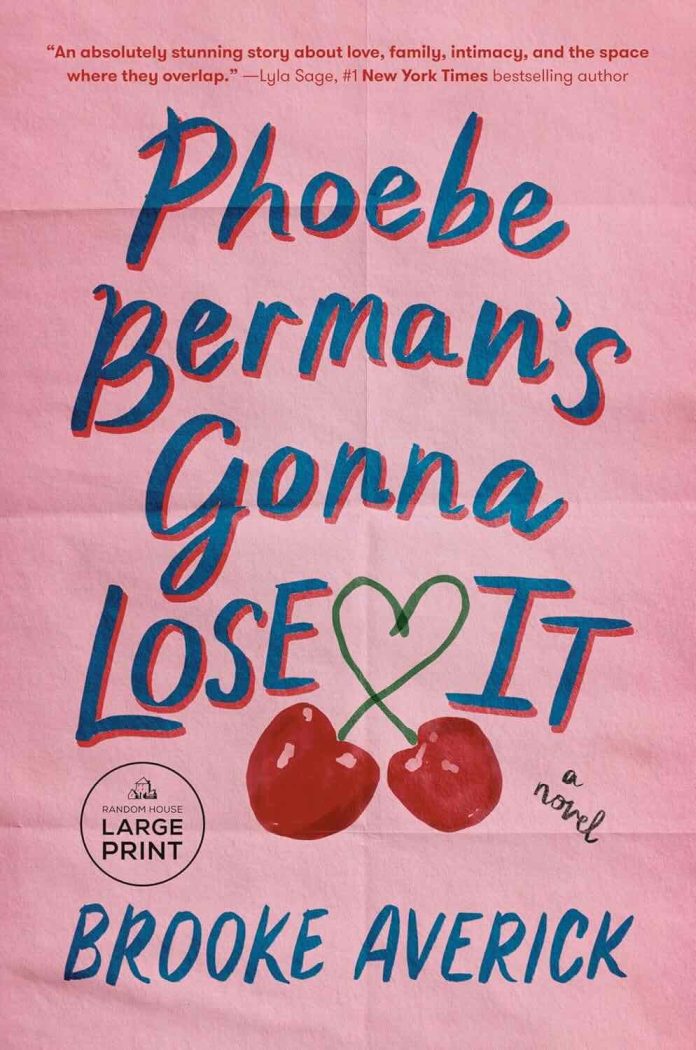
There is a specific kind of woman who keeps a paper barf bag in her tote, carries a label maker between rooms, and has read enough romance novels to know exactly how a first kiss is supposed to feel. Brooke Averick has finally written her a book, Phoebe Berman’s Gonna Lose It.
The Premise, Briefly
Phoebe Berman is twenty-nine, lives in Los Angeles, teaches pre-K at a small private school called Brentwood Friends, and has a problem. She is a romance novel devotee who has never managed to do any of the things romance novels are actually about. A panic attack in a seventh-grade auditorium left her with crippling intimacy anxiety that has trailed her into adulthood, and a letter she wrote to her future self at eighteen has just arrived on her doormat with a single instruction: Lose your virginity. That’s all I ask. She has thirty days until her milestone birthday. The blurb promises three potential love interests, a supportive friend group, and the kind of internal chaos you only really understand if you have lived it.
Why This Debut Stands Apart
What lifts Phoebe Berman’s Gonna Lose It by Brooke Averick above the standard “horny disaster heroine” comedy is that Averick has actually committed to the bit. In her opening note, she points out that the heroines of most contemporary romance breeze through the parts of dating that, for many readers, are terrifying. The pre-date stomach rebellion. The panic attack before the kiss. Averick fills those gaps and makes them the whole story. The result is something funnier and slightly sadder than the cover suggests.
Phoebe is a fully realized lead. She is competent and adored at her job, comfortable in her body until she is suddenly not, sentimental about office supplies, and a quiet wreck about her younger sister’s wedding. Her inner monologue runs at a sprint, and Averick has a real gift for that voice. The sentences swing between deadpan observation and full-body panic in a way that reads like an honest transcription of an anxious brain rather than a stylized version of one. The cold palms, the lump in the throat, the bargaining with ice cubes inside an insulated water bottle. It is observed with the precision of someone who has lived it.
What Works Best
A few specific elements deserve a shout:
- The classroom scenes. Anyone who has spent five minutes with small children will read these and grin. The chapter where two preschoolers pretend to be pregnant, and a third performs an “ultrasound” with a play stethoscope, is the funniest sequence in the book.
- The friend group. Jonathan, Meg, Alex, and Nora feel like real people with their own running jokes and bruises. The group chat sequences, autocorrected drunk typing intact, are a small joy.
- Cheryl. Phoebe’s older co-teacher, who teases her about her crush via blurry playground photos and uses the phrase “winky face winky face” in texts, is the kind of secondary character a debut novelist rarely lands on the first try.
- The pop culture grammar. Phoebe quotes Grease, frames her life through Nicholas Sparks novels, and treats the discontinuation of a Twilight-themed Moleskine as genuine grief. The references work because they are deployed by a character who would actually make them.
Where It Stumbles
A four-star average exists for a reason, and Phoebe Berman’s Gonna Lose It by Brooke Averick has weak patches worth flagging honestly.
The pacing in the middle sags. Phoebe spends a long stretch juggling her romantic options, and the structure asks you to take the love triangle plus one at face value when a careful reader can see where things are heading from fairly early on. One of the three contenders, in particular, sometimes reads less like a real possibility and more like a holding pattern while the actual story catches up. The result is a middle act that loses some narrative tension.
The voice that makes Phoebe so likable can also tire. She is a chronic over-explainer, and Averick occasionally trusts a joke twice when once would have done it. A few running gags, especially the ones around the label maker, are charming the first three times and slightly less charming the eighth. There is also a stretch where the lists Phoebe is famous for begin to feel like a structural crutch rather than a character trait.
And readers who arrive at romance for the slow burn of physical tension may find the balance here a touch off. This is a book about a woman who cannot get to the kiss, which means the kiss arrives late and the genre’s usual heat is dialed several clicks down. That is the point. It is also fair to say that if you were hoping for the spice level of a Tessa Bailey, this is a different animal.
The Voice and the Heart
Averick is a podcaster and longtime TikTok presence, and you can hear it on the page. The book is dialogue-heavy, observational, very online without being smug about it. It is also more emotionally generous than the setup implies. Beneath the comedy is a thoughtful argument that timelines for love, sex, and self-knowledge are personal, and that the cultural insistence on a thirty-by-thirty checklist is part of the problem rather than the solution. The therapy scenes with Phoebe’s longtime psychologist, Sandy, thread this carefully without turning into a lecture, which is harder to pull off than it looks.
The wedding sequence is the emotional peak of the book, and Averick handles the older-sister-younger-sister dynamic with a tenderness that earned the tears I shed in spite of myself.
How It Compares
Readers who loved the anxious-heroine warmth of Talia Hibbert’s Get a Life, Chloe Brown will find similar territory here with a sharper LA-comedy edge. The pre-K workplace humor and chosen-family ensemble sit comfortably next to Abby Jimenez’s Yours Truly or Carley Fortune’s quieter beats. Fans of Emily Henry’s Book Lovers who liked the meta romance-novel awareness will recognize the same instinct, though Averick’s prose is more conversational than polished. Mhairi McFarlane’s If I Never Met You is another reasonable comp for the late-bloomer tone, and if you enjoyed the friend group of Dolly Alderton’s Ghosts, the dynamic among Jonathan, Meg, Alex, and Nora should land. For the anxiety representation specifically, Bryony Gordon’s nonfiction Mad Girl makes a useful chaser.
This is Averick’s first novel, so there is no backlist to point you toward yet. Her podcast Brooke & Connor Make a Podcast is essentially the long audition for this writing voice, and listeners will find a lot to recognize.
Who Should Read It
Pick up Phoebe Berman’s Gonna Lose It by Brooke Averick if you have ever felt like you arrived at adulthood without the manual everyone else seems to have read. Pick it up if you found yourself nodding through the anxiety sections of Sorrow and Bliss and wished for the lighter cousin. Skip it if you need your romance brisk and steamy from chapter three, or if you have a low tolerance for a narrator who likes the sound of her own thoughts.
It is not a flawless debut. It is a confident one. And the heroine of Phoebe Berman’s Gonna Lose It by Brooke Averick is the kind of character you will want to text afterward. Bring a tissue for the wedding scene. Maybe a barf bag too, just in case.