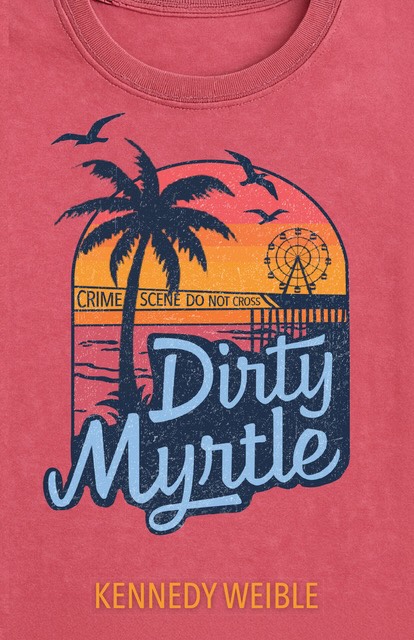
The first time you meet Sailor Cassidy, she is fishing a half-smoked joint out of the tab of an empty Coors Light can while a tiny imaginary miner hammers away at the inside of her skull. By the second page you already know two things: there will be sugary cocktails involved, and Kennedy Weible is the kind of writer who notices the cigarette butts in the puddle behind a bar and treats them like supporting characters. Dirty Myrtle by Kennedy Weible begins with a hangover and never quite shakes it off, which turns out to be the point. The Grand Strand is a place that wakes up every day a little wrecked, and the book inhabits that mood with a steadiness that feels lived-in rather than performed.
Set in the days leading into Thanksgiving, this is a novel about a town that vacationers think they know and locals understand differently. There are Confederate flag beach towels in the windows of every souvenir shop and McMansions built with what the contractor calls budget that should have included asbestos. Into this glittery, peeling backdrop drops a kidnapping, a cheating husband, a returning prodigal, and a young patrol officer trying to climb a slippery ladder without scuffing his boots.
The Engine of the Plot
Two storylines run on parallel rails until the inevitable collision. Sailor, nursing a fresh breakup and a borrowed digital camera, sets out to catch her older sister Carrie’s husband Morgan with the woman everyone in the family secretly knew he was sneaking around with. A few miles away, Officer Tuscaloosa “Tusk” Knight is doing his captain a favor by tailing a drifter named Judson “Jug” Shaw, a guy who skipped town three years ago and just turned up again wearing flip flops in late November.
Once those two threads tangle, the book becomes something larger than either a stakeout caper or a small-time cop drama. There is a banker with manicured fingers and unmanicured ethics, a former MMA fighter who runs cocaine out of a bar called Jumper’s, a tweaker named Bevel whose grudges have a long memory, and a knife that keeps showing up in inconvenient pockets. The pacing earns its tension honestly. Weible builds suspense not by withholding information but by letting you watch decent people make poor choices in real time, the way you sometimes notice friends doing it at a party and cannot quite think of a polite way to interrupt.
A Voice That Sounds Like It Grew Up There
The strongest argument for Dirty Myrtle by Kennedy Weible is the voice. The prose has a wry, observational rhythm that owes something to Carl Hiaasen’s Florida and something to Elmore Leonard’s casual menace, but the Carolina coastal accent is entirely its own. Sentences land with the timing of a comic who has worked the same room for a decade. Captain Lewis tells Tusk not to let “boring honesty get in the way of a career-defining event.” A new condo development looks like it was built with fondant. A bottle of locally distilled whiskey, also called Dirty Myrtle, tastes like the distiller poured cigarette butts into the mash and called it a flavor profile.
What keeps these one-liners from feeling like sketch material is the way they are stitched into character. Sailor’s running internal commentary is funny because she is bright and self-aware and stuck doing HVAC service calls for her father, with arms that have gotten unexpectedly muscular from a job she does not love. Tusk’s deadpan is funny because he is a Black cop in a Confederate-flag-T-shirt town and has perfected the art of choosing his battles. The humor never floats above the people. It comes through them.
The Cassidy Family as a Working Engine
A book set during the Thanksgiving week begs for a family dinner, and Dirty Myrtle by Kennedy Weible delivers the siblings in a way that feels genuine rather than assembled. There is JP, the stoner stand-up streaming his bits from a rented kitchen. Dex, the youngest, home from college and quietly the most grown of them. Carrie, the nurse holding a marriage together with duct tape and resentment. Sailor, the half-baked private eye who actually reads people better than anyone, despite the cloud she walks through. Their parents, Butch and Pam, manage to be one fixed point on the map while everything else drifts. The scene of the four siblings squeezed into a childhood treehouse, now too small for their adult bodies, is one of the best passages in the book.
What Works So Well
The pleasures of the novel show up in small, repeated ways:
- Place writing that earns its description. Ocean Boulevard, Kings Highway, Broadway at the Beach, the half-built developments where nothing ever quite sells, all photograph clearly in the reader’s head.
- Crime mechanics that respect the reader. Ransom calls play out with logic. Cops act like cops, even the bad ones. Plans go sideways for reasons you can trace.
- Side characters who could carry their own books. Tayto behind the bar, Chester the divorce lawyer with the squarer-than-mousy face, Nana Jean next door, all feel like they have lives running in the margins.
- Dialogue that reveals while it amuses. Conversations turn corners. People interrupt each other. Two characters can be having three different arguments at once.
Themes Under the Surface
For a book that moves like a crime novel, Dirty Myrtle by Kennedy Weible carries a surprising amount of weight on class, regional identity, and the particular loneliness of marriages held together for the wrong reasons. Carrie’s slow recognition of her own complicity is handled with a tenderness that sits oddly and beautifully next to the kidnapping plot. Jug’s three lost years in Florida become a quiet meditation on what it means to come back to a place that has not really missed you the way you hoped. The book respects its small-town ecosystem without sentimentalizing it.
Previous Books by Kennedy Weible
Kennedy Weible has been writing for a while. His earlier novels include Number One Loser and Prophet of Loss, alongside the short story collection How You’re Not Funny and a children’s book titled Bed Critters. His humor essays have appeared in Men’s Health and McSweeney’s Internet Tendency, which tracks. Dirty Myrtle by Kennedy Weible feels like the novel where his comic essay timing, his ear for short fiction, and his eye for place finally fit into one container.
If You Like This, You Will Probably Like
- Bad Monkey by Carl Hiaasen, for the sunburn-and-corruption energy of an oceanfront crime story.
- The Friends of Eddie Coyle by George V. Higgins, for dialogue that does almost all the heavy lifting.
- Razorblade Tears by S.A. Cosby, for Southern crime with literary chops and real interiority.
- Get Shorty by Elmore Leonard, for criminals who would rather be in showbiz and the comedy of moving parts.
- Crooked Letter, Crooked Letter by Tom Franklin, for the small-town secrets and the long shadow of one bad night.
Closing Thought
Some crime novels are puzzles. Some are mood pieces. Dirty Myrtle by Kennedy Weible is the rare one that works as both, written by someone who clearly loves Myrtle Beach enough to tell the truth about it. Bring it to the beach. Or, more in keeping with its spirit, bring it to a back porch with cheap beer and a screen door that does not quite shut.