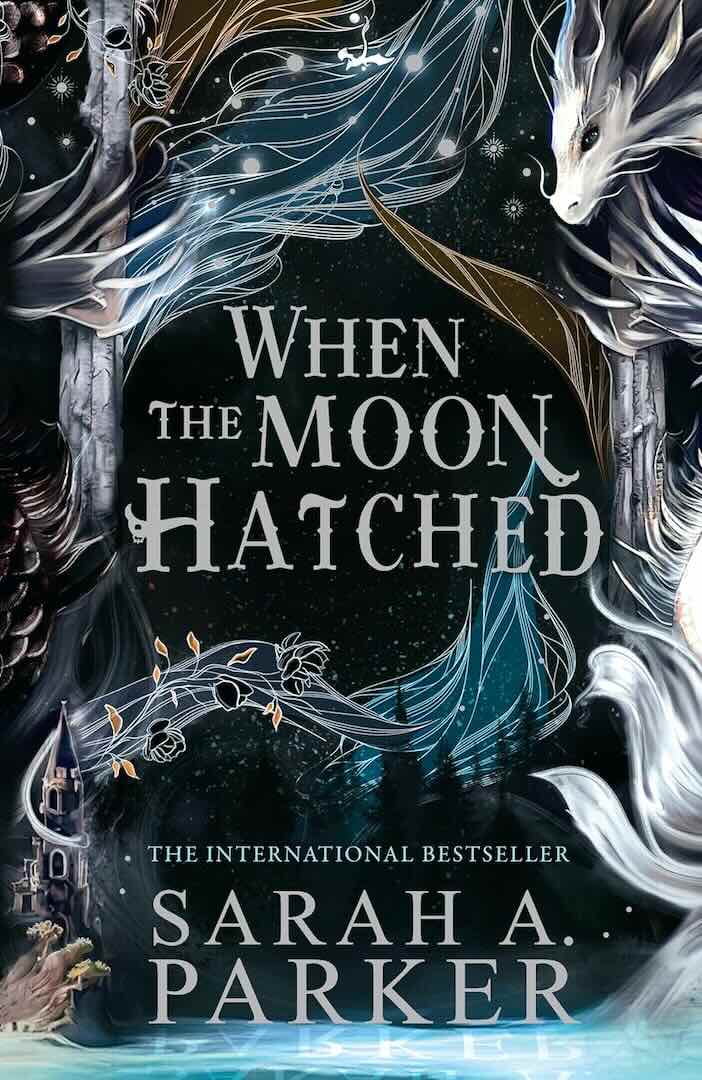
 1
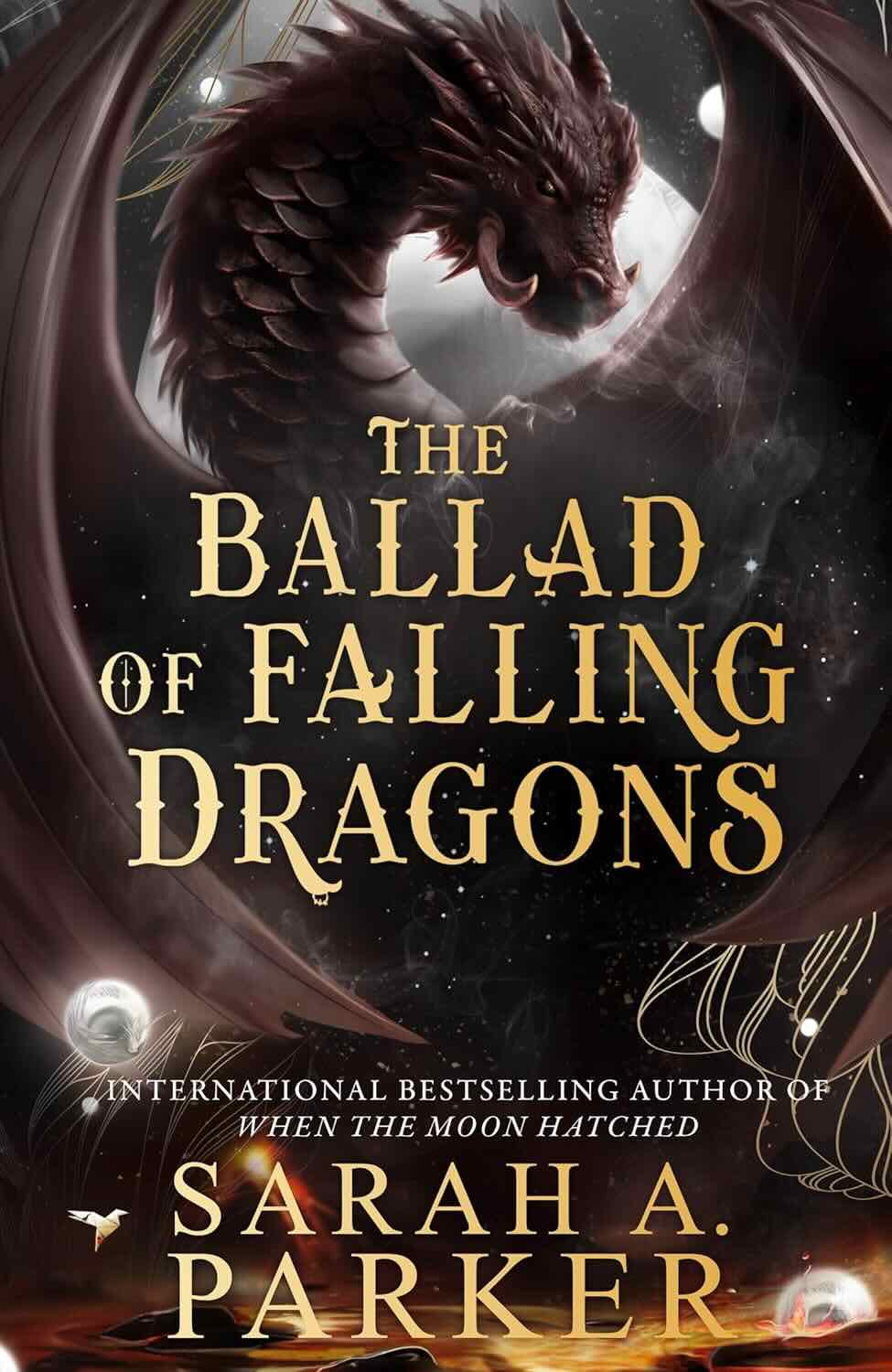
1The Ballad of Falling Dragons by Sarah A. Parker picks up after the bruised, bone-deep ending of When the Moon Hatched and pushes the story into territory that feels both bigger and rawer. Raeve still wears Rekk’s blood on her hands. Kaan still carries a crown that fits like a yoke. And the silver moons, drifting through skies stitched with aurora ribbons, are starting to wobble.
Where the story stands when book two opens
Book one, When the Moon Hatched, hatched a heroine out of a fallen moon and dropped her into a world of dragon clans, elemental Creators, blood-runes, and political rot. The Ballad of Falling Dragons by Sarah A. Parker doesn’t hand-hold returning readers, which I respected, though it makes this an absolutely terrible standalone entry point. If you’re new, start at book one or you’ll drown in glossary terms by chapter three.
This second outing keeps the dual identity thread alive (Raeve, and the woman she used to be), expands the cast in every direction, and sets the table for what the author’s own acknowledgments confirm as a planned third and final book. This is a middle book in the truest sense. Hinge. Lever. Ache.
What the second book does brilliantly
The dragons aren’t set dressing
Slátra. Rygun. Líri. The fact that I can list them with the same easy affection I’d use for human characters tells you almost everything. Parker writes dragons as full beings with grief, jealousy, devotion, patience. A few chapters even drop fully into a dragon’s point of view, and those passages are among the most affecting in the book. If you came to the genre through Fourth Wing and wished the dragons had more interior life, this scratches that itch and then some.
Emotional payoffs are enormous when they land
The Elluin flashbacks scattered through the book pay off in ways I did not see coming, even when I thought I had the shape of things mapped out. Without spoiling anything, motherhood is treated here as a force equal to war, vengeance, and even love. That’s rare in romantasy, and the book respects the cost of it.
The writing has a real voice
Sarah A. Parker’s prose is lyrical without going purple. Short lines. Single-word sentences when the moment calls for it. Visceral, body-first imagery. It takes a chapter or two to settle into the rhythm, but once you do, the cadence carries you. Compare a careful page about a parchment lark fluttering through a cell to a chase across a magma river and you have a writer who can shape her tools to the moment.
Where the book stumbles
I want to be honest, because a four-star average is honest. The Ballad of Falling Dragons by Sarah A. Parker is not airtight. A few snags worth flagging:
- It is long. Not just in page count but in chapter count (close to a hundred, plus prologues and interludes). Some middle stretches loop in place, especially the subplots around Bothaim and the Book of Voyd, which kept making me feel like I was waiting for the story to come back to its center.
- The world is dense to the point of being airless in places. The made-up vocabulary (daes, phases, larks, miskunn, weald) is part of the charm, but new and even returning readers will be flipping to the glossary more than they want to.
- Multiple points of view pull on the thread. Kyzari’s chapters, in particular, are riveting on their own, yet they sometimes break the emotional momentum of Raeve and Kaan’s arc just when it was finally surfacing.
- The ending leaves a lot of plates spinning. Some readers will find that thrilling. Others will close the book wanting one more chapter of grounding before book three arrives.
None of these are dealbreakers. They are honest reasons this is a four-star read rather than a five for many fans.
How the romance evolves in book two
The chemistry between Raeve and Kaan is no longer the question. The question this time is whether two damaged people can let each other all the way in while the world they love is splintering apart. Their scenes alternate between tender and brutal, and the spicier passages are written with the same care as the quiet ones. A scene where Kaan sings to a grieving child while Raeve watches from a doorway is, for my money, the emotional high of the book.
If you want a romance that grows up alongside the world rather than running on tension forever, this delivers.
Where it sits among Sarah A. Parker’s work
For fans of the author’s earlier Crystal Bloom series (To Bleed a Crystal Bloom, To Snap a Silver Stem, To Flame a Wild Flower), there is a noticeable craft jump here. The voice is sharper. The world is more confident. The Moonfall books feel like the project she was building toward.
The series as it currently stands:
- Book 1: When the Moon Hatched
- Book 2: The Ballad of Falling Dragons (this one)
- Book 3: forthcoming, confirmed by the author
The Ballad of Falling Dragons by Sarah A. Parker doesn’t close many doors. It kicks several wide open. That’s what a middle book should do, even when the wait for the next one is going to sting.
If you love this, try these next
A handful of read-alikes that pair well, depending on which thread of the book hooked you most:
- Fourth Wing by Rebecca Yarros, if the dragon bond was the part that wrecked you.
- The Serpent and the Wings of Night by Carissa Broadbent, for similar lyrical brutality and a slow-burn romance with high stakes.
- A Court of Mist and Fury by Sarah J. Maas, if you want a second book with bigger emotional stakes than its first.
- The Bridge Kingdom by Danielle L. Jensen, for political knots and an enemies-to-something-else arc.
- Empire of the Vampire by Jay Kristoff, if Parker’s prose style is the reason you keep reading.
Final word
The Ballad of Falling Dragons by Sarah A. Parker is messy in the way middle books are usually messy, and gorgeous in the way only this author seems to write. It asks for patience. It rewards that patience with grief, devotion, dragons, and one of the most quietly devastating mother-daughter throughlines I have read in the genre this year.
I closed it tired, a little raw, and ready to wait however long it takes for the third.