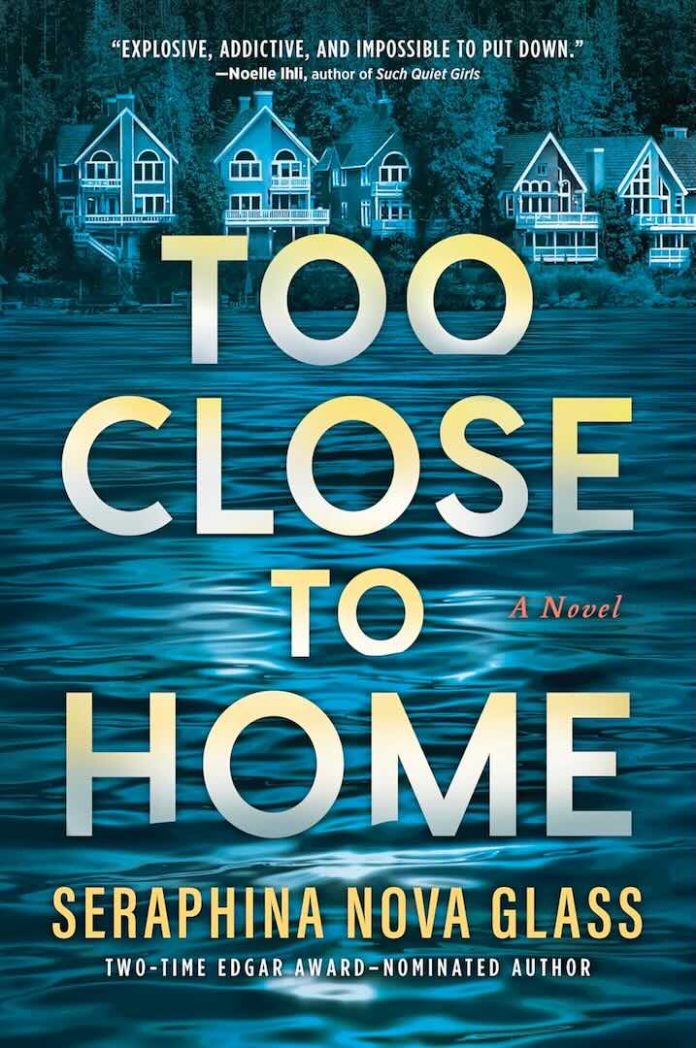
Cloverhill Lakes looks like the kind of place real-estate brochures fight over. Top schools, sundresses on Labor Day, catered “barbecues” that everyone still calls barbecues for the rustic charm. Then a car explodes in the parking lot, the wrong woman dies, and the polite pecking order of the PTA crowd starts shedding its outer layers. That is the opening setup of Too Close to Home by Seraphina Nova Glass, and it is the sort of opening that tells you the author is not planning to ease anyone in slowly.
I came to this book having read the writer before, mostly through On a Quiet Street and The Vacancy in Room 10. Glass writes a particular flavor of domestic suspense, the kind that takes lakefront communities, lawn-care obligations, and curated friend groups, and treats them like potential evidence. Too Close to Home by Seraphina Nova Glass keeps that signature, then leans harder on the voice work.
The setup, briefly and without giving the game away
Three women carry the story. Regan, a recent widow, narrates in the close-to-the-bone first person of someone rationing her benzos and her composure. Andi, the loud-mouthed friend with a cheating ex and a too-young new stepmom rival, also gets first person, and her chapters carry most of the comic charge. Sasha, the new arrival to the neighborhood, gets third person, which keeps her at a slight distance and pays off in ways I will not spell out here. The blurb already mentions a car bomb, a missing resident, and Regan glimpsing a husband she buried, so I will only confirm that none of those threads is decorative. They braid.
Writing style and pacing
Glass writes the way a sharp friend texts. Sentences run short when they need to, dialogue snaps, and the running joke is that every PTA disaster gets the dramatic treatment of a real one. Lines like the one about a stiletto sinking into the sand at a Labor Day party, or the rainbow-striped-dress insult delivered straight-faced, land because the women in this book are written as actually funny, not just labeled funny. That is a subtle thing, and Glass does it consistently.
The pacing is strongest in the front half. The first hundred pages or so move with real propulsion, and the chapter endings are pleasingly cheap in the best sense, exactly the kind that make you say “one more chapter” at one in the morning. The book also handles a tricky structural ask, three POVs that need to feel distinct and sound like three different women. Mostly it pulls it off. Andi is the most vivid. Regan reads as quieter and more wounded by design. Sasha is the most reserved and, depending on the reader, either a slow-burn payoff or the cooler third of the lineup.
What works
A short list of the things this book gets right:
- Three first-or-close-third narrators that do not blur. Each has her own slang, anxieties, and rhythm.
- A central mystery that respects the reader. Clues are seeded fairly. Red herrings exist, but they are honest ones.
- A real sense of place. Cloverhill Lakes feels specific, from the beach gazebo to the wooded acreage behind the houses.
- Genuinely funny lines, especially around the divorce wars and the absurd HOA-flavored cruelty of suburban one-upmanship.
- Motherhood as actual stakes rather than backdrop. Every major decision in the book gets pulled toward the children, and the moral compromises that come from that pull are where Too Close to Home by Seraphina Nova Glass earns its title.
Where it falters
This is where the four-star average rating starts to make sense. The back third gets crowded. Without giving anything away, the reveal pulls in elements that are larger and more cinematic than the suburban frame the book sets up, and a few plot mechanics rely on coincidence stacked on coincidence. One key character makes a choice in the climax that is dramatically satisfying but, on a second pass, a little too convenient for the timeline. Some readers will not mind. The ones who do will probably feel that the final chapters trade the book’s best quality, the lived-in domestic tension, for a more genre-standard showdown.
A second, smaller note: Tia, the other-woman antagonist of the early chapters, is written almost entirely through her enemies’ eyes, which makes her useful to the plot but thinner on the page than the central trio. The book seems aware of this and tries to round her out late. It half succeeds.
Themes worth chewing on
Too Close to Home by Seraphina Nova Glass is, at heart, a book about who the suburbs are designed to protect and what that protection costs. It also keeps circling motherhood, specifically the fear that being a “good mother” can become indistinguishable from being a complicit one. There is a thread on grief and anti-anxiety dependency that Glass treats with more seriousness than the genre usually allows, particularly in Regan’s chapters. None of these themes hijacks the thriller engine, which is a craft achievement of its own.
Comparable reads and where it sits in Glass’s catalog
If this is your first Glass novel, On a Quiet Street is the closest cousin in tone and structure, and The Vacancy in Room 10 hits a similar small-community-with-secrets register. Nothing Ever Happens Here and The Vanishing Hour are the next steps after that. Readers who liked Too Close to Home by Seraphina Nova Glass will likely also enjoy:
- Big Little Lies by Liane Moriarty, for the school-gate dynamics and a central group of moms with too many secrets.
- The Couple Next Door by Shari Lapena, for the same suburban-implosion energy and shock-twist economy.
- Such a Quiet Place by Megan Miranda, for the closed-community paranoia.
- The Soulmate by Sally Hepworth, for the multi-POV, who-actually-did-it construction.
- The Party by Robyn Harding, for the affluent-neighborhood reckoning after a single bad night.
Final thoughts
Too Close to Home by Seraphina Nova Glass is not flawless, and the ending will spark arguments in book clubs, which is half the fun. What the book delivers is voice, a strong opening, three women you actually want to follow into a mess, and a reading experience that is hard to put down once it gets going. For fans of the cul-de-sac thriller, it is worth the shelf space. For new readers of the author, it works as a fair entry point, with the caveat that some of her older titles show off her construction a little more cleanly.







