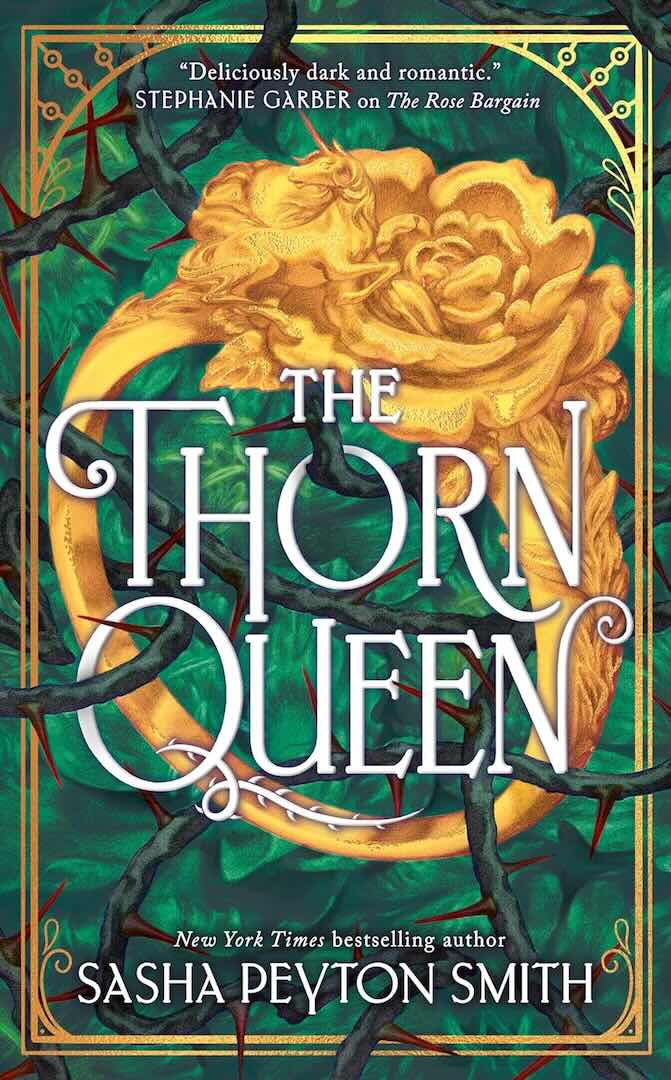
There is a particular thrill in returning to a series whose first book ended in flames. The Rose Bargain left readers in the smoke of a wedding gone sideways, with Ivy Benton crowned queen of England and the boy she actually loves locked away by the brother she had just married. The Thorn Queen by Sasha Peyton Smith picks up four months later, in a country slowly choking on faerie cruelty, and asks a quietly brutal question: what does it mean for a girl to play queen when the throne itself is a cage?
The answer, it turns out, is bruising.
What This Sequel Sets Out To Do
Set against the grime and gilding of Victorian England in 1848, the second installment in The Rose Bargain duology follows Ivy as she pretends to be a doting wife to King Bram while quietly plotting his downfall. Her sister Lydia and her beloved Emmett are missing, presumed trapped in the Otherworld. The first half of the book unfolds at Bath’s Royal Crescent, repurposed as Bram’s winter playground, and the second half pulls Ivy into the faerie kingdom itself, where her sister sits on a different throne and Emmett has built a different life.
Smith hands her heroine a quieter form of warfare than the parade-and-pact contests of book one. There are no public trials at first, only smiles held like blades, and Ivy’s daily performance grows almost unbearable to watch. When the games do arrive in the back half, they are wickeder, lonelier, and far more personal.
The Otherworld, Up Close
One of the strongest reasons to pick up The Thorn Queen by Sasha Peyton Smith is the Otherworld itself. After two books of hearing about it, readers finally walk through the door. Smith resists the urge to render it as a postcard. Instead, she gives us oversized acorns with golden caps, birdsong in a minor key, faerie wine that bites, double moons, and a cruelty so casual that the worst horrors take place between sips of champagne.
Her prose has tightened since her earlier YA fantasy series The Witch Haven, and that economy serves the new setting well. She writes in clipped, present-tense first person, mostly through Ivy’s voice, with shorter chapters folded in from Emmett, Lydia, and lady-in-waiting Faith. The style is sensory without being purple. A lover’s mouth is described once and you remember it three chapters later. A girl in a deer mask is described once, and you do not forget her at all.
Characters Who Earn Their Pages
Ivy is the engine of the book, and she has grown a spine of cold iron since the wedding. She is sharper here, less prone to hope, more willing to lie. Smith does not redeem her by making her gentle; she lets her get angry, jealous, and sometimes cruel in turn. The friendship between Ivy and her ladies-in-waiting Marion, Faith, Olive, and Emmy continues to be one of the series’ real pleasures, with Marion and Faith’s quiet partnership earning some of the book’s tenderest beats.
Emmett, given his own chapters, becomes a more complicated figure than the brooding love interest of book one. He is a boy who has survived a dungeon and is busy hating himself for what survival cost him. The push and pull between him and Ivy is not always graceful, and there are moments where their misunderstandings could have been resolved with one honest sentence, but the longing is real and the chemistry is hot enough to fog a window.
Lydia is the sleeper character of the duology. Her transformation from London debutante to Otherworld queen is handled with quiet care, and a late conversation between the sisters about envy, sacrifice, and shared history is the most moving stretch of writing in either book.
What Works
A short list of what The Thorn Queen by Sasha Peyton Smith gets right:
- The court politics. Bargains, glamours, gossip-as-currency, and a faerie court that runs on collective bad faith are all rendered with conviction.
- The romance pacing. After the slow burn of book one, the heat finally breaks, and Smith does not rush the reconciliation.
- The sister story. Ivy and Lydia’s relationship gets the emotional weight it deserves, and the duology earns its shift from rose to thorn.
- The supporting cast. Marion, Faith, Olive, and Emmy are fully realized rather than ornamental, and their loyalty has shape.
- The Bram problem. He stays genuinely menacing without becoming a moustache-twirling caricature, partly because his earlier charm still flickers through the worst of it.
Where It Stumbles
A book that averages four stars on reader sites is one that mostly delivers, and this one does, but a few weak seams show:
- The middle section settles into a familiar trial-and-revel rhythm that some readers will recognize from a dozen other faerie courts.
- Bram’s cruelty is sometimes so total that his earlier gray areas flatten by the final act.
- A late plot beat involving Lydia leans on a fantasy convention so well-worn it loses some of its sting.
- The Bath section runs slightly long before the Otherworld doorway opens, and a few subplots in those early chapters quietly evaporate.
- Emmett’s withdrawal from Ivy is dragged out a beat past the point where it stays interesting.
None of these are enough to sink the book, but they keep it shy of the very top shelf.
Comparable Reads And Where This Fits
If the comp titles in the publisher’s pitch worked on you, The Thorn Queen by Sasha Peyton Smith delivers what they promise. Fans of The Cruel Prince by Holly Black will find familiar pleasure in mortal-girl-among-fae politics. Readers who loved Once Upon a Broken Heart by Stephanie Garber and Belladonna by Adalyn Grace will recognize the swooning gothic register, and anyone who enjoyed The Selection by Kiera Cass will spot the bones of a competition narrative dressed in much darker silks. Bridgerton fans get the Crescent and the corsetry. For something tonally adjacent, try A Study in Drowning by Ava Reid or Rebecca Ross’s Divine Rivals duology for the same lush, letter-laden sense of yearning. Sasha Peyton Smith’s earlier Witch Haven trilogy, also published by HarperCollins, is worth picking up for readers who want more of her gothic-historical voice.
For another Gilded Age heroine with a notebook and no jurisdiction, try Hawk & Sparrow by Ayana Gray.
Final Word
The Rose Bargain duology now sits as two books, The Rose Bargain and The Thorn Queen, and it reads cleanly as a closed story rather than the setup for an endless series. The Thorn Queen by Sasha Peyton Smith lands with enough resolution to feel earned and enough breath in its world to leave readers content. Smith has written a sequel that is angrier, sadder, hungrier, and more grown-up than its predecessor, and while it does not always escape the gravity of its genre conventions, it knows exactly what it wants to be and commits to it without flinching.
For readers who came to this series for forbidden romance, sister stakes, and a faerie court that knows how to ruin a girl’s slippers and her marriage in the same evening, this is the close they were waiting for.







