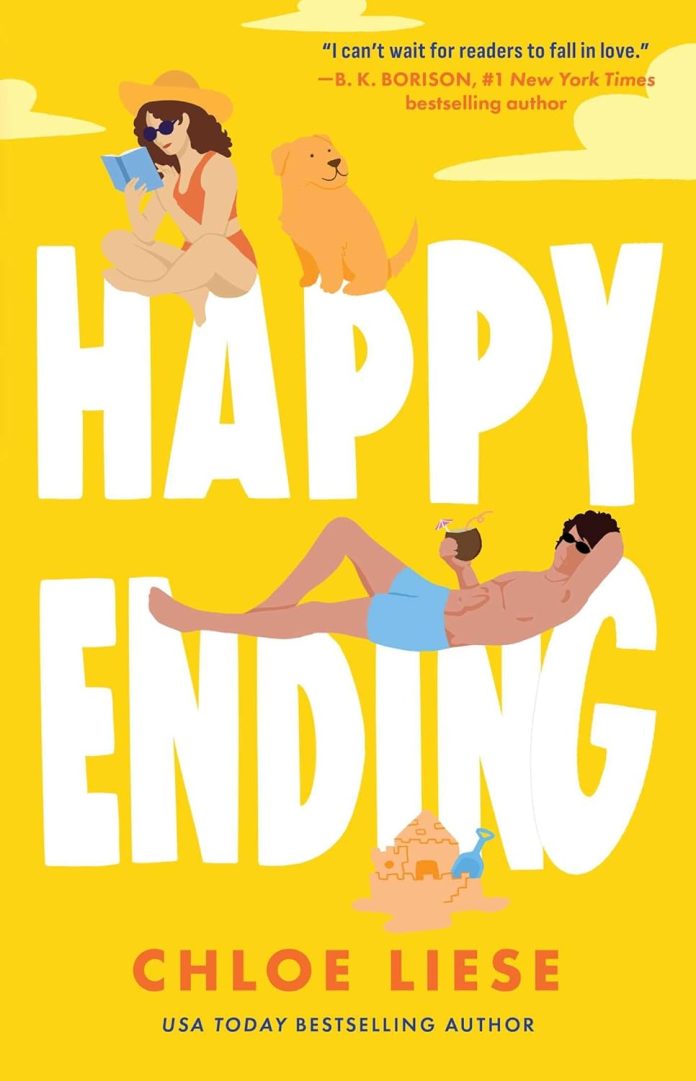
There’s a particular kind of romance novel that earns its title twice over, once as a promise to the reader, and again as a question the characters have to wrestle with. Happy Ending by Chloe Liese belongs to that smaller, sturdier category. This is a romance about two divorced people who are scared half to death of starting over, who tell one small lie that snowballs into a real friendship, and who eventually have to decide what to do when that friendship starts feeling suspiciously like the very thing they swore off.
If you’ve followed Liese through the Bergman Brothers and Wilmot Sisters series, you’ll recognize the familiar warmth, the bookish heroine, the food-coded hero. This one carries something heavier in its bones, though, and the author announces it openly in her note: divorce. Not as a backstory beat, but as the soil the whole book grows out of.
The Setup, Briefly
Thea Meyer is a thirty-something bookseller in Pittsburgh, freshly divorced, fighting a contentious custody dispute over her golden retriever Argos. Alex Bruscato is a celebrity chef back in his hometown, co-parenting a daughter named Mia with his ex-wife Jen. They meet on Thea’s old front steps the day they realize their exes are sleeping together. Cornered, humiliated, and standing within earshot of those exes, Thea blurts out that she and Alex are old friends. Alex, sensing the play, escalates it into “first loves.”
Two years later, that lie has hardened into a genuine best friendship, and an email lands in their inboxes inviting them to a two-week beach vacation with the very people they’ve been performing for. That’s the engine. The book runs on alternating timelines: “Now” chapters (the vacation, the breaking point) and “Then” chapters (how the friendship actually grew).
What Lands With Real Weight
The strongest element of Happy Ending by Chloe Liese is how seriously it takes divorce as a wound. Most contemporary rom-coms treat a failed marriage as scaffolding for a meet-cute. Liese treats it as a slow, ongoing hurt, the kind that makes you flinch away from anything that looks too much like hope. Thea’s habit of dialing herself down to a one, of accommodating until she disappears, has texture and history. Alex’s exhaustion, his guilt about Mia’s home life, his quiet anger at how amicably his ex moved on, all read like things the author knows from the inside.
A few specific elements deserve their own beat:
- The friendship itself is convincing. Two years of inside jokes, text threads, cooking lessons, and a shared collection of grumpy elderly neighbors do the work that most romances skip. By the time the romantic tension comes to a head, you understand exactly what’s at stake, because you’ve watched the thing they’re afraid of losing get built brick by brick.
- Mia is written like an actual child. Six years old, demanding, perceptive, occasionally wrong-footed by adult drama. She isn’t a prop for hero softness, she’s a person, and Thea’s care for her is one of the book’s most honest emotional engines.
- Food is a love language done right. Alex’s kitchen is the book’s heart. The brioche hot dog buns, the homemade pumpkin tortellini, the crème brûlée that Thea torches with possibly too much glee, none of it feels like decoration. It’s how Alex says the things he can’t say out loud.
- The bookseller voice gives the prose its flavor. Thea narrates like a woman who has read a lot of romance novels and knows exactly which trope she’s currently inhabiting, which lends the book a self-aware spark without tipping into smugness.
Where the Story Drags Its Feet
Happy Ending by Chloe Liese is good, sometimes very good, but it isn’t unblemished.
The biggest issue is structural. The “Then” timeline carries so much of the emotional groundwork that the “Now” timeline ends up doing comparatively little. Once the dam breaks (and you’ll know when), the romantic resolution feels rushed against the patient, two-year accumulation that preceded it. The vacation conflict, hyped from the first chapter, resolves with less friction than the buildup suggests. Readers who came for sustained fake-dating chaos may notice that the fake-first-loves premise spends more time as set dressing than as ongoing plot pressure.
Single POV is the other limitation. Thea’s voice is rich, but Alex stays slightly out of reach because we only ever see him through her. Liese has done dual POV beautifully in earlier books, and here, where the hero carries his own divorce, his own parenthood, and his own quiet long-running ache, you feel the absence of his interior. A handful of his text messages have to do work that a full chapter could’ve handled in twenty pages.
A few smaller frictions worth flagging: Ethan, the ex-husband, is pretty thinly drawn, more punching bag than real foil. The repeated internal “but we’re just friends” loop runs longer than it needs to, and the reader can clock the breaking point well before Thea does. The third-person Thea Meyer thought to herself interludes, where Thea narrates her own life like a novel character, are charming the first two times and a touch twee by the eighth.
The Voice, Adapted
Stylistically, Liese is doing what she does best: a tender, conversational first person stitched through with food, books, and gentle physical comedy. The banter has snap (Thea and Alex’s text threads are some of the funniest pages in the book), the spicier scenes earn their place rather than getting parachuted in, and the prose has those small bright phrases (a smile that “sparks joy,” a love that’s “ravaging” one moment and “indefatigable” the next) that signal a writer who has lived with these themes long enough to find her own language for them.
Who This Is For, and What to Read Next
If you came to Happy Ending by Chloe Liese through the cited comp authors and want more in that exact key, the bench is deep. A short list of titles that would feel at home on the same shelf:
- Same Time Next Summer by Annabel Monaghan, the nearest tonal cousin to this one, especially for the divorced-and-restarting heroine.
- Happy Place by Emily Henry, for the friend-group beach pressure cooker and the fake-relationship pretext that hides real grief.
- Beach Read by Emily Henry, for the way it handles loss and writerly comfort food in equal measure.
- First Time Caller by B.K. Borison, blurbed on this very book and a strong match for the gentle friends-to-lovers texture.
- Out on a Limb by Hannah Bonam-Young, for the emotional honesty and the way it handles parenthood mid-romance.
- Meet Me at the Lake by Carley Fortune, for the second-chance, summer-setting, healing-after-loss feel.
- From Liese’s own backlist, Once Smitten, Twice Shy (Wilmot Sisters) and Ever After Always (Bergman Brothers) are the closest siblings if you want more of her interiority and her thoughtful representation work.
Final Take
Happy Ending by Chloe Liese is a romance about being scared, and being held, and slowly learning to put those two things in the same sentence. It isn’t her tightest book on the page, and the structural choices keep it from the kind of compressed devastation that Beach Read managed with similar grief material. But it’s an unusually grown-up entry in the genre, with one of the most lived-in friendships you’re likely to read this year. You’ll close it a little tender. You may end up calling someone you love. That’s a respectable return on a few hundred pages of fiction, and the book earns it.







