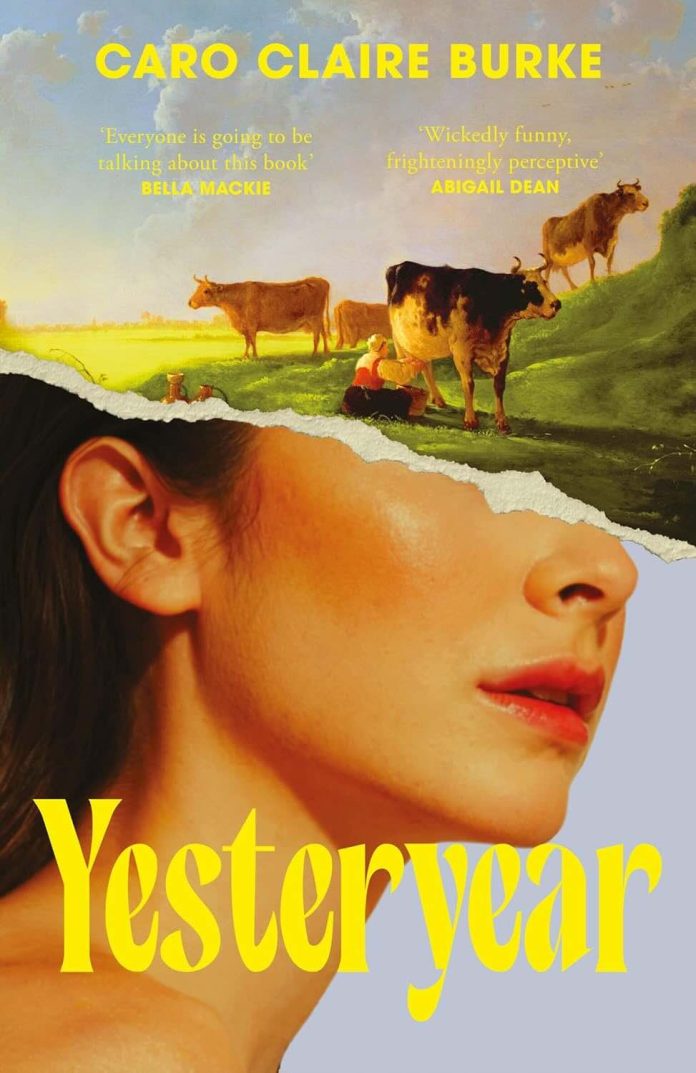
Natalie Heller Mills is perfect at being alive. She will tell you this herself, in the opening lines of Yesteryear by Caro Claire Burke, and she means it with the particular sincerity of a woman who has rehearsed sincerity until it becomes indistinguishable from the real thing. She has the followers, the farmhouse, the handsome cowboy husband, the six children in prairie dresses. She has nannies and producers and industrial-grade ovens hidden behind rustic wooden panels. What she does not have is an exit plan for the morning she wakes up somewhere she does not recognize, in a body that feels wrong, in a house that is and is not her own.
Burke’s debut opens in January, Idaho, on a farm called Yesteryear Ranch. The setup is familiar to anyone who has scrolled past a homesteading account with mild fascination: raw milk, sourdough tutorials, chickens with names, a husband who tips his cowboy hat. Burke’s masterstroke is that Natalie knows exactly what she is selling, and she sells it brilliantly. The satire in these early chapters is wicked and precise. Every “Pregnancy brain!” deflection, every canned laugh before a difficult question, every backstage industrial fridge concealed behind an antique cabinet door: the performance of womanhood here is observed with a cold, gimlet-eyed clarity that makes you laugh before you wince.
Then Natalie wakes up somewhere else. Same farmhouse, same layout, no electricity. Children who look like hers but are not hers. A man who looks like her husband but carries something dead behind his eyes. And a date carved into the doorframe suggesting she is not where, or when, she should be.
Two Farmhouses, One Doorframe
The structural gamble of Yesteryear by Caro Claire Burke is a dual timeline. The chapters set in the displaced past alternate with flashback chapters tracing how Natalie became Natalie: how the Harvard-educated daughter of a single Idaho mother married into political dynasty money; how the social media account grew from a thousand strangers to eight million; how the farm became a brand, the brand became a religion, and the religion became a cage.
What the Backstory Actually Gives You
Here is where Burke earns genuine admiration. The backstory chapters are frequently the most gripping pages in the novel. In long, funny, aching stretches, we watch Natalie move from a Harvard dorm room, a stranger among coastal elite women she despises and envies in equal measure, to a kitchen in Idaho where millions of women watch her make bread she did not entirely bake. The timeline reveals character not through confession but through consequence. You understand how Natalie became what she is, and more uncomfortably, you find yourself understanding why.
The chapters set in the past carry a different energy: disoriented, sensory, laced with dark humor and real menace. They work best when the mystery of what is actually happening to Natalie sits at the surface, when her sharp, marketing-trained brain turns itself toward survival. Watching her apply influencer logic to nineteenth-century domestic labor is one of the book’s genuine pleasures. Her theory that she is the unwitting star of a brutal reality show, the way she performs for an imagined camera even while she is terrified and injured, is both funny and quietly devastating.
A Voice Sharp Enough to Leave Marks
The single most valuable asset in Yesteryear by Caro Claire Burke is Natalie’s voice. First person, unreliable, exhilarating. She insults people she is smiling at. She prays with one breath and thinks something unprintable with the next. She is controlling, calculating, and occasionally vicious, and beneath all of it she is genuinely lonely in a way she would never admit and can barely perceive. Burke’s prose does not editorialize. It trusts readers to hold Natalie in her full contradiction, and most of the time, that trust pays off.
The novel’s form reflects its subject: Natalie has been performing so long that even her interiority reads like a drafted caption. Burke layers in imagined press interviews, parenthetical asides, and scripture quotations as structural punctuation, all of it voice-consistent, all of it controlled. The comedy is dark in the specific way that something only becomes funny once you have seen how terrible it actually is.
Where the Clock Moves Slowly
For all of its sharpness, Yesteryear by Caro Claire Burke is not without real friction. The displaced-past chapters, while atmospherically rich, occasionally lose momentum in their middle sections. Some stretches devoted to bread-baking and chore routines run longer than the mystery they are wrapped around can sustain. The tension that makes the early displacement chapters so genuinely frightening flattens, at times, into something more episodic.
The secondary characters in the historical timeline are vivid in isolated scenes but feel thinly drawn against Natalie’s enormous presence. When the novel asks readers to feel the emotional weight of these relationships, it sometimes reaches for feeling that has not been fully built. The resolution of the central mystery is satisfying in its logic, though it arrives with a certain tidiness that readers expecting a harder or more ambiguous ending may find convenient.
These are the particular missteps of a debut that is attempting, and largely achieving, something genuinely original. They are friction, not failure.
The Long History of Women Performing
What Yesteryear by Caro Claire Burke is really about sits just beneath the genre surface: the long history of women asked to perform versions of themselves that serve other people’s needs. Natalie is not simply a hypocrite. She is a woman who looked at her options, calculated ruthlessly, and built the best life available to her given the available materials. That this life required hiding everything real about herself behind a curated image is not unique to influencers. It is as old as the doorframe she finds herself trapped behind.
Burke does not exempt her protagonist from critique, nor does she let anyone else off lightly: not the critics who watch Natalie hungrily while claiming to hate her, not the political class using her image as campaign currency, not the women who want her to be something simpler. The novel is funny in the way that things are funny when they have been true for a very long time.
What Stays, What Slips
Strengths
- Natalie’s voice: singular, dark, deeply interior, and genuinely original
- Scalpel-sharp satire of influencer culture, tradwife ideology, and political dynasty America
- The dual timeline structure, when it fires on all cylinders
- A protagonist who refuses to be easy to hate or easy to love
- Prose that is consistently controlled and often brilliant
Points of Friction
- Pacing unevenness in the middle of the historical chapters
- Secondary characters feel thinly sketched against Natalie’s dominance
- The resolution, while logical, leans toward convenience
Books That Travel Similar Ground
If you finished Yesteryear by Caro Claire Burke and found yourself looking for more:
- American Wife by Curtis Sittenfeld: the political wife as unreliable narrator
- Little Fires Everywhere by Celeste Ng: perfect motherhood and its costs
- Fleishman Is in Trouble by Taffy Brodesser-Akner: marriage under a satirical lens
- Followers by Megan Angelo: influencer culture and its long consequences
- Outlander by Diana Gabaldon: temporal displacement and bodily survival in a hostile past
- The Handmaid’s Tale by Margaret Atwood: womanhood as state-sanctioned performance
Caro Claire Burke, an MFA graduate of the Bennington Writing Seminars and co-host of the politics and culture podcast Diabolical Lies, has written a debut that is, at its best, genuinely electrifying: smart enough to be satirical and human enough to ache. It is the kind of novel that makes you think about what you curate, what you hide, and what happens when someone takes the choice away from you.