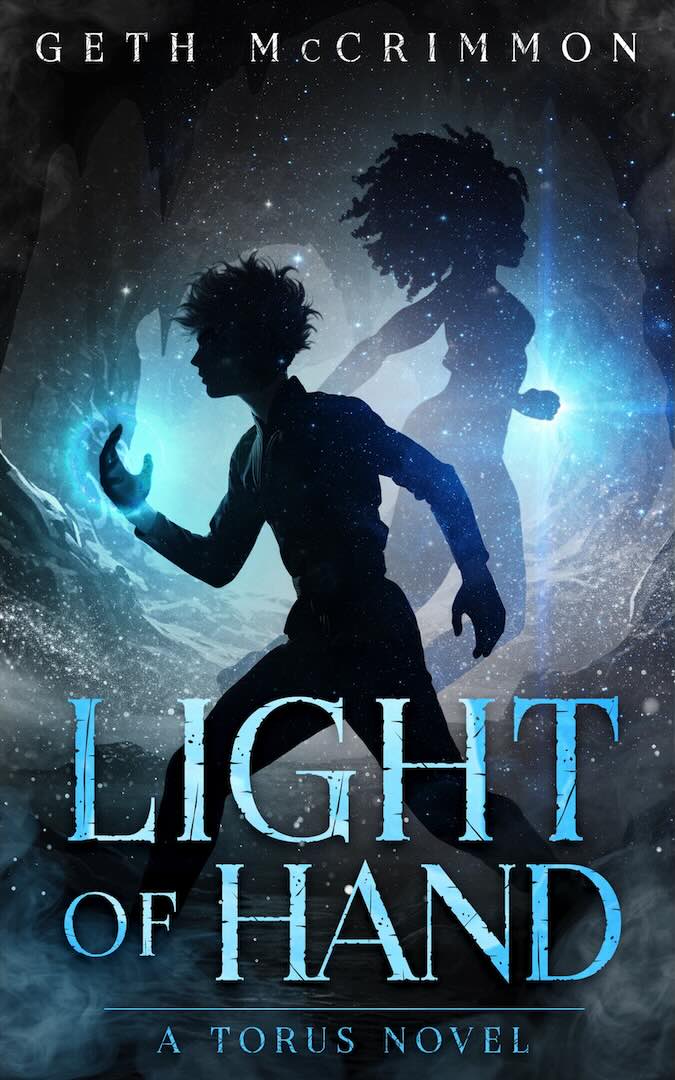
There are books that invite you gently across their threshold, and then there are books that seize you by the collar, hurl you through a portal, and leave you blinking in some impossible, perpendicular world with wonky angles and a populace that considers human flesh a dietary option. Light of Hand: A Torus Novel by Geth McCrimmon is decidedly, gloriously, the latter.
This debut fantasy novel announces itself with the kind of confidence typically reserved for authors several books deep into their career. McCrimmon has crafted something that feels simultaneously fresh and deeply rooted in the grand traditions of British portal fantasy, delivering a story where humour and mortal peril share the same sentence with enviable ease, and neither suffers for the company.
Where Earth Ends and the Donut Begins
The premise is deceptively simple at its origin. Tobias Chatterley is, by most measures, a fairly ordinary teenager whose greatest immediate concern is the retribution awaiting him after ricocheting a football off a teacher’s nose. His best friend, Jemima Catlock, is the sort of fiercely intelligent, deeply sardonic companion every protagonist deserves but few are lucky enough to get. Their world pivots irrevocably when a lightning strike, an exploding tree, and the sudden eruption of light from Tobias’ hand reveal that ordinary is something they never actually were.
What follows is a cascade of revelations: identities unmasked, family histories rewritten, and a whole other world called Torus thrown open before them. McCrimmon handles the architecture of these revelations beautifully, parcelling out information through naturalistic dialogue rather than expository lectures. We learn what Tobias learns, when he learns it, and often share his bewildered profanity in response.
Characters That Breathe Off the Page
The true engine of Light of Hand: A Torus Novel by Geth McCrimmon is not its magic system or its world-building, impressive as both are, but its characters. McCrimmon writes people the way people actually are: contradictory, warm, infuriating, brave in ways they did not plan and frightened in ways they cannot hide.
Tobias is a wonderfully realised protagonist whose heroism is never the stoic, chiselled-jaw variety. He swears. He panics. And he does not want to kill anyone, thank you very much, and says so in terms that would make his grandmother blush. His growth across the novel is earned through terror and tenderness in roughly equal measure, and by the final chapters, the distance he has travelled as a person is as vast as the distance between Earth and Torus.
Jemima, meanwhile, is a revelation. Sharp-tongued, fearless, and possessed of abilities that develop along lines entirely her own, she is nobody’s sidekick. Her relationship with Tobias crackles with genuine affection and the kind of bickering that only true friendship permits. She commands stone guards with a glare, converses with wind spirits, and faces down interdimensional horrors with the same no-nonsense pragmatism she brings to everything. McCrimmon has written a female lead who is fully realised, fiercely independent, and integral to the plot in ways that never feel tokenistic.
The supporting cast deserves particular attention:
- Cornelia Bloom – Tobias’ grandmother, a sword-wielding, wine-swilling, magnificently crotchety former warrior whose courtly bows and sharp strategic mind conceal a manipulative streak that drives much of the plot’s tension. She is part Gandalf, part your most embarrassing relative, and entirely unforgettable.
- Tristan Bloom – Tobias’ father, an accountant who is spectacularly not just an accountant. His emotional vulnerability, particularly when speaking of Tobias’ mother, Nahlea, provides the novel’s most quietly devastating moments.
- Lizzie Catlock – Jemima’s mother, a Wayfinder who can open gates between worlds, wears blue boots, bakes extraordinary cinnamon buns, and wields a walking stick with the air of someone who has seen far more of the multiverse than she lets on. Her warmth is the novel’s hearth.
- Li Yin – A Guardian monk whose lyrical speech and formidable combat abilities are beautifully balanced. McCrimmon describes Li Yin with a deliberate absence of gendered pronouns, a subtle choice that enriches rather than distracts.
- Seraphin – A volatile, grief-ravaged Lightbringer whose single-minded pursuit of vengeance creates some of the novel’s most morally complex and breathlessly tense sequences.
A World Built with Care and Wit
Torus itself is a magnificent creation. McCrimmon populates this perpendicular world with staggering imagination: bearish humanoids, feathered beings with glorious wings, waist-high badger trios muscling through crowds, toothy sprites on diaphanous wings, and shuffling columns of sentient kelp. The world feels genuinely lived-in, its markets and pubs and cobbled streets carrying the weight of history rather than the sheen of invention.
The magic system, too, is elegantly conceived. Abilities are channelled through personal objects called foci, each attuned to a specific individual. Lightbringers command light and dark. Wayfinders navigate the gates between worlds. Sensates perceive across planes. There is an internal logic here that McCrimmon respects rigorously, never pulling convenient powers from thin air to resolve a corner he has written himself into.
Light of Hand: A Torus Novel by Geth McCrimmon is also quietly thoughtful in its world-building. The Aetherfeld, the plane between worlds, is not merely a transit corridor; it is a space with its own ecology and guardians. The stone guard are not simply monsters; they are spirits of rock and earth, subverted by shadow, and their liberation forms one of the novel’s most satisfying arcs. Even the palace of Arx Torus refuses to be what you expect: not gilded opulence, but government office space. McCrimmon clearly delights in subverting fantasy conventions, and his readers will delight right alongside him.
Humour as a Survival Tool
What separates this novel from many in its genre is the quality of its humour. This is not comic relief bolted onto serious fantasy; it is humour woven into the fabric of the narrative, arising naturally from character and situation. When Tobias first meets his grandmother and tells her she needs a bath, or when Jemima demands explanations with the fury of a courtroom prosecutor, or when Cornelia describes her knowledge of a secret portal as having been won in a game of bones from a peddler, the laughter is genuine because the characters are genuine.
McCrimmon writes dialogue with a playwright’s ear. The rhythms are impeccable, the comic timing precise, and the emotional register shifts seamlessly from banter to heartbreak without either note feeling forced. It is a distinctly British sensibility, dry and warm simultaneously, reminiscent of the tonal dexterity found in Terry Pratchett’s Discworld or Diana Wynne Jones’ Chrestomanci series, though McCrimmon’s voice is entirely his own.
Pacing, Stakes, and the Art of the Page-Turner
The novel’s pacing is relentless in the best possible way. McCrimmon understands that tension requires release, and he alternates sequences of genuine peril with quieter moments of character development and world exploration. The battle sequences are visceral and inventively choreographed, particularly the encounters with shadow-bound stone guard and the climactic confrontation with Marduk. Yet the novel never sacrifices emotional truth for spectacle. Every fight matters because we care about who is fighting and why.
Light of Hand: A Torus Novel by Geth McCrimmon is also unafraid to put its characters in genuine danger. Injuries are real, grief is real, and the moral weight of violence is never brushed aside. Tobias’ anguished refusal to be complicit in assassination is handled with nuance and emotional honesty that elevates the entire narrative.
A Debut That Signals a Series Worth Following
As a debut novel and the first instalment in what promises to be a larger Torus saga, Light of Hand: A Torus Novel by Geth McCrimmon accomplishes the difficult feat of telling a complete and satisfying story while leaving doors wide open for future adventures. The concluding chapters settle the immediate conflict while seeding questions about what comes next for Tobias, Jemima, and the world they have now chosen to call home.
McCrimmon has arrived with a fully formed voice, a richly imagined world, and characters who feel like people you would genuinely want to share a pot of tea with, even if that tea comes in a beaten-up tin mug beside a campfire in an alternate dimension. For fans of portal fantasy, witty YA fiction, and the kind of British storytelling that treats its audience with intelligence and warmth, this is an essential read.
If You Loved This, You Will Also Love
If Light of Hand: A Torus Novel by Geth McCrimmon left you hungry for more adventures across worlds and dimensions, consider these kindred spirits:
- A Darker Shade of Magic by V.E. Schwab – Parallel Londons, smuggling between worlds, and a magic system built on elemental control
- The Magicians by Lev Grossman – A portal fantasy for readers who want their wonder laced with sharp self-awareness
- Neverwhere by Neil Gaiman – London Below awaits, where dark humour and mythic storytelling collide
- His Dark Materials by Philip Pullman – Multiple worlds, daemons, and a coming-of-age epic that reshaped the genre
- The Chronicles of Chrestomanci by Diana Wynne Jones – British wit, parallel worlds, and magic that is by turns hilarious and profound
- Stardust by Neil Gaiman – A standalone fairy tale of adventure, romance, and crossing the wall between worlds
- The Name of the Wind by Patrick Rothfuss – For readers drawn to richly detailed magic systems and lyrical prose
- Septimus Heap: Magyk by Angie Sage – YA fantasy with hidden powers, political intrigue, and immersive world-building