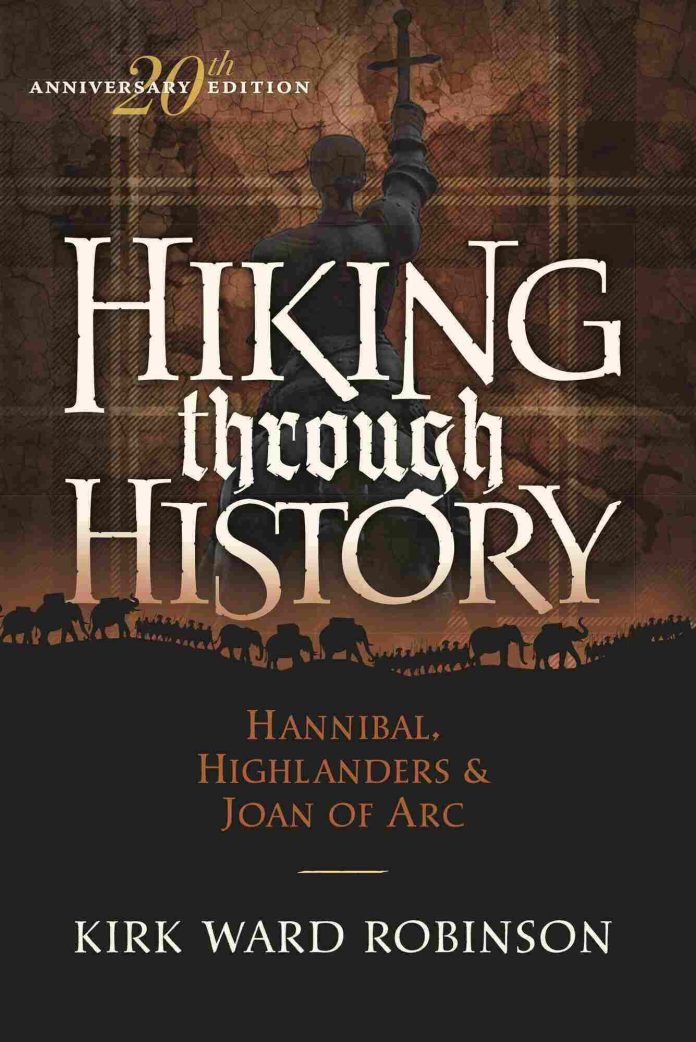
There is a certain kind of traveler who cannot walk past a battlefield without hearing the dead. Kirk Ward Robinson is that kind of traveler — the kind who crosses an ocean on a cruise ship not to bask at the pool bar, but to disembark in Spain with a backpack, trekking poles, and a decade’s worth of historical research loaded into his mind like ammunition. Hiking Through History by Kirk Ward Robinson — in this beautifully revised 20th Anniversary Edition — is not just a travel memoir. It is a sustained act of historical imagination, a walking meditation across three of the most dramatic landscapes in Western history, and one of the more honest, funny, and genuinely moving accounts of solo travel you are likely to read.
The Man Behind the Miles
Before the journeys begin, it helps to know who is doing the walking. Robinson is a four-time Appalachian Trail thru-hiker with more than 10,000 miles on foot and 20,000 on a bicycle. He is twice named to Kirkus Reviews’ Best Books list — for Life in Continuum and The Appalachian — and has earned a five-star review from Foreword Clarion for his novel The Latter Half of Inglorious Years, among other accolades. He approaches Europe not as a tourist checking monuments off a bucket list, but as a serious reader of landscape, someone who has trained his body and sharpened his intellect for exactly this kind of expedition. His background as a naturalist, historian, storyteller, and endurance hiker coalesces into a voice that is simultaneously expert and self-deprecating — a combination that keeps the pages turning.
The Architecture of the Book
Hiking Through History by Kirk Ward Robinson is organized into four distinct movements, each with its own geography and emotional register.
- Transatlantic — Robinson and his friend Nymous, a former roadie for the Rolling Stones, cross the Atlantic aboard the Celebrity Galaxy. This section serves as a prelude: comic, observant, and laced with the anxiety of a man who knows that something large and demanding lies ahead.
- Hannibal ad Portas — The longest and most ambitious section, tracing Hannibal’s extraordinary route from Cartagena, Spain, through the Pyrenees, across southern France, over the Alps into northern Italy, and south to the sites of Trebia, Lake Trasimene, and Cannae.
- Scotland Wha Hae — A solo 1998 journey through the Scottish Highlands, from Glasgow to Stirling, Bannockburn, Inverness, Loch Ness, and the ancient stones of Orkney, where Robinson first felt history ambush him.
- Jehanne — A return to France to follow Joan of Arc from her birthplace in Domremy through Vaucouleurs, Chinon, Orleans, and north to Rouen, the city where she burned.
Each section holds to the same structural philosophy: personal narrative and comic misadventure wind through dense, deeply researched historical passages like ivy through ironwork.
How Robinson Writes — and Why It Works
The writing style in Hiking Through History by Kirk Ward Robinson is distinctive in its pacing and range. He can move, sometimes within a single paragraph, from the precise logistics of bivouacking on a Sicilian campground to the tactical genius Hannibal displayed at the Battle of Cannae, where a force of 40,000 Carthaginians encircled and destroyed 80,000 Romans — a maneuver still studied in military academies. This tonal elasticity never feels jarring because Robinson has earned both registers. He walks the actual ground before he writes the actual history; standing on the ridge above Lake Trasimene at dusk, he asks what Hannibal might have seen and felt, and then answers with scholarship rather than sentimentality.
His prose carries the dust of the road in it. Descriptions of cycling through the Dolomites, hiking in a torrential Highland rain near Loch Ness, or waking beside the standing stones of Orkney are rendered with a naturalist’s precision and a novelist’s ear for sensory detail. He is also genuinely funny — the incident with a romantic couple asleep on the cruise ship’s deck, or the misadventures of navigating Italian roads without GPS in 2005, are written with the timing of a practiced storyteller.
History That Breathes
What separates Hiking Through History by Kirk Ward Robinson from conventional travel writing is the quality and depth of the embedded history. Robinson brings rigorous sourcing to Hannibal’s campaigns — drawing on Polybius, Livy, and modern scholars — while making the narrative accessible enough that a reader with no prior knowledge of the Second Punic War will finish the book understanding why Cannae became one of history’s most studied military encounters. His Joan of Arc research is equally impressive. He owns approximately sixty books on the subject, works through the contradictions between sources with care, and presents the Maid of Orleans not as a saint draped in stained glass but as a young woman of extraordinary psychological courage who navigated ecclesiastical politics, military strategy, and a medieval court simultaneously.
The Scotland section covers ground that might seem more familiar — Bannockburn, William Wallace, Robert the Bruce — but Robinson’s approach to the Picts and the ancient Norse kingdom of Orkney opens less-trodden historical corridors. The Standing Stones of Stenness and the Ring of Brodgar, encountered by the author on a quiet afternoon with sheep grazing among megalithic stones, become meditations on anonymity and the human need to mark one’s presence in time.
What Makes This Edition Distinctive
The 20th Anniversary Edition benefits not only from two decades of the author honing his prose but also from the addition of maps and original photography throughout. These are not decorative afterthoughts. Robinson’s photographs — of mountain passes, campgrounds beside ancient battlefields, cobbled medieval streets in the Lorraine — ground the reader in specific, verifiable geography. This is travel writing that can be used, practically, by someone planning a similar route.
Who Should Read This Book
Hiking Through History by Kirk Ward Robinson will find its most natural audience among readers who believe that the best way to understand history is to stand where it happened. But its appeal extends further:
- Readers of adventure travel memoir who want intellectual substance alongside the narrative
- History enthusiasts who enjoy scholarship delivered without academic dryness
- Hikers and long-distance trail walkers curious about international routes
- Anyone drawn to the question of what the past feels like underfoot
If You Enjoyed This, Consider These
Readers drawn to this kind of historically grounded travel writing may also want to explore:
- Walk the Blue Fields by Claire Keegan (Irish landscape and story)
- Apsley Cherry-Garrard’s The Worst Journey in the World (endurance travel classic)
- In Patagonia by Bruce Chatwin (literary travel with historical texture)
- The Pillars of Hercules by Paul Theroux (Mediterranean travel, wit, and observation)
- Turn Right at Machu Picchu by Mark Adams (adventurous history-chasing on foot)
- Wolf Hall by Hilary Mantel (not travel, but a comparable sense of lived-in history)
A Final Word
Hiking Through History by Kirk Ward Robinson earns its place on a short shelf of travel books that genuinely teach while entertaining. The 20th Anniversary Edition is the definitive version: cleaner, deeper, and enriched by the perspective of a writer who has spent two more decades thinking about what those journeys meant. Whether you come to it as a hiker, a historian, or simply as someone who wonders what Hannibal saw when he finally crested the Alps and looked down into Italy — this book will meet you where you are.
It will then take you much further.







