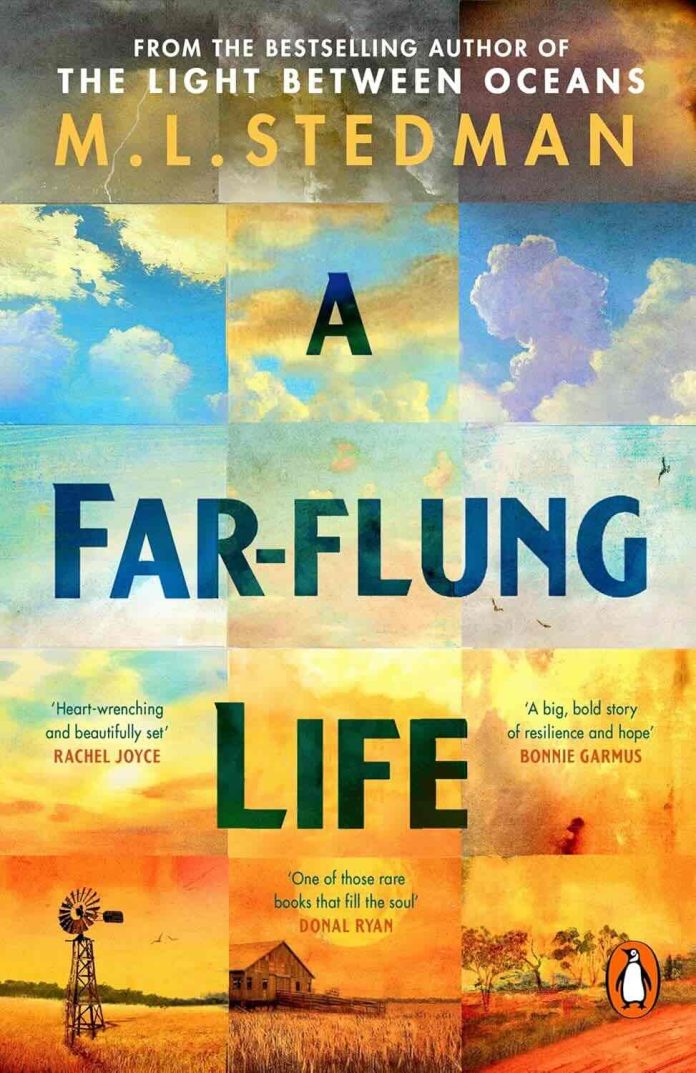
Fourteen years is a long time between novels. For the readers who fell in love with M.L. Stedman’s internationally bestselling debut, The Light Between Oceans (2012), the wait for her follow-up has been its own kind of endurance test. A Far-Flung Life by M.L. Stedman arrives as a sweeping, multigenerational family saga set in the vast arid interior of Western Australia, and it carries the same luminous prose and moral complexity that made her first book a global phenomenon. Whether the wait was entirely worth it depends on what you’re looking for, but there is no denying the ambition and emotional heft of this novel.
The Shattering Moment That Sets Everything in Motion
The story opens with deceptive calm. It is January 1958, and the three MacBride men are rattling along a dusty outback road in their truck, hauling sheep. Phil, the patriarch, drives. Warren, the eldest son, sits beside him. Matt, the youngest, daydreams about his future. Then a kangaroo bounds into the road and, in a split second of confused reflex, the truck rolls. Phil and Warren are killed. Matt survives, but with traumatic brain injuries that strip him of memory, language, and the future he had imagined just moments earlier.
From this single catastrophic event, A Far-Flung Life by M.L. Stedman unfurls across decades, tracing the reverberations of loss through the MacBride family and the fragile community that surrounds their million-acre sheep station, Meredith Downs. What distinguishes this novel from a straightforward family tragedy is the way secrets accumulate beneath the surface, each one a weight that bends the lives it touches.
Characters Drawn With Dust and Light
Stedman populates Meredith Downs with characters who feel genuinely lived-in rather than assembled for dramatic convenience.
- Matt MacBride is the emotional spine of the novel. His recovery from brain injury is rendered with patience and clinical honesty, and his gradual return to competence and selfhood is among the most affecting arcs in recent literary fiction. He is not restored to who he was; he becomes someone new, and Stedman refuses to sentimentalize the difference.
- Lorna MacBride, the matriarch, is a masterclass in stoic resilience. She buries a husband and two of her three children over the course of the narrative, and yet Stedman never reduces her to a figure of noble suffering. She is practical, occasionally rigid, and deeply flawed in her inability to bridge the gap with her daughter.
- Rose, Matt’s older sister, is perhaps the most fascinating and morally complicated character. Impulsive, dishonest, fiercely independent, and ultimately tragic, she is the family member who refuses to fit the mold that the outback demands. Her choices create the novel’s most painful consequences.
- Pete Peachey, the station’s roo shooter, is a quiet revelation. A war veteran who harbours a deeply private life, he becomes a surrogate conscience and protector for the family. His eventual departure from Meredith Downs, after a brutal act of violence born from small-town prejudice, is one of the novel’s most devastating passages.
Prose That Shimmers, Even When the Pace Doesn’t
Stedman writes the Australian landscape with the kind of authority that can only come from genuine intimacy with it. The red earth, the salt lakes, the skeletal windmills turning in silence, the eerie stillness of a million empty acres — she renders this world with a sensory richness that makes it feel almost tactile. There are passages in A Far-Flung Life by M.L. Stedman where the prose achieves something close to poetry, particularly in the meditative interludes on time, memory, and the way human lives are scoured and shaped by the landscape they inhabit.
That said, this is not a novel in a hurry. Stedman’s narrative approach is discursive, moving freely between timelines and perspectives, pausing for philosophical reflection, and frequently stepping back to offer panoramic observations about outback culture, pastoral economics, or the mechanics of shearing. For readers who loved the tightly wound tension of The Light Between Oceans, the looser, more episodic structure here may test their patience. The middle third, in particular, could benefit from trimming. Some of the secondary characters and subplots — the mining conflict, certain townspeople — feel as though they exist more to furnish period detail than to advance the emotional core of the story.
Secrets as Architecture
What holds the narrative together, and what gives it its cumulative power, is the architecture of secrets. Nearly every character in this novel is concealing something, and Stedman is masterful at showing how these concealments ripple outward:
- Rose’s lie about the truck journey — a deception that haunts her conscience and ultimately reshapes the entire family
- The true identity of her child’s father, held close by different characters for different reasons across decades
- Pete Peachey’s private life, exposed and punished by a community that prefers ignorance to tolerance
- Matt’s lost memories, which are themselves a kind of enforced secret — things the brain cannot or will not surrender
A Far-Flung Life by M.L. Stedman argues, with quiet conviction, that secrets are not merely personal. They are communal. They shape the stories a family tells about itself, and the stories it refuses to tell.
Where the Novel Stumbles
For all its beauty and ambition, the book has its weaknesses. The philosophical asides, while often eloquent, can occasionally feel like authorial intrusions rather than organic outgrowths of the narrative. The tense shifts — between past and present, first person and third — are handled with confidence for the most part, but a few transitions feel jarring rather than purposeful.
There is also a tendency toward neatness in the final act. After spending hundreds of pages demonstrating how messy and irrecoverable life can be, the novel’s concluding chapters lean a touch too heavily toward resolution and symmetry. The return of a certain character, the fulfilment of a long-standing family promise, the rekindling of an old love — individually, each of these moments is earned. Collectively, they risk softening a story that had been bracingly honest about the permanence of damage.
The Larger Conversation
A Far-Flung Life by M.L. Stedman sits comfortably alongside the great Australian literary family sagas. Stedman’s treatment of isolation, masculinity, grief, and the quiet heroism of endurance places it in conversation with works by Tim Winton and Peter Carey, while its moral seriousness and compassion for flawed characters recall her own debut.
It is not a perfect novel. But it is an ambitious, deeply felt, and often breathtaking one — a book that trusts its readers to sit with discomfort, to hold contradictory sympathies, and to accept that some wounds are never healed, only carried differently with time. One finishes a book like this feeling as though one has been traveling alongside the MacBrides for a lifetime — which is perhaps the highest compliment a multigenerational saga can earn.
Books You Might Also Enjoy
If A Far-Flung Life by M.L. Stedman resonated with you, consider exploring these titles:
- The Light Between Oceans by M.L. Stedman — her celebrated debut about moral dilemmas on a remote Australian lighthouse
- Cloudstreet by Tim Winton — an epic of two working-class families sharing a house in post-war Perth
- The Narrow Road to the Deep North by Richard Flanagan — war, memory, and the long shadow of trauma in Australian history
- The Yield by Tara June Winch — land, language, and inheritance in rural Australia
- The Thorn Birds by Colleen McCullough — a sprawling Australian family saga across generations
- Lessons in Chemistry by Bonnie Garmus — a woman defying the expectations of her era, told with wit and warmth
- The Dutch House by Ann Patchett — siblings, loss, and the house that defines a family across decades