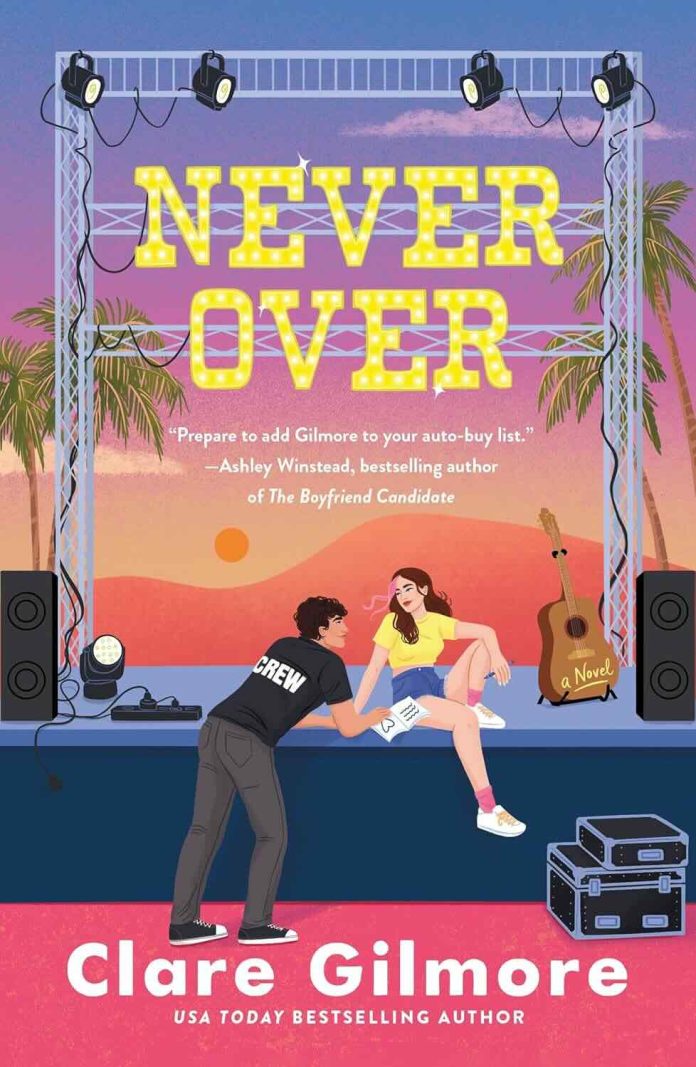
Clare Gilmore’s Never Over poses a question that resonates beyond its Nashville backdrop: Can you mine your past heartbreak for creative gold without reopening old wounds? This third offering from Gilmore, following Perfect Fit and Love Interest, demonstrates her evolving mastery of contemporary romance while tackling the messy intersection between artistic ambition and authentic connection.
Twenty-five-year-old Paige Lancaster exists in the shadows of her four vibrant sisters and a childhood spent being perpetually invisible. When music publisher Paul Friedman dangles a contract with one caveat—that her lyrics need more emotional depth—Paige makes a decision that borders on reckless brilliance. She tracks down Liam Bishop, the ex-boyfriend who shattered her four years prior, with an unusual proposition: date her for the summer, break her heart again, and give her the raw material she needs to write songs that matter.
What unfolds isn’t simply a second-chance romance dressed in music industry glamour. Gilmore crafts a thoughtful exploration of how we use art to process pain, the fine line between inspiration and manipulation, and whether love can flourish when it begins with an expiration date stamped on it.
The Melody of Character Development
Paige Lancaster is Gilmore’s most complex protagonist yet. As the youngest of five daughters, she’s spent her life being the tagalong, the invisible one, the girl defined entirely by her relationships to others. Her character arc from people-pleaser to artist claiming her voice forms the emotional backbone of this narrative.
The author captures Paige’s journey with remarkable authenticity:
- Initial state: A waitress with a prestigious Belmont songwriting degree, afraid to claim her own talent
- Core conflict: Struggling between writing for commercial success and protecting her emotional truth
- Growth trajectory: Learning that vulnerability isn’t weakness and that authentic connection can coexist with artistic ambition
- Defining moment: Choosing to perform her most personal songs publicly, reclaiming ownership of her story
Liam Bishop emerges as more than the requisite love interest. A former college baseball pitcher whose career-ending injury forced him to reinvent his entire identity, he understands transformation intimately. Gilmore gives him layers that prevent him from becoming a one-dimensional romantic hero. His decision to secretly apply Paige to Belmont four years ago—the betrayal that ended their relationship—wasn’t simple villainy but misguided love colliding with control.
The supporting cast enriches rather than clutters. Paige’s sisters each represent different responses to their absent mother and overwhelmed father, creating a family dynamic that feels lived-in rather than manufactured. Folly, the free-spirited sister currently pregnant and working alongside Paige, provides both comic relief and emotional wisdom. The musicians Paige encounters on tour—Penelope Parker, the Etta Girls, and Misha Mohan—create a vibrant ecosystem that mirrors the collaborative nature of the music industry.
Harmonizing Romance with Reality
Gilmore’s depiction of the music industry demonstrates genuine research and insider understanding. The tour logistics, sound checks, cowriting sessions, and contract negotiations ground the romantic fantasy in professional reality. Readers gain insight into the collaborative songwriting process, the vulnerability required to share unfinished work, and the delicate balance between commercial viability and artistic integrity.
The romance itself employs several beloved tropes executed with fresh perspective:
- Second-chance romance with legitimate obstacles from their past
- Forced proximity during the summer tour
- Fake relationship elements that blur into genuine feelings
- Grumpy-sunshine dynamics subtly woven through their interactions
However, what elevates Never Over beyond tropey satisfaction is Clare Gilmore’s refusal to sand down the rough edges. Paige’s initial proposition is ethically murky—using someone’s emotions as creative fuel raises uncomfortable questions the narrative doesn’t shy away from. The characters grapple with whether art for art’s sake justifies emotional manipulation, even when all parties theoretically consent.
Where the Beat Falters
Despite its considerable strengths, Never Over by Clare Gilmore occasionally stumbles under the weight of its own ambitions. The dual timeline structure—alternating between present-day tour life and four-years-ago flashbacks—sometimes creates pacing issues. Certain revelations about their past relationship arrive when readers have already pieced together the puzzle, diminishing their emotional impact.
The central conflict occasionally feels manufactured. While Paige’s codependency and people-pleasing tendencies are well-established, her complete paralysis around writing authentic lyrics sometimes strains credulity for someone who completed a rigorous songwriting program. The narrative would benefit from exploring why she flourished academically but flounders professionally beyond the obvious answer of heartbreak.
Additionally, the resolution arrives with perhaps too much tidiness. Several plot threads—Paige’s relationship with her absent mother, Folly’s pregnancy journey, the fate of specific songs—wrap up in ways that favor narrative satisfaction over messy realism. Some readers may find this comforting; others might wish for more ambiguity in the ending.
The Art of the Sentence
Gilmore’s prose shines brightest in intimate moments. She has a gift for capturing the physical manifestations of emotional states—the way Paige’s voice literally disappears when overwhelmed, how Liam’s hands betray his feelings when his words don’t. The dialogue crackles with wit and authenticity, particularly in exchanges between Paige and her sisters or the musicians on tour.
The author effectively mirrors the songwriting process in her narrative structure. Just as Paige builds songs from fragments—a melody here, a lyric there—Gilmore constructs scenes through sensory details that accumulate into emotional crescendos. The motif of songs as memory devices, each associated with specific moments in Paige and Liam’s relationship, provides elegant thematic unity.
The Deeper Chords
Beneath the romantic surface, Never Over by Clare Gilmore wrestles with substantial themes about identity formation, family legacy, and the relationship between pain and creativity. Paige’s journey mirrors that of many women who’ve spent their lives adapting to others’ expectations rather than discovering their own desires. Her four sisters represent different responses to maternal abandonment and paternal emotional absence, creating a nuanced portrait of how childhood wounds shape adult choices.
The book’s examination of the art-versus-life question proves particularly resonant. Can you create meaningful art without mining your deepest pain? Should you? What happens when the people in your life become characters in your creative work? These questions linger beyond the final page, suggesting depths that extend past typical romance fare.
The Verdict and Your Next Read
Never Over by Clare Gilmore succeeds as both swoony romance and thoughtful meditation on creativity’s costs. While it doesn’t revolutionize the second-chance trope, Gilmore brings enough emotional intelligence and industry authenticity to justify the journey. Readers seeking pure escapist romance may find the introspective elements occasionally slow the momentum, while those wanting deeper character exploration will appreciate Gilmore’s willingness to complicate her love story with genuine obstacles.
If You Loved This, Try These Similar Reads:
- Beach Read by Emily Henry – Romance between writers wrestling with creative blocks and past heartbreak
- The Unhoneymooners by Christina Lauren – Forced proximity romance with emotional depth beneath the comedy
- Daisy Jones & The Six by Taylor Jenkins Reid – Music industry setting with complex relationship dynamics
- People We Meet on Vacation by Emily Henry – Second-chance romance built on years of friendship and unresolved feelings
- The Kiss Quotient by Helen Hoang – Romance featuring a protagonist learning to claim her desires and voice
Clare Gilmore has crafted a romance that honors both the heart’s capacity for healing and art’s power to transform pain into beauty. Never Over proves that sometimes the most compelling love stories are the ones we write and rewrite until we finally get them right.