There’s something magical about picking up a young adult novel and feeling that instant spark of recognition. Whether it’s the tension between two characters who clearly despise each other (but we know better), the moment an ordinary teenager discovers they’re actually the prophesied savior of the world, or the heart-fluttering dynamics of a fake relationship that’s about to become very real, these familiar patterns, known as Young Adult Tropes, have an undeniable power to captivate readers.
Young adult book tropes aren’t just recycled plot devices—they’re the emotional DNA of teen fiction, carefully crafted patterns that speak directly to the adolescent experience. These narrative structures have evolved to address the unique challenges, dreams, and anxieties that define the journey from childhood to adulthood, creating stories that feel both comfortingly familiar and thrillingly unpredictable.
Understanding these popular YA tropes isn’t just academic curiosity; it’s the key to unlocking why certain books become cultural phenomena while others fade into obscurity. From the dystopian rebellion narratives that dominated the 2010s to the contemporary romance patterns taking over BookTok today, these tropes reflect and shape how young people see themselves and their possibilities.
In this comprehensive exploration of young adult book tropes, we’ll dive deep into 25+ irresistible patterns that continue to hook teen readers across genres and generations. We’ll examine why these narrative structures work so effectively, how they’ve evolved to stay relevant, and what makes the difference between a trope that feels fresh and one that falls flat.
Most Popular Young Adult Book Tropes
Based on BookTok mentions, Goodreads tags, and reader surveys
What Are Young Adult Book Tropes?
Young adult book tropes are recognizable narrative patterns, character archetypes, and story structures that appear repeatedly across teen fiction. Unlike simple plot devices, these patterns serve as emotional and psychological frameworks that resonate specifically with the adolescent experience. The term “trope” comes from the Greek word “tropos,” meaning “turn” or “way,” reflecting how these patterns provide familiar pathways through the complex territory of growing up.
What distinguishes young adult book tropes from general fiction patterns is their specific focus on the teenage experience. These tropes address the unique challenges of adolescence: identity formation, first experiences with love and loss, questioning authority, discovering personal power, and navigating the transition from childhood dependence to adult autonomy. They create safe spaces for readers to explore intense emotions and challenging situations within familiar narrative frameworks.
The appeal of these popular YA tropes lies in their ability to validate teenage experiences while providing hope and guidance. When a sixteen-year-old reader encounters a protagonist struggling with similar identity questions or relationship dynamics, the trope creates an immediate emotional connection. The familiar structure allows readers to focus on character development and personal relevance rather than decoding entirely unfamiliar narrative territory.
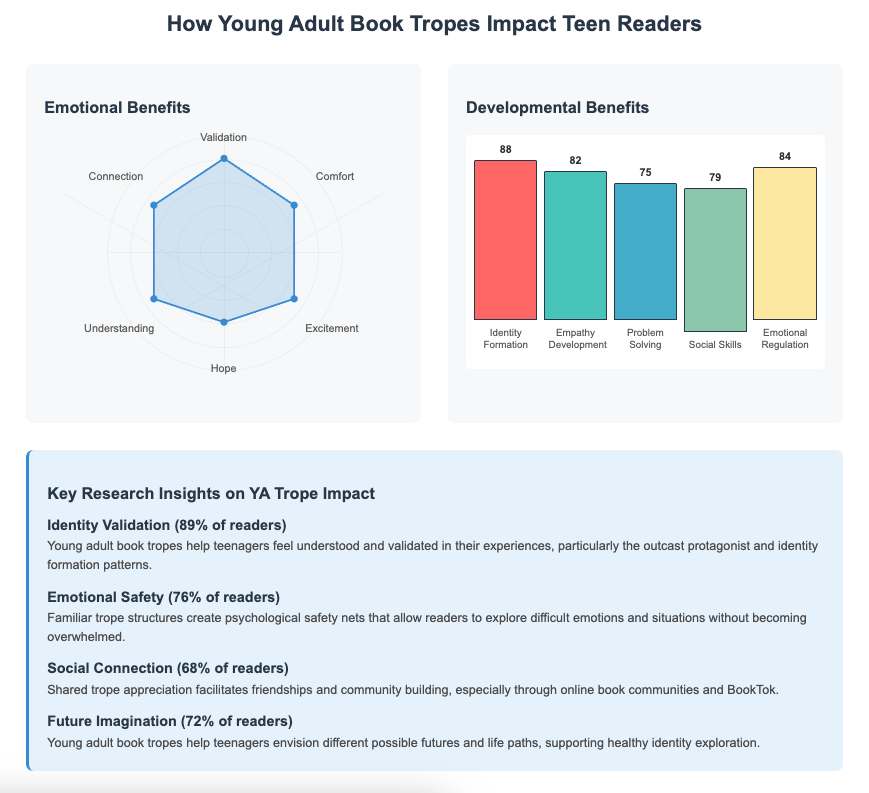
Young adult book tropes also serve important developmental functions. They help teenagers process complex emotions, explore different aspects of identity, and imagine various possible futures. The predictable elements of beloved tropes create psychological safety that enables deeper exploration of challenging themes like first love, family conflict, social pressure, and personal growth.
The Psychology Behind YA Trope Appeal
Understanding why young adult book tropes exert such powerful appeal requires examining the psychological mechanisms at work during adolescence. The teenage brain is undergoing massive developmental changes, particularly in areas responsible for identity formation, emotional regulation, and social understanding. Young adult book tropes provide crucial support during this turbulent period.
Identity Formation and Validation
Adolescence is characterized by intense identity exploration and formation. Teenagers are constantly asking “Who am I?” and “Where do I belong?” Young adult book tropes provide multiple frameworks for exploring these questions safely. The outcast protagonist trope validates feelings of not fitting in, while the chosen one pattern suggests that being different might actually be special and valuable.
The psychological concept of “possible selves”—imagined future identities that motivate current behavior—is heavily supported by YA tropes. When readers encounter characters discovering hidden powers or finding their true calling, they’re simultaneously exploring their own potential futures and capabilities.
Emotional Safety and Exploration
The familiar structure of young adult book tropes creates emotional safety nets that allow teenagers to explore intense feelings without becoming overwhelmed. Knowing that enemies-to-lovers romances will ultimately resolve positively enables readers to enjoy the tension and conflict without genuine anxiety about the outcome.
This emotional safety is particularly important for teenagers who may be experiencing similar situations in real life. A reader navigating their first serious relationship can explore different romantic dynamics through various YA romance tropes, gaining insight and perspective on their own experiences.
Social Connection and Belonging
Young adult book tropes create shared cultural touchstones that facilitate social connection among teen readers. Discussing favorite tropes, recommending books based on beloved patterns, and sharing emotional reactions to familiar story structures helps teenagers build friendships and feel part of larger communities.
The rise of online book communities, particularly on platforms like BookTok and Goodreads, has amplified this social aspect of trope appreciation. Teenagers can find others who share their specific trope preferences, creating micro-communities around particular narrative patterns.
Young Adult Book Tropes Distribution by Genre
by Genre
Romance (35%)
Fantasy (25%)
Contemporary (15%)
Dystopian (12%)
Paranormal (8%)
Sci-Fi (5%)
Romance Tropes in YA Fiction
Romance occupies a central place in young adult literature, with romantic tropes forming the emotional core of many beloved teen novels. These patterns address the unique aspects of first love, teenage relationships, and the intense emotions that characterize adolescent romantic experiences.
Enemies to Lovers
The enemies-to-lovers trope stands as perhaps the most beloved of all young adult book tropes, appearing successfully across fantasy, contemporary, and paranormal romance. This pattern features two characters who begin as adversaries—whether through opposing goals, personality conflicts, or fundamental misunderstandings—before gradually developing mutual respect and eventual romantic attraction.
The appeal of this trope lies in its emotional journey from conflict to connection. Teen readers experience the satisfaction of watching characters overcome their preconceptions while discovering hidden depths in supposed enemies. The initial tension creates natural chemistry and conflict, while the transformation provides compelling character development that mirrors real-life relationship growth.
Classic examples include Elizabeth Bennet and Mr. Darcy in Jane Austen’s “Pride and Prejudice,” which established many conventions still used today. In contemporary YA, Sarah J. Maas’s “A Court of Thorns and Roses” featuring Feyre and Rhysand has become a defining example, while Jennifer L. Armentrout’s “From Blood and Ash” series showcases how this trope evolves in fantasy settings.
Love Triangles
Despite frequent criticism from some readers and critics, love triangles remain among the most popular YA tropes, particularly in young adult literature. This pattern features one character torn between two romantic interests, each representing different qualities, values, or life paths.
The psychological appeal stems from validation of feeling uncertain about major life decisions while exploring compatibility questions that real relationships involve. Well-executed love triangles examine genuine emotional complexity rather than simple indecision, reflecting the confusion many teenagers feel when navigating early romantic relationships.
Stephenie Meyer’s “Twilight” series, featuring Bella’s choice between Edward and Jacob, helped establish modern conventions for this trope. Suzanne Collins’s “The Hunger Games” elevated the pattern by making Katniss’s choice between Peeta and Gale reflect deeper themes about violence, healing, and the kind of future she wanted to build.
Fake Dating/Relationships
Fake relationship scenarios have surged in popularity among contemporary young adult book tropes, especially in romance-focused novels. Characters enter pretend romantic relationships for practical reasons—appeasing family members, making ex-partners jealous, or achieving social goals—before real feelings inevitably develop.
This trope creates delicious tension through forced intimacy and the forbidden nature of growing attraction. Teen readers enjoy watching characters navigate couple-like situations while maintaining emotional distance, knowing that genuine feelings are inevitable. The pattern also provides a safe way to explore romantic dynamics without the vulnerability of immediate emotional investment.
Popular examples include “The Proposal” by Jasmine Guillory in adult romance that influences YA patterns, and “Beach Read” by Emily Henry, which showcases contemporary approaches to the trope. In YA specifically, books like “The Spanish Love Deception” by Elena Armas demonstrate how fake dating evolves for younger audiences.
Forbidden Love
Forbidden love tropes address relationships that violate social rules, family expectations, or institutional boundaries. This pattern appears across all YA subgenres, from contemporary novels featuring relationships across social classes to fantasy stories with lovers from opposing kingdoms or species.
The appeal lies in the “us against the world” dynamic that validates teenage feelings of being misunderstood or constrained by adult authority. These relationships often force characters to choose between love and duty, family and heart, safety and passion—conflicts that mirror real adolescent struggles with independence and identity.
Examples range from Shakespeare’s “Romeo and Juliet,” which established foundational patterns, to contemporary YA like “Eleanor & Park” by Rainbow Rowell, which explores forbidden love across racial and economic boundaries. Fantasy examples include “Red Queen” by Victoria Aveyard, where love develops across enemy lines.
First Love Intensity
The first love intensity trope captures the overwhelming, all-consuming nature of teenage romantic feelings. These narratives validate the genuine emotional power of adolescent relationships while exploring themes of vulnerability, growth, and the transformative nature of love.
This pattern acknowledges that teenage emotions, while sometimes dismissed by adults, are genuinely intense and meaningful. The trope provides frameworks for exploring the euphoria, anxiety, passion, and confusion that characterize first romantic experiences.
Notable examples include “Eleanor & Park” by Rainbow Rowell, which captures the breathless intensity of first love, and “The Fault in Our Stars” by John Green, which combines first love with profound themes about mortality and meaning.
Evolution of Young Adult Romance Tropes
Fantasy and Supernatural Tropes
Fantasy elements dominate many of the most popular young adult book tropes, providing frameworks for exploring adolescent themes through metaphor and magical realism. These patterns allow readers to examine personal growth, identity formation, and empowerment through supernatural lenses.
The Chosen One
The chosen one represents one of the most enduring young adult book tropes, spanning from ancient mythologies to modern fantasy epics. This pattern features ordinary individuals who discover they possess special destinies, unique abilities, or prophetic significance that makes them crucial to saving their world or community.
This trope resonates powerfully because it validates the universal teenage desire to be special and significant. Every adolescent reader can imagine themselves as the unlikely hero who rises to meet extraordinary challenges. The pattern provides clear stakes and motivation while exploring themes of responsibility, sacrifice, and personal growth that mirror real-world coming-of-age experiences.
J.K. Rowling’s Harry Potter remains the most influential recent example, establishing many modern conventions for the chosen one narrative. The series demonstrates how this trope can evolve across multiple books, showing the burden and growth that comes with special destiny. Other notable examples include Rick Riordan’s Percy Jackson series, which modernizes Greek mythology, and Cassandra Clare’s “The Mortal Instruments,” which combines chosen one elements with urban fantasy settings.
Hidden Powers/Special Abilities
The discovery of supernatural abilities ranks among the most appealing young adult book tropes across fantasy, urban fantasy, and paranormal genres. Characters learn they possess magical powers, psychic abilities, or enhanced skills they were previously unaware of possessing.
This pattern appeals to anyone who has felt different, overlooked, or like they don’t quite fit in—common adolescent experiences. The power discovery provides the fantasy that hidden potential might explain feelings of not belonging, transforming perceived weaknesses into actual strengths. The revelation often coincides with learning about magical heritage or joining supernatural communities where differences are valued.
Examples include Percy Jackson discovering his demigod status in Rick Riordan’s series, which connects power discovery to family heritage and identity. The X-Men comics and films showcase characters manifesting mutant abilities during adolescence, directly paralleling teenage development. In YA literature, books like “Shadow and Bone” by Leigh Bardugo explore how discovering magical abilities changes both personal identity and social relationships.
Magical Schools/Academies
Educational settings for supernatural learning have become incredibly popular young adult book tropes, largely influenced by the massive success of Hogwarts in the Harry Potter series. These institutions provide controlled environments where young people can develop their abilities while navigating typical adolescent challenges like friendship, romance, and academic pressure.
The appeal lies in combining the familiar school setting—something all readers understand—with the excitement of magical education. These environments validate the teenage experience of feeling like you’re learning who you are while providing fantasies about what that education might look like if you possessed special abilities.
Beyond Harry Potter, examples include Richelle Mead’s “Vampire Academy,” which combines supernatural education with boarding school drama, and “The School for Good and Evil” by Soman Chainani, which explores fairy tale education. More recent examples like “Fourth Wing” by Rebecca Ross blend military academy structures with dragon bonding, showing how the trope continues evolving.
Special Heritage Discovery
Learning about magical or significant ancestry provides powerful frameworks for exploring identity and belonging—central concerns of adolescence. Characters discover they’re descended from powerful magical bloodlines, royal families, or supernatural beings, fundamentally changing their understanding of themselves and their place in the world.
This trope addresses teenage questions about identity and potential while providing explanations for feeling different or special. The heritage revelation often comes with both power and responsibility, reflecting real-world experiences of learning about family history and cultural identity.
Examples include “Throne of Glass” by Sarah J. Maas, where Celaena’s true heritage unfolds across multiple books, and “Red Queen” by Victoria Aveyard, where Mare discovers her unique abilities stem from her mixed heritage. These revelations typically drive both character development and plot progression, making them central to YA fantasy narratives.
Identity and Belonging Tropes
Young adult literature excels at exploring themes of identity formation and the search for belonging—fundamental aspects of the teenage experience. Several key tropes provide frameworks for examining these crucial developmental challenges.
Found Family
Found family has become increasingly popular among young adult book tropes, reflecting changing social attitudes about what constitutes family and the growing recognition that chosen relationships can be as meaningful as biological ones. This pattern features characters who form deep, family-like bonds with people they’re not related to, often after losing biological families or never experiencing healthy family relationships.
The trope appeals to readers who value chosen relationships over inherited ones, celebrating the idea that love and loyalty matter more than blood connections. Found families often form among outcasts, adventurers, or survivors who support each other through challenges that biological families might not understand or accept.
The “Fast and Furious” franchise popularized the “family is who you choose” theme in popular culture, while “The Lord of the Rings” fellowship demonstrates the power of chosen bonds in fantasy literature. In YA specifically, examples include the crew in “Six of Crows” by Leigh Bardugo, which showcases how damaged teenagers can heal through mutual care and support. “The Raven Boys” by Maggie Stiefvater explores found family dynamics within contemporary fantasy settings.
The Outcast Protagonist
Outcast protagonists who don’t fit in with their peers appear frequently in young adult book tropes, validating the common teenage experience of feeling different, misunderstood, or socially isolated. These characters often discover that their differences are actually strengths or that there are communities where they belong.
This pattern provides comfort to readers who feel like outsiders while suggesting that not fitting in might indicate special qualities rather than personal flaws. The outcast’s journey typically involves finding their people and learning to value their unique perspectives and abilities.
Examples include Charlie in “The Perks of Being a Wallflower” by Stephen Chbosky, who finds acceptance through friendship and self-discovery. “Miss Peregrine’s Home for Peculiar Children” by Ransom Riggs literalizes the outcast experience through characters with supernatural abilities who find sanctuary together. Contemporary examples like “Aristotle and Dante Discover the Secrets of the Universe” by Benjamin Alire Sáenz explore cultural and sexual identity aspects of feeling like an outsider.
Secret Societies
Hidden organizations with special knowledge create frameworks for exploring belonging and exclusivity while addressing teenage desires to be part of something important and secret. These groups often recruit outcasts or individuals with special abilities, providing instant community and purpose.
The appeal lies in the fantasy of being chosen for something exclusive and meaningful, while the secrecy adds excitement and importance to membership. These societies often come with both privileges and responsibilities, reflecting real-world experiences with exclusive groups and communities.
Examples include “The Secret History” by Donna Tartt, which explores the dark side of exclusive academic communities, and “The Raven Boys” series, where secret knowledge about ley lines creates informal societies. Urban fantasy like “City of Bones” features shadow societies of supernatural beings operating hidden from mundane awareness.
Adventure and Growth Tropes
Adventure-focused young adult book tropes provide frameworks for exploring personal growth, courage development, and the transition from dependence to independence that characterizes adolescence.
Coming-of-Age Journeys
Coming-of-age journeys form the backbone of many young adult book tropes, featuring protagonists who undergo significant physical, emotional, or psychological transformation while facing challenges that force them to mature and take responsibility.
These narratives address universal aspects of growing up while providing hope that the difficult transition from childhood to adulthood can lead to strength, wisdom, and authentic self-knowledge. The journey often involves leaving familiar environments, facing fears, and discovering inner resources.
Classic examples include “The Outsiders” by S.E. Hinton, which established many YA conventions, and “The Hunger Games,” where survival challenges force rapid maturation. Contemporary examples like “The Hate U Give” by Angie Thomas explore coming-of-age through social justice themes, while fantasy examples like “The Golden Compass” combine personal growth with epic adventure.
Rebellion Against Authority
Challenging adult control and institutional power appears frequently in young adult book tropes, reflecting natural adolescent development toward independence and autonomy. These narratives validate teenage impulses to question rules while exploring the complexities of authority, justice, and social change.
The appeal lies in wish fulfillment around teenage powerlessness while providing frameworks for examining when rebellion is justified and how to create positive change. These stories often show young people succeeding where adults have failed, validating youth perspectives and capabilities.
“The Hunger Games” trilogy exemplifies this trope through Katniss’s rebellion against the Capitol, while “Divergent” by Veronica Roth explores rebellion within faction-based society. Contemporary examples like “The Hate U Give” show rebellion through social activism and speaking truth to power.
The Underdog
Underdog stories represent universally appealing young adult book tropes that transcend genre boundaries. These narratives feature protagonists who begin with significant disadvantages—lack of resources, training, natural ability, or social status—before overcoming seemingly insurmountable odds through determination and character growth.
Everyone can relate to feeling overlooked or disadvantaged at some point, making underdog victories particularly satisfying for teenage readers. These stories validate the belief that effort and character matter more than initial advantages, providing hope for readers facing their own challenges.
Examples range from sports narratives to academic competitions to supernatural battles. “Harry Potter” functions as an underdog story despite the chosen one elements, as Harry consistently faces opponents with greater knowledge, resources, and power. “The Queen’s Gambit” by Walter Tevis shows an underdog chess prodigy, while “Red Rising” by Pierce Brown features an underdog challenging an entire social system.
Contemporary and Realistic Fiction Tropes
Not all popular young adult book tropes involve supernatural elements or epic adventures. Contemporary YA fiction has developed its own set of patterns that address real-world teenage experiences and challenges.
Identity Formation Struggles
Realistic exploration of identity development appears frequently in contemporary young adult book tropes, addressing questions about sexual orientation, cultural identity, family expectations versus personal dreams, and authentic self-expression.
These narratives validate the confusion and exploration that characterize adolescent identity development while providing representation for diverse experiences and perspectives. The struggles often involve reconciling different aspects of identity or choosing between competing loyalties and expectations.
Examples include “Simon vs. the Homo Sapiens Agenda” by Becky Albertalli, which explores coming out and gay identity, and “American Born Chinese” by Gene Luen Yang, which addresses cultural identity and assimilation. “The House You Pass on the Way” by Jacqueline Woodson examines racial and sexual identity intersection.
Family Dynamics
Complex family relationships provide rich material for young adult book tropes, exploring divorce, blended families, parent-teen relationship evolution, sibling dynamics, and generational conflict. These patterns address universal family experiences while validating teenage perspectives on family challenges.
The appeal lies in seeing family struggles reflected in literature while gaining perspective on different approaches to family conflict and resolution. These stories often show growth and understanding developing between family members through communication and empathy.
Examples include “It’s Kind of a Funny Story” by Ned Vizzini, which explores family dynamics around mental health, and “The Perks of Being a Wallflower” by Stephen Chbosky, which examines family trauma and healing. “Everything I Never Told You” by Celeste Ng explores family expectations and cultural pressures within Asian-American families.
Mental Health Exploration
Contemporary young adult book tropes increasingly address mental health themes, including depression, anxiety, eating disorders, self-harm, and therapy experiences. These narratives help reduce stigma while providing representation and validation for readers facing similar challenges.
The growing awareness of teenage mental health issues has made these tropes more prominent and important in YA literature. These stories often show characters seeking help, developing coping strategies, and finding support systems, providing hopeful models for readers.
Examples include “Speak” by Laurie Halse Anderson, which addresses trauma and recovery, and “All the Bright Places” by Jennifer Niven, which explores bipolar disorder and depression. “Wintergirls” by Laurie Halse Anderson examines eating disorders, while “Turtles All the Way Down” by John Green focuses on anxiety and OCD.
Dystopian and Sci-Fi YA Tropes
The dystopian boom of the 2010s established several young adult book tropes that continue influencing teen fiction, even as the genre has evolved beyond its initial popularity peak.
Dystopian Government Control
Dystopian settings that amplify feelings of powerlessness against authority became dominant young adult book tropes following the success of “The Hunger Games.” These narratives feature oppressive governments that control citizens through surveillance, propaganda, resource limitation, or forced participation in brutal systems.
The appeal lies in externalizing teenage feelings of powerlessness while providing frameworks for resistance and change. These stories validate adolescent perceptions that adult authority can be corrupt or misguided while offering hope that young people can create positive change even against overwhelming odds.
“The Hunger Games” by Suzanne Collins established many conventions still used today, featuring a totalitarian government that forces children to fight to the death for entertainment. “Divergent” by Veronica Roth explored control through social categorization and faction systems. “The Giver” by Lois Lowry, though earlier, influenced many later dystopian narratives with its exploration of controlled, emotionless society.
Post-Apocalyptic Survival
Survival narratives in post-apocalyptic settings provide frameworks for exploring resilience, leadership, and community building while addressing teenage anxieties about the future. These stories often feature young protagonists taking responsibility in broken worlds where adult systems have failed.
The pattern appeals to readers by validating youth perspectives while providing empowerment fantasies about capability and importance. These narratives often show teenagers succeeding where adults have failed, building new and better communities from the ruins of the old.
Examples include “The Maze Runner” by James Dashner, which combines survival elements with mystery and memory loss, and “The 5th Wave” by Rick Yancey, which blends alien invasion with survival themes. More recent examples like “The Darkest Minds” by Alexandra Bracken focus on children with supernatural abilities surviving in hostile post-pandemic environments.
Tournament and Competition
Structured contests driving plot development became popular young adult book tropes largely through “The Hunger Games” influence, but the pattern has evolved to include academic competitions, magical tournaments, and selection processes for elite positions.
These competitions provide clear stakes and progression while exploring themes of fairness, talent versus effort, and the costs of success. The competitive framework often reveals character through how participants treat opponents and handle pressure.
Beyond “The Hunger Games,” examples include “Red Rising” by Pierce Brown, which features competitions for social advancement, and “The Testing” by Joelle Charbonneau, which focuses on academic competition for university admission. Fantasy variations appear in “Fourth Wing” by Rebecca Ross with dragon bonding competitions.
The Evolution and Subversion of YA Tropes
As young adult literature has matured and diversified, authors have become increasingly sophisticated in their use of popular YA tropes, leading to creative subversions and innovative combinations that keep familiar patterns feeling fresh.
Modern Trope Consciousness
The rise of social media book communities, particularly BookTok and Goodreads, has created unprecedented awareness of young adult book tropes among both readers and writers. This consciousness has led to more intentional trope usage, creative subversions, and reader demands for specific patterns.
Contemporary authors often acknowledge trope awareness directly, using familiar patterns as starting points for deeper exploration or creative subversion. This meta-awareness allows for more sophisticated storytelling that honors what readers love about certain tropes while challenging problematic elements or offering fresh perspectives.
Problematic Elements and Modern Solutions
Many traditional young adult book tropes contained problematic elements that reflected the social attitudes of their time. Love triangles often reduced female agency to romantic choice, chosen one narratives could promote individual exceptionalism over community cooperation, and enemies-to-lovers relationships sometimes romanticized toxic dynamics.
Contemporary YA authors have worked to address these issues while maintaining the emotional appeal of beloved tropes. Modern enemies-to-lovers relationships emphasize mutual respect and growth rather than dominance and submission. Love triangles increasingly resolve with protagonists choosing themselves or finding polyamorous solutions rather than simple either-or decisions.
Cultural Diversification
The expansion of diverse voices in YA literature has led to the incorporation of different cultural perspectives into traditional young adult book tropes. Romance patterns now reflect various cultural approaches to relationships and family involvement. Coming-of-age narratives incorporate different cultural rites of passage and family structures.
This diversification has enriched the global vocabulary of YA tropes while creating opportunities for cross-cultural understanding and appreciation. Readers worldwide can now access storytelling traditions beyond their local literary cultures, expanding their trope preferences and cultural awareness.
Evolution of Young Adult Book Tropes: Traditional vs Modern Approaches
Key Improvements in Modern YA Tropes:
- Consent Culture: Relationships emphasize enthusiastic consent and clear communication
- Diverse Representation: LGBTQ+, multicultural, and neurodivergent characters in leading roles
- Mental Health Awareness: Realistic portrayal of therapy, medication, and mental health support
- Healthy Relationships: Focus on mutual respect, support, and individual growth within partnerships
- Social Justice Integration: Contemporary issues woven naturally into fantasy and contemporary settings
Global Perspectives and Cultural Variations
Young adult book tropes don’t exist in cultural isolation. Different literary traditions around the world have contributed unique patterns to the global YA landscape, while familiar tropes take on new meanings when filtered through different cultural contexts.
Eastern Storytelling Influences
Japanese light novels, Korean webtoons, and Chinese web novels have introduced distinctive patterns to global young adult book tropes. Cultivation narratives from Chinese literature emphasize gradual self-improvement and mastery rather than sudden power discovery, offering different approaches to personal growth themes.
Korean media has contributed unique romantic dynamics and family relationship patterns that emphasize respect, persistence, and emotional support. The popularity of K-pop and K-dramas has influenced contemporary YA romance, introducing concepts like the “green flag” male love interest who demonstrates emotional intelligence and healthy communication from the beginning.
Japanese storytelling traditions contribute complex power systems, detailed world-building approaches, and unique character archetypes that have influenced Western YA fantasy. The concept of “nakama” (companions who become family through shared struggle) has enriched found family tropes in global YA literature.
Indigenous and Diverse Cultural Contributions
Indigenous authors have brought unique perspectives to young adult book tropes, particularly in areas of spiritual connection, community responsibility, and environmental stewardship. These contributions challenge individualistic approaches to chosen one narratives, emphasizing community support and collective responsibility.
African and African-diaspora authors have contributed rich mythological foundations for fantasy tropes while addressing themes of cultural identity, colonialism, and resistance. Latin American magical realism traditions have influenced how supernatural elements integrate with contemporary settings in YA literature.
The Psychology of Trope Combinations
Modern young adult book tropes rarely appear in isolation. Successful contemporary YA novels typically layer multiple tropes together, creating rich, multifaceted narratives that satisfy different reader preferences simultaneously while avoiding the predictability that comes with relying on single patterns.
Strategic Layering
Authors increasingly combine complementary young adult book tropes to create narrative depth. A single novel might feature enemies-to-lovers romance within a magical academy setting, combined with found family dynamics and a tournament competition structure. This layering allows for more complex character development and plot progression while maintaining familiar emotional touchstones.
The key to successful trope combination lies in ensuring that each pattern serves the overall narrative rather than competing for attention. The best YA novels use multiple tropes to reinforce central themes and character arcs, creating synergistic effects that amplify emotional impact.
Reader Satisfaction and Expectations
Contemporary readers often seek specific trope combinations, leading to increasingly sophisticated reader awareness of narrative patterns. BookTok and Goodreads users frequently describe books by their trope combinations, creating a shared vocabulary for discussing narrative preferences.
This awareness has led to more intentional marketing around trope content, with publishers and authors explicitly highlighting trope combinations to attract target audiences. Reader reviews increasingly focus on trope execution and combination effectiveness, influencing how authors approach familiar patterns.
The Future of Young Adult Book Tropes
As we look toward the future of young adult literature, several trends suggest how popular YA tropes will continue evolving to meet changing reader needs and social contexts.
Technology Integration
Digital natives expect technology to play realistic roles in contemporary YA narratives. Social media dynamics, online relationships, digital privacy concerns, and virtual reality experiences are becoming integrated into traditional young adult book tropes. Romance patterns now include online relationships and digital communication, while identity formation stories address social media influence and digital identity management.
The rise of AI and virtual reality will likely create entirely new trope categories addressing human-AI relationships, virtual world experiences, and questions about authentic identity in digital spaces. These technological elements will be woven into familiar emotional patterns rather than replacing them entirely.
Environmental and Global Consciousness
Climate change anxiety and global interconnectedness are beginning to influence young adult book tropes, with new patterns emerging around environmental catastrophe, global cooperation, and sustainable living. These contemporary concerns are being integrated into familiar trope structures, creating hybrid patterns that address modern anxieties while maintaining emotional appeal.
Future YA tropes will likely include climate refugees, environmental activism, sustainable technology, and global community building as central themes, while maintaining the personal growth and relationship dynamics that make YA literature appealing.
Mental Health Normalization
The growing awareness and acceptance of mental health challenges among teenagers will continue influencing how young adult book tropes address psychological well-being. Therapy, medication, and mental health support are becoming normalized elements in YA narratives rather than exceptional circumstances.
Future tropes will likely include mental health advocacy, peer support systems, and recovery journeys as standard elements rather than special focus areas. The stigma reduction around mental health treatment will create new narrative possibilities for character development and conflict resolution.
🔮 Emerging Young Adult Book Tropes: 2025-2030 Predictions
How Readers Can Navigate and Discover YA Tropes
Understanding your preferences among young adult book tropes can significantly enhance your reading experience while helping you discover new books and authors that align with your interests.
Identifying Personal Trope Preferences
The first step in leveraging young adult book tropes for better reading experiences involves systematically examining your favorite books to identify recurring patterns. Create a reading journal that tracks not just titles and ratings, but specific tropes each book contains and your emotional response to them.
Pay attention to which elements consistently appear in your highest-rated books. Do you gravitate toward enemies-to-lovers dynamics? Are you drawn to magical academy settings? Do found family narratives consistently move you to tears? Recognizing these patterns helps you understand your reading DNA and seek out similar content more effectively.
Consider using online tools and communities to help identify tropes. Goodreads allows users to tag books with specific tropes, while BookTok creators often organize content around trope discussions. StoryGraph and other reading platforms provide detailed content warnings and trope tagging that can help you identify patterns in your reading preferences.
Expanding Your Trope Horizons
Once you’ve identified your favorite young adult book tropes, consider exploring adjacent patterns or familiar tropes in unfamiliar genres. This gradual expansion allows you to experience new narrative structures while maintaining connection to beloved elements.
If you love enemies-to-lovers in contemporary romance, try fantasy novels with similar romantic dynamics. Mystery fans who enjoy unreliable narrators might explore psychological thrillers or contemporary YA with similar narrative techniques. This approach helps you discover new genres without completely abandoning the patterns that initially drew you to reading.
Use trope combinations as bridges to new reading territories. A book that combines your favorite romance trope with an unfamiliar fantasy element might help you develop appreciation for magical world-building. Similarly, contemporary novels that incorporate beloved fantasy character dynamics can help bridge genre preferences.
Critical Reading and Trope Evaluation
Developing critical reading skills around young adult book tropes helps you distinguish between skillful execution and lazy reliance on familiar patterns. Learn to recognize when authors use tropes as foundations for building something fresh versus when they depend on tropes to carry entire narratives without additional development.
Pay attention to how authors handle potentially problematic elements within beloved tropes. Does an enemies-to-lovers relationship emphasize mutual growth and respect, or does it romanticize toxic dynamics? Do chosen one narratives acknowledge community support and sacrifice, or do they promote unhealthy individualism?
Understanding trope evolution helps you appreciate innovative approaches to familiar patterns. Authors who successfully subvert expectations while maintaining emotional appeal demonstrate mastery of both reader psychology and narrative craft.
For Writers: Using YA Tropes Effectively
Aspiring young adult authors can leverage understanding of popular YA tropes to create emotionally resonant stories that honor reader expectations while offering fresh perspectives and innovative execution.
Foundation vs. Crutch
The key distinction between effective and ineffective trope usage lies in treating familiar patterns as foundations rather than complete solutions. Young adult book tropes provide emotional and structural scaffolding that supports unique character development, innovative plot elements, and meaningful thematic exploration.
Use tropes to establish quick emotional connections with readers, then build beyond those initial frameworks. An enemies-to-lovers setup creates immediate tension and reader investment, but the specific reasons for conflict, the process of resolution, and the unique character dynamics must come from original development.
Avoid over-reliance on trope expectations to drive narrative momentum. While readers appreciate familiar patterns, they also expect authors to justify those patterns through compelling character motivations, logical plot development, and meaningful thematic content.
Subversion Strategies
Successful trope subversion maintains the emotional appeal that makes patterns popular while challenging assumptions or offering fresh perspectives. The best subversions honor what readers love about familiar tropes while providing commentary on problematic elements or exploring unconsidered possibilities.
Consider subverting reader expectations about resolution rather than setup. Maintain the emotional journey that makes a trope appealing while arriving at unexpected but satisfying conclusions. A love triangle might resolve with the protagonist choosing neither option, starting a business with both love interests, or realizing they’re aromantic—subversions that honor character development while challenging traditional assumptions.
Respectful subversion requires understanding why certain patterns appeal to readers. Chosen one narratives satisfy desires for significance and agency; subversions should provide alternative paths to those emotional rewards rather than simply denying them.
Combining Multiple Tropes
Contemporary YA novels increasingly layer multiple young adult book tropes to create rich, multifaceted narratives. Successful combination requires ensuring that each pattern serves the overall story rather than competing for attention or creating conflicting expectations.
Choose tropes that reinforce central themes and character arcs. A magical academy setting might combine naturally with found family dynamics and hidden powers discovery, all supporting themes about belonging and self-discovery. Romance tropes should complement rather than overshadow adventure or fantasy elements.
Balance familiar comfort with narrative surprise by combining expected and unexpected trope elements. Readers might anticipate certain romantic developments while remaining surprised by magical system reveals or plot twist execution.
The Cultural Impact of Young Adult Book Tropes
Young adult book tropes extend far beyond individual reading experiences to influence broader cultural conversations about adolescence, relationships, identity, and social values. Understanding this impact reveals why these narrative patterns matter beyond entertainment value.
Shaping Teen Expectations and Aspirations
Popular young adult book tropes help shape how teenagers understand relationships, personal growth, and possible futures. The prevalence of certain romantic patterns influences how young people approach dating and partnership, while coming-of-age narratives provide models for navigating identity development and adult transition.
The representation within beloved tropes matters enormously for teenage readers who are forming their understanding of what’s possible and normal. Diverse representation in enemies-to-lovers narratives helps normalize different types of relationships, while varied approaches to chosen one stories expand concepts of leadership and heroism.
Contemporary awareness of this influence has led to more intentional representation efforts and critical examination of the messages embedded within popular narrative patterns. Authors and publishers increasingly consider the educational and social impact of the tropes they employ and promote.
Influence on Other Media
Young adult book tropes have significantly influenced television, film, and digital media, creating shared cultural touchstones that extend across different entertainment platforms. The success of YA adaptations has brought book-specific narrative patterns into mainstream visual media, influencing how stories are told across different formats.
Social media platforms have created new venues for trope appreciation and discussion, with BookTok, Instagram, and Twitter communities organizing around specific narrative patterns. This digital engagement has accelerated trope evolution and awareness while creating international communities around shared reading preferences.
Gaming and interactive media increasingly incorporate young adult book tropes, allowing players to experience familiar narrative patterns through interactive participation. Dating simulation games, role-playing games, and interactive fiction often draw directly from YA romance and fantasy tropes.
Research and Academic Perspectives
Scholarly interest in young adult book tropes reflects their importance as cultural phenomena worthy of serious academic attention. Researchers in psychology, education, literary studies, and media studies have begun examining how these narrative patterns function and what they reveal about contemporary adolescent development.
Psychological Research Findings
Studies examining the psychological impact of young adult book tropes have found generally positive effects on teenage readers, including increased empathy, improved emotional regulation skills, and enhanced identity exploration. Reading about diverse characters navigating familiar challenges helps teenagers develop broader perspectives and coping strategies.
Research on “bibliotherapy“—the use of literature for psychological healing—has identified specific young adult book tropes as particularly effective for addressing common teenage challenges. Found family narratives help readers who feel isolated or misunderstood, while underdog stories provide hope and motivation for young people facing difficult circumstances.
However, researchers have also identified potential negative impacts from certain trope presentations, particularly around romantic relationships and body image. This research has influenced contemporary approaches to trope execution and representation.
Educational Applications
Educators increasingly recognize young adult book tropes as valuable tools for engaging reluctant readers and facilitating discussions about complex social and emotional topics. The familiar patterns provide accessible entry points for exploring challenging themes like identity, relationships, social justice, and personal growth.
Library science research has shown that trope-based book recommendations significantly improve reader satisfaction and engagement compared to traditional genre-based suggestions. Understanding reader trope preferences allows librarians and teachers to make more targeted recommendations that encourage continued reading.
Writing education programs now include trope awareness and analysis as components of creative writing instruction, helping young authors understand audience expectations while developing their own creative voices.
📚 Your Personal Young Adult Book Tropes Discovery Guide
Identify Your Current Favorites
Quick Self-Assessment:
- Do you prefer slow-burn or instant attraction romances?
- Are you drawn to magical or realistic settings?
- Do you like protagonists who are powerful or underdogs?
- Do family relationships or friend groups matter more to you?
Explore Trope Categories
- Enemies to Lovers
- Fake Dating
- Friends to Lovers
- Love Triangles
- Forbidden Love
- Chosen One
- Hidden Powers
- Magical Schools
- Prophecies
- Special Heritage
- Found Family
- Outcast Protagonist
- Coming of Age
- Identity Struggles
- Secret Societies
- Rebellion vs Authority
- Tournaments
- The Underdog
- Mentor Figures
- Dystopian Settings
Use Discovery Tools
Branch Out Strategically
Try fantasy books with romantic subplots to ease into magical elements while keeping beloved relationship dynamics.
Try science fiction with similar world-building complexity or contemporary books with found family themes.
Try historical fiction with resistance themes or contemporary books addressing social justice.
Try different cultural perspectives on similar themes or time period variations.
Track and Refine
- Identify subtle preferences you might not notice consciously
- Recognize which trope combinations work best for you
- Spot patterns in authors or publishers who consistently execute your favorite tropes well
- Discover which subversions or creative takes on familiar patterns you enjoy
Rate tropes separately from overall book enjoyment. Sometimes you love a trope but dislike the execution, or enjoy a book despite disliking certain trope elements.
Conclusion: The Enduring Power of Young Adult Book Tropes
Young adult book tropes represent far more than simple storytelling shortcuts or signs of unoriginal writing. These popular narrative patterns serve as fundamental building blocks of human storytelling, providing emotional resonance, cognitive efficiency, and community connection that enhance rather than diminish the reading experience.
The 25+ young adult book tropes we’ve explored in this comprehensive analysis represent just a fraction of the rich vocabulary of narrative patterns that continue evolving to meet contemporary needs and values. From the enemies-to-lovers dynamics that help readers explore conflict resolution and personal growth, to the found family narratives that validate chosen relationships over inherited ones, these patterns address the core concerns and dreams of adolescent experience.
Understanding and appreciating these popular YA tropes allows readers to find books they’ll love, discover new genres and authors, and connect with broader reading communities. The patterns provide reliable emotional foundations while supporting infinite creative variations, each offering new insights into universal human experiences of growth, love, identity, and belonging.
For writers, conscious trope usage provides powerful tools for creating emotionally resonant stories that honor reader expectations while offering fresh perspectives and innovative executions. The key lies in treating these young adult book tropes as foundations rather than complete solutions, building unique stories on familiar emotional frameworks that readers already understand and appreciate.
The cultural impact of these narrative patterns extends far beyond individual reading experiences. Young adult book tropes influence how teenagers understand relationships, identity, and possibilities for their futures. They shape conversations about representation, mental health, social justice, and cultural values. The evolution of these patterns reflects broader social progress while maintaining their core function of supporting adolescent development.
As we look toward the future, young adult book tropes will undoubtedly continue adapting to reflect changing social values, technological influences, and global perspectives. Climate change, artificial intelligence, virtual reality, and increasing cultural interconnectedness will create new narrative patterns while enriching existing ones. The fundamental appeal of these patterns—their ability to provide emotional safety, validate experience, and offer hope—ensures their continued relevance.
The rise of social media book communities has created unprecedented awareness of young adult book tropes among both readers and writers. This consciousness has led to more sophisticated usage, creative subversions, and explicit reader preferences that shape publishing decisions. Rather than reducing creativity, this awareness has enhanced the art of storytelling by creating shared vocabulary between creators and audiences.
Contemporary readers increasingly seek books that combine multiple beloved tropes while subverting problematic elements and providing diverse representation. This demand has pushed authors to create more complex, layered narratives that satisfy familiar emotional needs while challenging assumptions and expanding perspectives.
The psychology behind our love for these familiar patterns reveals fundamental aspects of human nature and development. The need for belonging, the desire for significance, the fear of isolation, the hope for transformation—these universal experiences find expression through young adult book tropes that speak directly to adolescent hearts and minds.
Whether you’re a casual reader seeking your next great book, an educator looking to engage students, a librarian making recommendations, or an aspiring writer learning the craft, understanding these young adult book tropes transforms how you approach teen literature. These patterns aren’t limitations but possibilities—invitations to explore universal human experiences through infinite creative variations.
The continuing popularity of young adult book tropes across cultures, generations, and mediums demonstrates their fundamental importance to human narrative understanding. By embracing rather than dismissing these popular narrative patterns, we celebrate the shared heritage of storytelling that connects all readers and writers in the eternal human quest for meaning, connection, and understanding through the power of story.
As young adult literature continues to evolve, these beloved tropes will remain constant companions to new generations of readers, providing the emotional scaffolding needed to navigate the complex, exciting, and sometimes overwhelming journey from childhood to adulthood. In a world of constant change, these familiar patterns offer comfort, hope, and the timeless promise that even the most difficult challenges can lead to growth, love, and authentic self-discovery.
The magic of young adult book tropes lies not in their predictability, but in their ability to make the universal feel personal and the impossible seem achievable. They remind us that every reader’s story matters, every identity deserves representation, and every dream has the potential to become reality—one perfectly crafted, emotionally resonant narrative pattern at a time.







