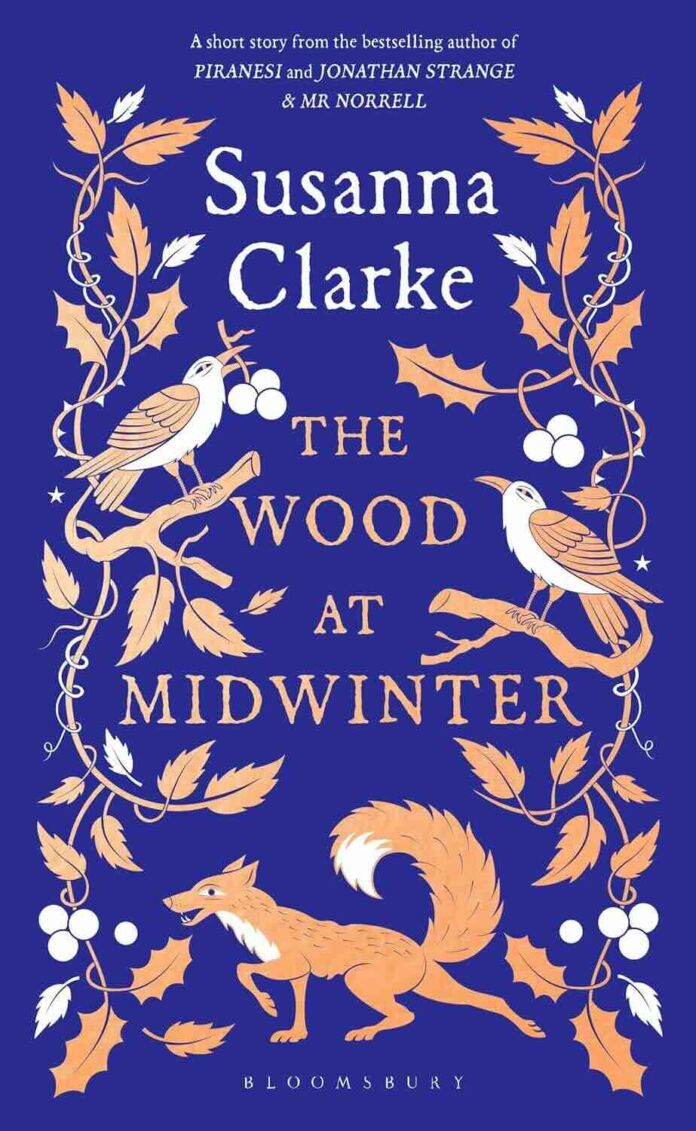
When Susanna Clarke, the acclaimed author of Piranesi and Jonathan Strange & Mr Norrell, releases a new work, the literary world takes notice. The Wood at Midwinter, her latest offering, is a beautifully crafted short story that serves as both a standalone piece and a subtle expansion of her Strange universe. While more intimate in scope than her previous works, this tale carries no less emotional weight or philosophical depth.
The Tale Within the Wood
Set in a snow-dusted Victorian landscape, the story follows nineteen-year-old Merowdis Scott, an extraordinary young woman who shares more in common with medieval saints than her contemporaries. Accompanied by her understanding sister Ysolde, two dogs named Pretty and Amandier, and a delightfully philosophical pig called Apple, Merowdis makes regular pilgrimages to a mysterious wood where the boundaries between the natural and supernatural blur like snow in winter wind.
A Symphony of Voices
Clarke’s genius shines in her ability to weave multiple perspectives into a seamless narrative tapestry. The story shifts effortlessly between human dialogue, animal conversations, and the collective voice of the wood itself. Each character, whether human, animal, or vegetable, speaks with a distinct voice that feels both authentic and slightly otherworldly. Apple the pig’s optimistic practicality (“There’s always something, she said. You just have to smell”) contrasts beautifully with the wood’s ancient, measured wisdom (“All woods join up with all other woods. All are one wood”).
Style and Structure
The prose is quintessential Clarke—precise yet poetic, formal yet intimate. She maintains the period voice that served her so well in Jonathan Strange & Mr Norrell, but here it’s softened by an almost fairy-tale quality that suits the story’s themes of transformation and transcendence. The narrative structure, moving from a seemingly simple afternoon excursion to a profound supernatural encounter, demonstrates Clarke’s mastery of the short form.
Themes and Symbolism
The Sacred and the Natural
One of the story’s most striking aspects is its exploration of the relationship between religious devotion and natural connection. Merowdis’s observation that “A church is a sort of wood… a wood is a sort of church” encapsulates the story’s central theme: the sacred can be found in the natural world, and nature itself possesses a kind of holiness.
Motherhood and Transformation
The story delves deep into the concept of maternal love, though not in conventional terms. Merowdis’s desire for a child manifests in an unexpected way that challenges readers to consider what constitutes true motherhood and nurturing.
Areas of Critique
While the story is masterfully crafted, there are elements that might challenge some readers:
- The pacing in the middle section occasionally slows to a meditative crawl that, while thematically appropriate, might test readers accustomed to more dynamic narratives
- Some may find the resolution uncomfortably ambiguous, though this appears to be by design
- The theological undertones, while fascinating, might feel heavy-handed to readers seeking a simpler tale
Visual Elements
Victoria Sawdon’s illustrations deserve special mention. The delicate line work and attention to natural detail complement Clarke’s prose perfectly, creating a visual atmosphere that enhances rather than overwhelms the story. The illustrations capture both the physical reality of the Victorian setting and the magical elements that lurk at its edges.
In the Context of Clarke’s Work
The Wood at Midwinter serves as an interesting bridge between Clarke’s earlier and more recent work. While it shares the historical setting and magical elements of Jonathan Strange & Mr Norrell, its focus on the relationship between the human and natural worlds echoes themes from Piranesi. The story’s length allows Clarke to experiment with a more concentrated form of her signature style, resulting in something that feels both familiar and fresh.
Literary Connections
The story’s themes and approach bring to mind other works in the British fantastic tradition:
- The nature writings of Robert Macfarlane, particularly in its attention to the personality of place
- Angela Carter’s darker fairy tale retellings
- The religious fantasy of C.S. Lewis, though Clarke’s approach is more nuanced and ambiguous
Final Thoughts
The Wood at Midwinter is a remarkable achievement that showcases Clarke’s ability to pack profound ideas into a relatively small space. While it may not have the scope of her novels, it possesses a similar depth and perhaps even greater emotional immediacy. The story demonstrates that Clarke’s talent for blending the historical with the magical, the ordinary with the miraculous, remains undiminished.
For Readers Who…
- Appreciate subtle, layered fantasy
- Enjoy stories that blur the line between natural and supernatural
- Are interested in examining the intersection of faith and nature
- Love beautifully illustrated works that enhance the reading experience
Not Recommended For…
- Readers who prefer action-driven narratives
- Those uncomfortable with religious themes
- Anyone seeking a straightforward, unambiguous story
The Verdict
The Wood at Midwinter is a finely crafted winter’s tale that rewards careful reading and rereading. While it may not be Clarke’s most ambitious work in terms of scope, it is perhaps her most focused and emotionally resonant. The story proves that sometimes the most profound truths can be found in the smallest spaces—much like the winter wood itself, which contains multitudes in its silent, snow-covered depths.