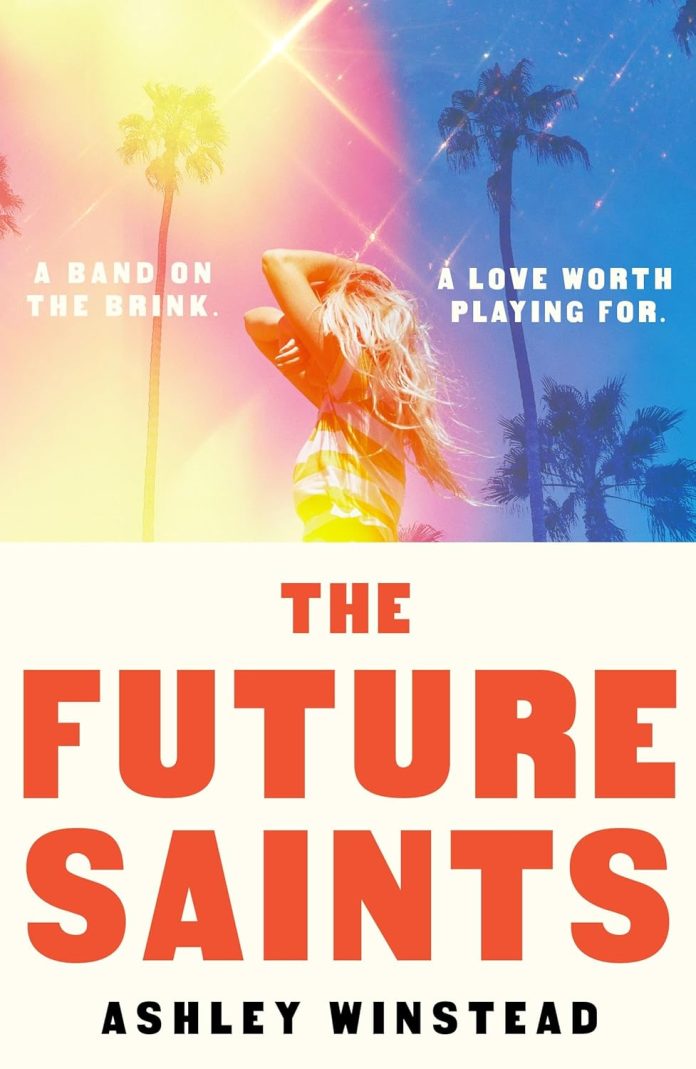
Ashley Winstead delivers her most ambitious work yet with The Future Saints by Ashley Winstead, a sprawling exploration of grief that refuses to romanticize suffering while simultaneously celebrating the transformative power of pain. Following the troubled ascent of California rock band Future Saints and their chaotic front woman Hannah Cortland, Winstead crafts a narrative that feels less like traditional fiction and more like witnessing someone’s unraveling in real time.
The novel opens with record executive Theo Ford arriving at a dive bar in Bonita Vista, California, tasked with an impossible mission: coax one final successful album from a band circling the drain. Since the drowning death of their manager—Hannah’s younger sister Ginny—the Future Saints have abandoned their sunny California pop sound for something darker, more visceral, and infinitely more dangerous. What Theo doesn’t anticipate is Hannah herself: haunted, self-destructive, and utterly magnetic in her refusal to move forward.
The Architecture of Anguish
Winstead’s structural choices elevate The Future Saints by Ashley Winstead beyond conventional contemporary fiction. The narrative weaves between traditional chapters and fabricated media artifacts—Rolling Stone profiles, Pitchfork reviews, TikTok transcripts, and social media commentary. This kaleidoscopic approach mirrors the fragmented reality of modern fame, where public personas become indistinguishable from private pain. Each manufactured article and viral post serves dual purposes: advancing plot while examining how society consumes grief as entertainment.
The prose itself oscillates between lyrical introspection and stark brutality. Winstead’s academic background in contemporary American literature shows in her willingness to experiment with form without sacrificing emotional accessibility. When Hannah performs onstage, the writing pulses with an almost physical intensity. When she spirals in private, the language becomes spare and devastating. This tonal variance keeps readers off-balance in ways that serve the story’s exploration of instability and transformation.
Yet this stylistic ambition occasionally undermines narrative momentum. The multimedia elements, while innovative, sometimes feel excessive—particularly in the novel’s middle section where the ratio of “articles” to traditional narrative grows disproportionate. Readers seeking straightforward storytelling may find themselves frustrated by the constant format shifts, even as they admire Winstead’s formal daring.
The Complicated Geography of Grief
Hannah Cortland emerges as one of contemporary fiction’s most complicated protagonists. She’s neither aspirational nor entirely sympathetic, existing instead in that uncomfortable middle ground where real humans actually live. Her relationship with her deceased sister Ginny forms the novel’s emotional core, and Winstead handles this bond with remarkable nuance. Hannah’s grief manifests as literal hallucinations—she converses with Ginny’s ghost throughout much of the narrative—and the author resists the temptation to pathologize or explain away this coping mechanism too quickly.
The supporting cast proves equally dimensional:
- Theo Ford: The dutiful manager whose growing feelings for Hannah complicate his professional obligations, embodying the novel’s central tension between care and control
- Ripper Ravishankar: The bassist whose own grief over Ginny’s death gets eclipsed by Hannah’s more spectacular suffering
- Kenny Lovins: The philosophical drummer who serves as the band’s moral center and emotional anchor
- Ginny Cortland: Present only in memory and hallucination, yet rendered so vividly she becomes as real as any living character
What distinguishes Winstead’s character work is her refusal to divide people into heroes and villains. Hannah makes genuinely destructive choices that harm people who love her. Theo’s protective instincts sometimes veer into controlling territory. Even Ginny, idealized in death, reveals herself to have kept significant secrets. This moral complexity gives The Future Saints by Ashley Winstead a psychological realism often absent from commercial fiction.
Love as Impossible Equation
The slow-burn romance between Hannah and Theo provides the novel’s most quietly radical element. Their attraction develops against every reasonable objection—professional ethics, Hannah’s mental health crisis, Theo’s savior complex, the power imbalance inherent in their working relationship. Winstead doesn’t pretend these complications don’t exist; instead, she makes them central to understanding why these two damaged people gravitate toward each other.
Their relationship progresses through incremental moments of connection: shared silences backstage, late-night songwriting sessions, the accumulation of small kindnesses that build toward something neither can name. When physical intimacy finally arrives, it feels earned rather than inevitable. More importantly, Winstead understands that romantic love cannot fix grief or addiction—a truth many contemporary romances ignore in favor of healing-through-romance narratives.
Where Ambition Meets Execution
The novel’s treatment of mental health and addiction deserves particular recognition. Hannah’s journey through therapy, mandatory treatment, and eventual rehabilitation in Malibu’s Atone Treatment Center rings authentic in its messiness. Recovery isn’t linear; setbacks aren’t failures. Dr. Xavier, Hannah’s therapist, emerges as a compelling secondary character precisely because she refuses to coddle her famous patient while maintaining genuine compassion.
However, The Future Saints by Ashley Winstead occasionally stumbles under the weight of its own thematic density. The novel attempts to interrogate fame, grief, sisterhood, mental illness, addiction, the music industry’s exploitation of trauma, and romantic love simultaneously. While Winstead possesses the skill to juggle these elements, certain threads receive insufficient development. The examination of how record labels commodify artists’ pain, for instance, promises incisive industry critique but ultimately settles for surface-level observations.
The pacing also proves uneven. The first third crackles with energy as Theo attempts to wrangle the chaotic band through increasingly disastrous performances. The middle section, dominated by Hannah’s downward spiral, can feel repetitive—how many times can readers watch her self-destruct before the pattern loses impact? The final act, set largely in rehab and culminating at the Grammy Awards, rushes through resolution that might have benefited from additional development.
The Music We Cannot Hear
Perhaps the novel’s most significant limitation stems from its medium: we’re told repeatedly about the transformative power of the Future Saints’ new music, particularly Hannah’s grief-stricken compositions, yet we cannot actually hear these songs. Winstead works admirably to convey sonic experience through language—describing performances with visceral detail, including lyrics that gesture toward the band’s evolution—but something essential remains absent. Readers must take on faith that these songs justify the characters’ emotional responses and the public’s viral fascination.
This challenge faces any novel about musicians, but it feels particularly acute here where music functions not merely as setting but as central metaphor. The songs supposedly capture something about grief that transcends language, yet we access them only through language. The gap between description and experience occasionally undermines the narrative’s emotional claims.
Literary Lineage and Contemporary Resonance
Winstead positions herself within a tradition of women writers exploring female anger and grief without apology—think Melissa Broder’s stark examinations of desire and despair, or Ottessa Moshfegh’s unflinching portraits of difficult women. Like those authors, Winstead refuses to make Hannah palatable or her choices defensible. She simply presents a human being in extremis and trusts readers to engage with complexity.
The novel also enters conversation with recent music industry fiction, though it hews closer to psychological realism than works like Taylor Jenkins Reid’s Daisy Jones & The Six. Where Reid’s novel offers nostalgia-tinged rock mythology, The Future Saints by Ashley Winstead provides something rawer and less romanticized. The music industry here appears predatory and extractive, fame as much punishment as reward.
A Bittersweet Crescendo
For readers of Winstead’s previous novels—the propulsive thriller In My Dreams I Hold a Knife or the unsettling domestic suspense of The Last Housewife—this represents a significant departure. Those books delivered twisty plots and high-concept premises. This one trades narrative mechanics for emotional authenticity, choosing character study over mystery. The shift won’t satisfy every reader, but it demonstrates Winstead’s range and willingness to challenge herself.
The ending, which finds Hannah tentatively emerging from treatment and Theo waiting patiently on a California beach, resists easy resolution. Their reunion feels hopeful without promising happily-ever-after. The Future Saints have disbanded; Hannah’s future in music remains uncertain. What readers receive instead is the possibility of healing, the suggestion that love—romantic and familial—might endure even through grief’s most destructive phases. It’s an earned ambiguity that honors the novel’s refusal to offer simple answers.
The Future Saints by Ashley Winstead succeeds most when embracing messiness—of grief, of fame, of human connection. Its flaws stem largely from overreach rather than under-ambition, which feels appropriate for a novel about artists who refuse to play it safe. Winstead has written a book that demands emotional investment and rewards careful attention, even as it occasionally frustrates with structural excess and uneven pacing.
For Readers Seeking Similar Journeys
If The Future Saints by Ashley Winstead resonates with you, consider these kindred explorations:
- Tomorrow, and Tomorrow, and Tomorrow by Gabrielle Zevin—another meditation on creative partnership, grief, and the complicated nature of love between people who build something together
- Carrie Soto Is Back by Taylor Jenkins Reid—for readers craving more athletic/artistic comeback narratives centered on driven, difficult women
- Daisy Jones & The Six by Taylor Jenkins Reid—the obvious companion piece about fictional rock bands, though with lighter emotional stakes
- The Interestings by Meg Wolitzer—examining how youthful ambitions calcify or transform across decades of adult compromise
- Cleopatra and Frankenstein by Coco Mellors—another unflinching portrait of addiction, creative ambition, and love’s inability to solve fundamental human problems
Final Thoughts
This novel asks difficult questions about whether art can redeem suffering, whether love can survive grief’s transformation of the beloved, and what we owe the dead versus the living. Winstead doesn’t presume to answer these questions definitively. Instead, she offers Hannah, Theo, and the Future Saints themselves—flawed, striving, occasionally transcendent—as evidence that the asking matters more than any answer we might construct.