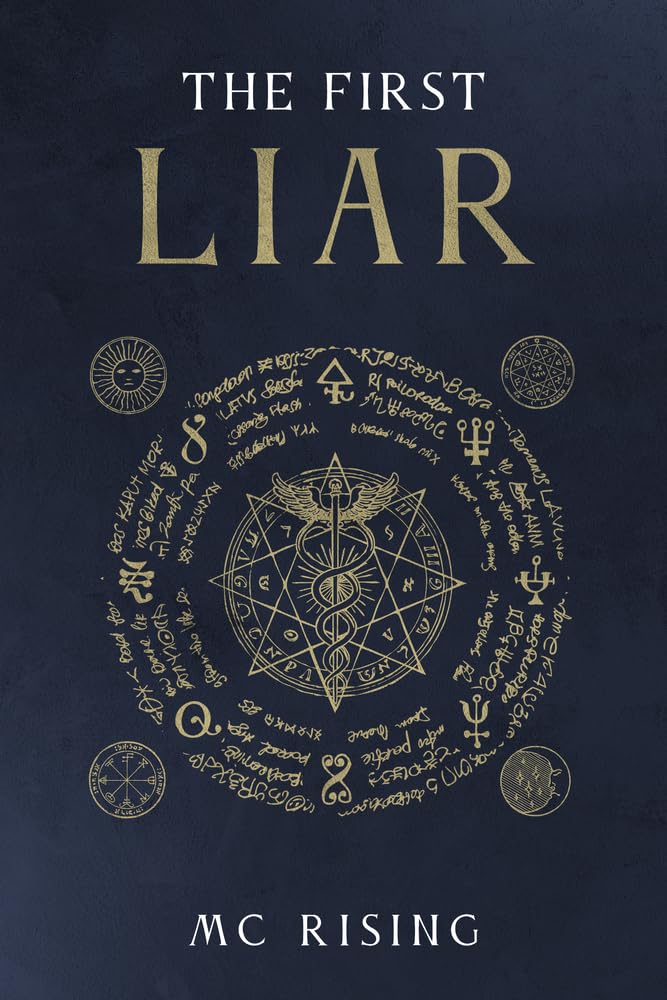
In a literary landscape saturated with urban fantasy, M.C. Rising’s debut novel “The First Liar” emerges as a refreshingly grounded take on mythological resurrection. This isn’t your typical “chosen one discovers hidden magical world” narrative. Instead, Rising crafts a story that feels remarkably relevant to our current political and corporate climate, using Greek mythology as a lens to examine power, identity, and the price of survival in modern America.
The novel follows Tori Jaecar, a software engineer trapped in the soul-crushing machinery of corporate life, whose mundane existence shatters when her boss is murdered before her eyes. Enter Vince Lenoir, a part-time monster hunter whose cynical exterior masks deeper wounds, and suddenly Tori finds herself thrust into a world where legendary villains from Greek mythology have migrated to America with decidedly contemporary ambitions.
Character Development: From Archetypes to Authenticity
Rising’s greatest strength lies in her masterful character development, particularly in how she transforms mythological archetypes while honoring their essential nature. Tori begins as an overworked millennial, complete with imposter syndrome and a suffocating sense of purposelessness following her twin brother Luke’s death. Rising creates a protagonist whose grief is specific, whose technical skills matter to the plot, and whose transformation into “the Greatest Hunter to Ever Live” feels completely earned and authentic.
Vince Lenoir represents one of the most compelling interpretations of the “bad boy with a heart of gold” trope in recent fantasy literature. His relationship with his makeshift family—Roy Angelus and Brooks Wyman—provides emotional depth that perfectly grounds the supernatural elements in genuine human connection. The mystery surrounding Roy’s true identity (revealed to be Hermes himself) adds rich layers to their dynamic that reward careful readers throughout the narrative.
The mythological antagonists transcend simple villainy through Rising’s exceptionally nuanced portrayal. Narcissus, cursed to seduce anyone he touches despite his own revulsion, becomes a genuinely tragic figure whose barbed wit masks profound pain. Orion’s toxic masculinity and need to prove himself feels disturbingly contemporary, while Director Webb’s transformation into Arachne the spider-weaver serves as a perfect metaphor for corporate manipulation and the web of lies that bind modern institutions.
Mythological Framework: Ancient Wisdom for Modern Problems
Rising demonstrates impressive mythological literacy while making the content completely accessible to readers. The revelation that creatures from various mythological traditions—Greek, Cherokee, Chinese—coexist in this world opens fascinating possibilities for cultural dialogue and representation. The author’s decision to root the primary conflict in Greek mythology while acknowledging the validity of other mythological systems shows sophisticated understanding of cultural appreciation and inclusivity.
The connection between mythological figures and constellations provides a particularly elegant structural element. When Grace explains that Orion the Hunter, Asterius the bull, and other enemies are literally written in the stars, it creates a beautiful sense of cosmic inevitability while emphasizing humanity’s ancient relationship with these stories. This astronomical connection also serves the plot brilliantly, providing clues that feel organic and meaningful.
The political dimension of the mythology proves especially compelling. President Arvis’s revelation as Zeus—the ultimate patriarch wielding power through fear and manipulation—serves as pointed commentary on authoritarian leadership. Rising’s decision to make the primary antagonist a sitting president creates genuine urgency and relevance that elevates the stakes beyond personal survival to societal transformation.
Prose Style and Pacing: Urban Fantasy with Literary Sensibilities
Rising’s prose strikes a perfect balance between accessibility and sophistication. Her descriptions of corporate life ring with authentic detail, particularly in the opening chapters where Tori navigates the casual sexism and mind-numbing bureaucracy of her workplace. The author’s background clearly informs these scenes, lending remarkable credibility to Tori’s technical expertise and workplace experiences.
The supernatural elements receive equally careful attention, with Rising creating genuine atmosphere through psychological depth rather than relying on simple shock value. The labyrinth sequence beneath Channel 4, where reality itself becomes unstable, showcases the author’s exceptional ability to create genuine dread through atmosphere and disorientation. Her descriptions of mythological creatures feel both ancient and contemporary—Orion’s toxic masculinity, the spider’s web of corporate manipulation, Narcissus’s complex relationship with his own power.
Rising demonstrates remarkable skill in integrating worldbuilding smoothly into action sequences and character development, making the learning curve feel natural and engaging throughout the narrative.
Thematic Depth: Identity, Power, and Transformation
“The First Liar” explores themes of identity and authenticity with remarkable sophistication for a debut novel. The central question—”who lies at the heart of it all?”—resonates on multiple meaningful levels. The exploration encompasses Zeus’s manipulation of truth for power, Narcissus’s tragic existence, and Tori’s journey toward recognizing her own worth and potential.
The examination of corporate culture as a form of mythological evil in “The First Liar” feels particularly timely and insightful. Director Webb’s transformation into Arachne creates a literal monster out of workplace manipulation, while the Tianyi corporation serves as a modern labyrinth designed to trap and exploit workers. Rising’s decision to stage climactic battles in corporate spaces—office buildings, conference rooms, underground facilities—reinforces the powerful idea that contemporary evil often wears a business suit.
The theme of chosen family versus blood family runs beautifully throughout the narrative. Tori’s relationship with her deceased twin Luke provides emotional weight to her character arc, while her growing bond with Vince, Grace, and the others demonstrates how trauma can create meaningful connections. The revelation that Roy has been acting as a surrogate father figure to Vince adds genuine poignancy to their relationship and emphasizes that family bonds transcend biological connection.
Cultural Commentary: Mythology as Mirror
Rising uses her mythological framework to examine contemporary American issues with impressive insight. The immigration of ancient mythological figures to America serves as a brilliant metaphor for cultural displacement and adaptation. These beings maintain their essential nature while adapting to new contexts—Narcissus becomes a manipulative corporate executive, Orion transforms into a toxic masculine archetype, Zeus assumes the identity of an authoritarian president.
The novel’s portrayal of President Arvis/Zeus as a political figure who thrives on fear and division feels particularly relevant to current political discourse. Rising grounds her critique in mythological tradition—Zeus has always been a problematic patriarch whose power depends on keeping others divided and subservient—creating commentary that feels both timeless and immediate.
The representation of diverse mythological traditions suggests a thoughtfully inclusive approach to fantasy worldbuilding. Rising’s mention of Cherokee mythology through Spearfinger and Chinese traditions through Chenlong demonstrates awareness that American mythology should reflect American diversity.
Technical Elements: Structure and Worldbuilding
The novel’s structure expertly balances multiple plot threads while maintaining clear focus. The central mystery—who is behind the mythological awakening and why—provides strong narrative momentum while character development and relationship building provide deep emotional investment. Rising demonstrates exceptional skill in managing exposition, integrating mythological information through character discovery in ways that feel natural and engaging.
The worldbuilding feels authentic and lived-in, particularly in its portrayal of contemporary settings. Atlanta emerges as a character in its own right, with Rising drawing on real locations and historical events to ground the fantastic elements beautifully. The use of actual Atlanta landmarks—from corporate towers to historic sites like Roswell Mill—creates geographic authenticity that enhances immersion and connection.
The magic system feels consistent and thematically appropriate throughout. Powers relate meaningfully to mythological origins and character psychology rather than feeling arbitrary, creating internal logic that supports the story’s emotional truth perfectly.
Similar Works and Literary Context
“The First Liar” occupies fascinating territory within the urban fantasy genre, sharing elements with works like Rick Riordan’s Percy Jackson series while targeting a more mature audience with greater sophistication. Rising’s approach explores how ancient powers might evolve and adapt to contemporary circumstances in ways that feel fresh and original.
“The First Liar” also recalls Neil Gaiman’s “American Gods” in its exploration of mythological figures adapting to American culture, though Rising focuses more tightly on Greek mythology and contemporary politics in ways that feel distinctly her own. The corporate horror elements echo the work of authors like China Miéville, using supernatural elements to examine institutional power with impressive creativity.
For readers seeking similar mythological fantasy with contemporary relevance, consider:
- Madeline Miller’s “Circe“ – For its sophisticated treatment of Greek mythology and complex character development
- Silvia Moreno-Garcia’s “Gods of Jade and Shadow” – For its blend of mythology and coming-of-age themes
- N.K. Jemisin’s “The City We Became” – For its urban fantasy approach to contemporary issues
- Cassandra Clare’s “The Mortal Instruments” series – For its blend of mythological creatures and modern settings
- Holly Black’s “The Darkest Part of the Forest” – For its examination of the costs of power and transformation
Final Assessment: A Remarkable Debut with Extraordinary Promise
“The First Liar” announces M.C. Rising as a fantasy author with exceptional talent and vision. Rising demonstrates impressive mythological literacy, outstanding character development skills, and a keen eye for contemporary social issues. The book’s exploration of identity, power, and authenticity through a mythological lens creates a reading experience that feels both fantastical and urgently relevant.
The novel succeeds brilliantly in its portrayal of workplace culture as a form of modern evil, making the corporate setting feel as dangerous and compelling as any mythological labyrinth. Rising’s decision to make her protagonist a software engineer rather than a traditional fantasy hero creates opportunities for unique problem-solving approaches and grounds the supernatural elements in recognizable contemporary reality.
“The First Liar” establishes Rising as an author who masterfully balances entertainment with substance, creating a debut that exceeds genre expectations while offering meaningful commentary on contemporary life. The book’s rich mythological framework and compelling character development suggest tremendous potential for future installments, making this an essential read for anyone seeking urban fantasy with both heart and intelligence.
The novel represents a significant achievement in contemporary fantasy literature, demonstrating the kind of literary ambition and cultural awareness that marks Rising as a major new voice in the genre. “The First Liar” offers readers a perfect blend of ancient wisdom and modern insight, establishing M.C. Rising as an author whose future works will undoubtedly continue to push boundaries and explore new territory in mythological fiction.
For fans of mythology, urban fantasy, or contemporary fiction with supernatural elements, “The First Liar” delivers a compelling and thoroughly satisfying reading experience that will leave readers eagerly anticipating Rising’s next work.







