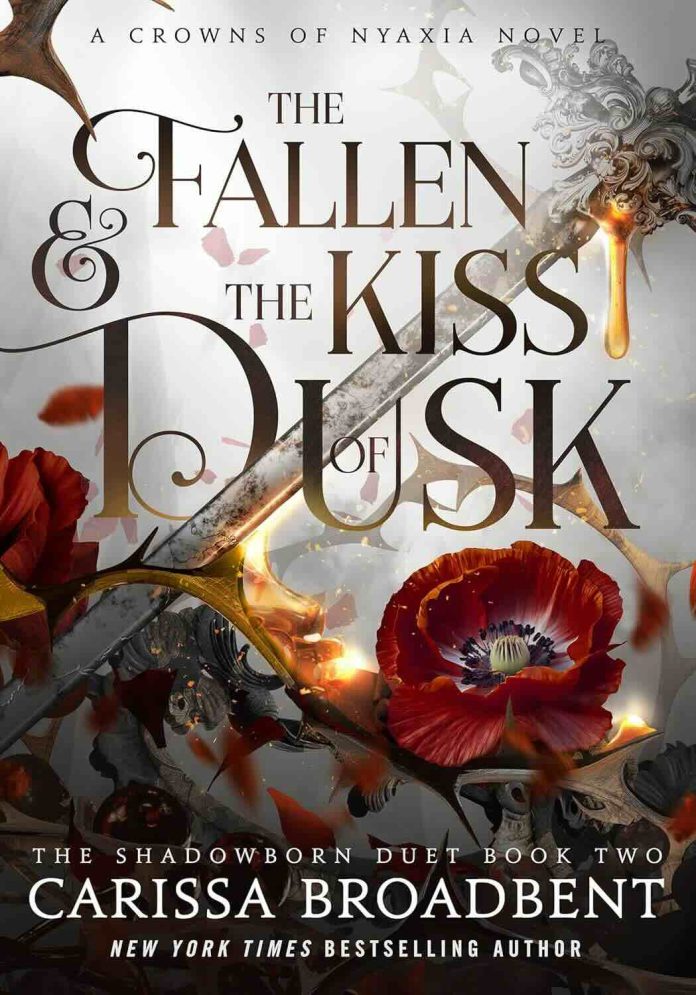
The Bottom Line: Carissa Broadbent delivers an emotionally devastating yet triumphant conclusion to Mische and Asar’s arc in The Fallen & the Kiss of Dusk, the fourth installment of the Crowns of Nyaxia series. While the pacing occasionally staggers under the weight of its epic scope, the raw emotional core of two broken souls learning to fight for life—rather than sacrifice themselves—creates a reading experience that will leave you breathless, tearful, and ultimately hopeful.
The Culmination of an Epic Journey
The Crowns of Nyaxia series has been building toward this moment across four books: The Serpent and the Wings of Night, Six Scorched Roses, The Ashes & the Star-Cursed King, Slaying the Vampire Conqueror, and The Songbird & the Heart of Stone have all laid the groundwork for Mische and Asar’s desperate quest to seize divinity itself. Where previous entries in the series focused on establishing the vampire houses and their intricate political machinations, The Fallen & the Kiss of Dusk ventures into truly mythic territory, asking what happens when love faces the wrath of gods themselves.
When Sacrifice Becomes Self-Discovery
The Emotional Architecture
Broadbent’s greatest achievement in this novel lies not in her world-building—though the underworld sequences are hauntingly beautiful—but in her psychological excavation of two characters who have been conditioned to believe their worth lies solely in their willingness to die for others. Mische, having plunged the world into eternal night to save Asar, now exists in a liminal state between life and death. Asar, granted a fragment of divine power through her sacrifice, faces imprisonment by the very gods whose attention they’ve unwittingly attracted.
The author’s exploration of trauma, particularly religious trauma in Mische’s case, feels both authentic and necessary. Her relationship with Atroxus—the sun god who groomed and abused her as a child—provides a dark backdrop against which her journey toward self-worth unfolds. When Mische finally confronts her past, the scene crackles with the kind of cathartic power that transforms good fiction into something transcendent.
The God of Death’s Burden
Asar’s transformation throughout the novel proves equally compelling, though occasionally less accessible. As he accumulates pieces of Alarus’s divine essence—the mask, the eye, and eventually portions of the heart—Broadbent traces his evolution from calculating vampire prince to something approaching true divinity. The mask’s whispers, the eye’s visions, and the heart’s overwhelming emotions create a layered internal conflict that drives much of the book’s tension.
However, Asar’s journey suffers slightly from the very power it explores. As he becomes more godlike, he paradoxically becomes more distant from readers, particularly during the sequences where divine consciousness overwhelms his mortal personality. These moments, while thematically appropriate, sometimes sacrifice emotional intimacy for cosmic scope.
World-Building and Political Intrigue
The Three Houses in Chaos
Broadbent continues to excel at vampire politics, and the House of Shadow sequences showcase her talent for weaving personal stakes into larger political maneuvering. Egrette’s challenge to Asar’s claim feels both inevitable and dangerous, particularly given his weakened state following Mische’s feeding. The author’s understanding of power dynamics—how vulnerability becomes opportunity for rivals—adds layers of tension to scenes that might otherwise feel purely ceremonial.
The glimpses we get of the House of Blood through Septimus provide fascinating contrast, though his role feels somewhat underdeveloped despite his obvious importance to future books. His casual cruelty and political maneuvering promise interesting developments for book five.
Divine Realms and Decay
The underworld sequences represent some of Broadbent’s most evocative writing. Her depiction of the Descent—the five Sanctums souls must traverse to reach true death—creates a geography of grief that feels both alien and achingly familiar. The decay caused by Alarus’s long absence manifests not just in crumbling architecture but in the very fabric of death itself, with souls unable to find peace or proper passage.
The author’s decision to show this decay through Mische’s eyes, as she works to heal the wounds in reality itself, provides both beautiful imagery and meaningful character development. Her instinctive understanding of how to mend these breaks connects directly to her nature as a healer, creating satisfying character consistency.
Pacing and Structure Challenges
Epic Ambitions, Uneven Execution
The Fallen & the Kiss of Dusk attempts to juggle multiple complex plotlines: the quest for Alarus’s body parts, political maneuvering in the vampire houses, the decay of the underworld, and the looming threat of divine war. While Broadbent manages these elements with generally impressive skill, certain sections feel rushed while others linger perhaps too long.
The middle section, dealing with the retrieval of the eye and the politics of the House of Shadow, maintains excellent pacing and tension. However, the final act—despite its emotional power—occasionally feels overwhelming in scope. The arrival of the White Pantheon and the subsequent confrontations pack so much cosmic significance into relatively few pages that some character moments get lost in the shuffle.
Multiple Perspectives, Multiple Challenges
The novel’s use of alternating perspectives between Mische, Asar, and eventually “The God of Death” creates interesting technical challenges. While this approach allows readers to experience both sides of their bond and Asar’s gradual transformation, it also fragments the narrative in ways that occasionally interrupt emotional momentum.
The “God of Death” chapters, in particular, walk a difficult line between showing Asar’s loss of humanity and maintaining reader connection. Broadbent largely succeeds, but some readers may find these sections more intellectually interesting than emotionally engaging.
Romance Amidst Cosmic Stakes
Love as Anchor and Catalyst
The romantic elements of The Fallen & the Kiss of Dusk transcend typical genre boundaries, moving beyond attraction or even devotion into something approaching spiritual communion. Mische and Asar’s relationship serves multiple narrative functions: emotional anchor, plot catalyst, and thematic statement about the power of connection to maintain humanity even in the face of cosmic transformation.
Their intimate scenes carry genuine heat, but more importantly, they demonstrate how physical connection becomes spiritual recognition. When Asar, consumed by divine consciousness, struggles to remember his own mortality, it’s Mische’s touch—and his body’s response to it—that calls him back to himself.
The Challenge of Divine Romance
However, the novel faces a fundamental challenge in maintaining romantic tension when one character gradually transcends mortality. Broadbent handles this skillfully by grounding their connection in shared trauma and mutual recognition of each other’s essential nature, but the dynamic necessarily shifts as Asar becomes something beyond vampire.
The final resolution—Mische’s decision to claim half of Alarus’s heart and share divinity with Asar—provides satisfying resolution while preserving the equality that makes their relationship compelling.
Themes and Deeper Meanings
Sacrifice Versus Self-Preservation
The novel’s central theme revolves around the distinction between noble sacrifice and self-destruction masquerading as nobility. Both Mische and Asar have been shaped by experiences that taught them their worth lies in their willingness to die for others. Their journey toward learning to fight for life—their own lives—provides the emotional backbone that elevates the cosmic plot beyond mere spectacle.
This theme resonates particularly strongly in contemporary contexts, where self-care and boundary-setting often struggle against cultural messages about selflessness and martyrdom.
Power and Corruption
Broadbent’s exploration of divine power serves as both literal plot element and metaphor for how extraordinary circumstances reveal character. Asar’s struggle to maintain his essential humanity while accessing godlike abilities reflects real-world questions about how power changes people and whether good intentions can survive overwhelming capability.
Critical Evaluation
Strengths That Elevate
The novel’s greatest strengths lie in its emotional authenticity and thematic coherence. Broadbent never loses sight of the fact that cosmic stakes only matter if readers care about the characters experiencing them. Her willingness to let characters be genuinely changed by their experiences—rather than simply tested by them—creates a sense of real growth that many fantasy novels struggle to achieve.
The integration of romantic, political, and mythological elements feels organic rather than forced, with each aspect serving and strengthening the others. The writing itself has matured throughout the series, with Broadbent’s prose in The Fallen & the Kiss of Dusk showing increased confidence in both intimate character moments and sweeping mythological sequences.
Areas of Concern
The novel’s ambitions occasionally exceed its grasp, particularly in the final act where multiple cosmic-level conflicts compete for attention. Some plot threads—particularly involving the other vampire houses and certain divine politics—feel underdeveloped, existing more to set up future books than to serve this story’s immediate needs.
Additionally, while the alternating perspectives generally work well, the shifts in voice and consciousness during Asar’s transformation sometimes create confusion about whose thoughts and memories readers are experiencing.
Cultural Impact and Series Context
BookTok and the Fantasy Romance Revolution
The Fallen & the Kiss of Dusk arrives during a renaissance in fantasy romance, particularly vampire romance, much of it driven by BookTok recommendations. Broadbent’s series has become a significant part of this cultural moment, offering sophisticated world-building and character development alongside the romantic elements that draw many readers to the genre.
The series’ success demonstrates the hunger for fantasy romance that takes both its fantastical elements and romantic relationships seriously, refusing to sacrifice one for the other.
Standing Among Vampire Romance Classics
Within the vampire romance subgenre, the Crowns of Nyaxia series distinguishes itself through political complexity and mythological depth. While it shares certain DNA with works like Anne Rice’s Vampire Chronicles or Christine Feehan’s Dark series, Broadbent’s approach feels distinctly contemporary in its treatment of trauma, consent, and power dynamics.
Final Verdict
The Fallen & the Kiss of Dusk succeeds as both the culmination of Mische and Asar’s specific story and as a pivotal moment in the larger Crowns of Nyaxia saga. Despite some pacing issues and occasional narrative overreach, the novel delivers on its emotional promises while setting up intriguing possibilities for future installments.
Broadbent has created something rare: a fantasy romance that neither subordinates its fantastical elements to its romantic ones nor sacrifices emotional intimacy for cosmic scope. The result is a reading experience that satisfies on multiple levels, offering political intrigue, mythological grandeur, and genuine romantic development in equal measure.
For readers who have followed Mische and Asar’s journey from The Songbird & the Heart of Stone, this conclusion provides both catharsis and promise. For those new to the series, it demonstrates why Broadbent has become such a significant voice in contemporary fantasy romance.
The book earns its place among the stronger entries in the series, even if it doesn’t quite achieve the flawless execution of its predecessors. More importantly, it leaves readers eager for book five and whatever cosmic consequences await in the continuing war between gods and vampires.
Recommended for Readers Who Enjoyed
- Jennifer L. Armentrout’s Blood and Ash series – for epic fantasy romance with divine elements
- Sarah J. Maas’s Throne of Glass series – for complex world-building and character development
- Holly Black’s Folk of the Air trilogy – for political intrigue and enemies-to-lovers dynamics
- Stephanie Meyer’s Twilight series – for vampire romance with cosmic stakes
- Cassandra Clare’s Dark Artifices – for urban fantasy with angel/demon mythology
The Crowns of Nyaxia series continues to prove that vampire romance has room for both intimate character development and epic mythological scope, and The Fallen & the Kiss of Dusk stands as compelling evidence of Broadbent’s growing mastery of this delicate balance.







