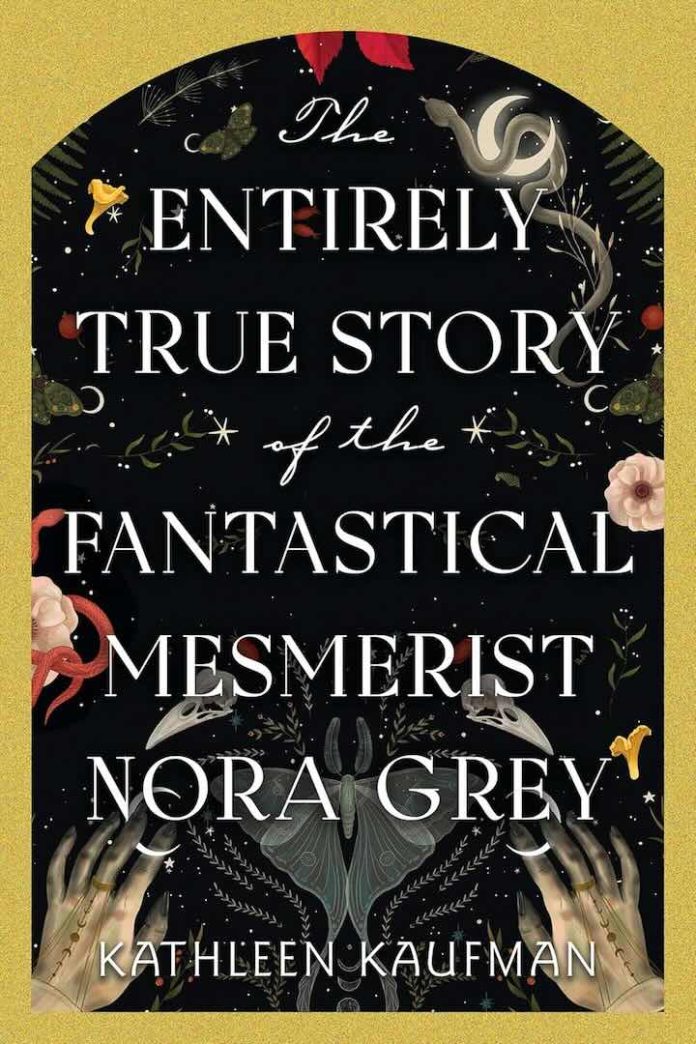
Kathleen Kaufman’s latest offering whisks readers into the fever dream of early 20th-century spiritualism with The Entirely True Story of the Fantastical Mesmerist Nora Grey, a novel that dances between historical fiction and magical realism with the deft touch of a master storyteller. This atmospheric exploration of feminine rage and agency delivers both supernatural thrills and a profound examination of how women have historically been othered, exploited, and ultimately forced to carve their own paths to freedom.
The narrative follows Nairna Liath, a seventeen-year-old Scottish girl traveling the countryside with her charlatan father Tavish, reading tarot cards at rural fairs and participating in fraudulent séances. But where Tavish peddles tricks, Nairna possesses genuine psychic abilities—a dangerous gift that could brand an impoverished country girl as a witch. Her journey from the muddy Scottish roads to Edinburgh’s elite spiritualist circles, and eventually to the mysterious Bell Island off the coast of Boston, forms the backbone of a story that is equal parts coming-of-age tale and supernatural thriller.
The Dual Timeline: Past Echoes in Present Wounds
Kaufman’s most brilliant structural choice lies in her dual timeline approach, weaving Nairna’s 1900-1901 story with that of her spirit guide, Lottie Liath, imprisoned in the nightmarish Argoll Asylum in 1866-1867. This alternating narrative creates a haunting echo effect, where Lottie’s torment at the hands of the sadistic Dr. Soekan and the asylum’s brutal system directly parallels Nairna’s exploitation by various father figures and mentors.
The asylum sequences are genuinely chilling, depicting the horrors inflicted upon women deemed “mad” by a patriarchal society. Lottie’s pregnancy, her forced commitment by her deceased husband’s family, and her subsequent abuse at Argoll serve as a stark reminder of how easily women could be disappeared from society. Kaufman doesn’t shy away from the brutality—the forced drugging, the restraints, the dehumanizing “treatments”—but she balances these horrors with moments of unexpected tenderness, particularly in the relationship between Lottie and Sister Therese.
Character Development: The Evolution of Agency
Nairna’s transformation from the subservient daughter to Nora Grey, the mesmerist who chooses her own destiny, represents the novel’s core triumph. Kaufman skillfully charts this evolution through a series of increasingly powerful supernatural manifestations—from simple card tricks to spectacular telekinetic displays that send furniture flying across rooms. Each display of power coincides with moments where Nairna asserts her independence, creating a satisfying correlation between supernatural ability and personal agency.
The supporting characters feel equally well-developed, though some serve more symbolic purposes than others. Dorothy Kellings, the famous American medium, functions as both mentor and cautionary tale—a woman who has achieved fame and fortune but at the cost of her humanity. Their relationship crackles with tension, as Dorothy sees in Nora both a protégée and a meal ticket, while Nora must navigate the treacherous waters of being both grateful for Dorothy’s guidance and wary of her exploitation.
Tavish Liath proves particularly complex as the roguish father whose love for his daughter is genuine but corrupted by his need to profit from her gifts. Kaufman avoids making him a simple villain, instead crafting a character whose desperation and fear of abandonment drive him to increasingly questionable choices.
The Supernatural Elements: Where Magic Meets Reality
The novel’s supernatural elements feel grounded in both historical context and emotional truth. Kaufman clearly researched the spiritualism movement extensively, and her depiction of séances, mediumship, and psychical research societies feels authentic to the period. The line between genuine psychic phenomena and elaborate fraud remains deliciously blurred throughout much of the narrative, reflecting the actual ambiguity that surrounded the spiritualism movement.
When genuine supernatural events do occur—Nairna’s spectacular levitation, her telekinetic furniture-throwing, her communication with Lottie’s spirit—they feel earned rather than gratuitous. These moments emerge from emotional peaks, particularly moments of rage and determination, suggesting that Nairna’s powers are intimately connected to her refusal to be controlled or diminished.
Writing Style: Atmospheric and Evocative
Kaufman’s prose style perfectly captures the gothic atmosphere while maintaining accessibility for modern readers. Her descriptions of the Scottish countryside, Edinburgh’s gaslit streets, and the mysterious Bell Island create vivid, almost cinematic scenes. The language feels period-appropriate without becoming overly archaic, and Kaufman has a particular gift for conveying the physicality of poverty—the constant hunger, the bone-deep cold, the exhaustion of traveling rough roads.
The author’s background in magical realism serves her well here, as she seamlessly blends the mundane details of Victorian life with moments of otherworldly terror and wonder. Her descriptions of the asylum sequences are particularly powerful, creating a sense of institutional horror that feels both historically accurate and emotionally devastating.
Themes and Social Commentary
The Commodification of Women’s Bodies and Abilities
One of the novel’s strongest themes explores how women’s gifts—whether supernatural or otherwise—are consistently commodified by the men around them. From Tavish’s exploitation of Nairna’s card-reading abilities to Dorothy’s business-minded approach to spiritualism, the novel repeatedly shows how women’s talents become currency in male-dominated economic systems.
The Price of Fame and Agency
Nairna’s rise to fame as Nora Grey comes with both liberation and new forms of entrapment. The attention she receives in Edinburgh and Boston provides her with financial independence and social status, but it also makes her a target for exploitation by new authority figures. Her eventual choice to retreat to the obscurity of Bell Island represents a conscious rejection of fame in favor of authentic autonomy.
Institutional Violence Against Women
The asylum storyline provides a stark examination of how society has historically dealt with women who don’t conform to expected roles. Lottie’s imprisonment and abuse serve as a reminder that the threat of institutionalization was used to control women’s behavior and eliminate those deemed inconvenient or dangerous to the social order.
Areas for Improvement
While the dual timeline structure generally serves the story well, there are moments where the transitions between past and present feel abrupt, occasionally disrupting the narrative flow. Some readers may find the pacing uneven, as the novel takes considerable time to build toward its supernatural climaxes.
The character of Edwin Harrison, while charming, feels somewhat underdeveloped compared to the richly drawn female characters. His motivations and the true nature of his Order of St. Cyprian remain frustratingly vague, leaving readers with questions that never receive satisfying answers.
Additionally, while the novel’s ending on Bell Island provides emotional closure for Nora’s character arc, some plot threads feel left dangling. The fate of several secondary characters and the resolution of certain supernatural mysteries might leave readers wanting more concrete conclusions.
Historical Context and Research
Kaufman’s research into the spiritualism movement shines throughout the novel. Her depiction of Edinburgh’s spiritualist community, the Society for Psychical Research, and the various testing methods used to verify or debunk psychic phenomena feels meticulously researched and historically grounded. The author’s note reveals that much of the inspiration came from family history, lending an additional layer of authenticity to the proceedings.
The portrayal of asylum conditions and the legal vulnerabilities of women in the 1860s demonstrates Kaufman’s commitment to historical accuracy, even when dealing with fantastical elements. The institutional violence depicted feels sadly realistic, grounded in documented practices of the era.
Kaufman’s Literary Evolution
This novel represents a natural evolution from Kaufman’s previous works in the gothic horror and magical realism genres. Readers familiar with her Diabhal trilogy, The Lairdbalor, Hag, and The Tree Museum will recognize her signature exploration of feminine power and generational trauma, but The Entirely True Story of the Fantastical Mesmerist Nora Grey feels more grounded in historical reality while maintaining the supernatural elements that define her work.
The novel demonstrates Kaufman’s growing confidence as a prose stylist, with her descriptions of Scottish landscapes and Victorian society feeling particularly vivid and immersive. Her ability to balance historical authenticity with supernatural elements has clearly matured since her earlier works.
Comparable Reads and Literary Connections
Readers who enjoyed The Entirely True Story of the Fantastical Mesmerist Nora Grey will likely appreciate similar works that blend historical fiction with supernatural elements and feminist themes:
- The Seven Husbands of Evelyn Hugo by Taylor Jenkins Reid – For its exploration of female agency in entertainment
- The Invisible Life of Addie LaRue by V.E. Schwab – For its themes of memory, identity, and supernatural abilities
- The Silent Companions by Laura Purcell – For gothic Victorian atmosphere and supernatural horror
- The Death of Jane Lawrence by Caitlin Starling – For its blend of gothic horror and historical setting
- Mexican Gothic by Silvia Moreno-Garcia – For its atmospheric horror and feminist themes
- The Rose Bargain by Sasha Peyton Smith – For young women discovering supernatural powers
- The Once and Future Witches by Alix E. Harrow – For its exploration of women’s power and historical suffrage themes
Final Verdict: A Compelling if Imperfect Gothic Tale
The Entirely True Story of the Fantastical Mesmerist Nora Grey succeeds as both an atmospheric piece of historical fiction and a thoughtful examination of women’s struggles for autonomy in patriarchal society. While it occasionally suffers from pacing issues and some underdeveloped plot elements, the novel’s strengths—particularly its complex character development, rich historical detail, and genuinely unsettling supernatural sequences—far outweigh its weaknesses.
Kaufman has crafted a story that honors both the historical realities of women’s oppression and the timeless appeal of tales where the powerless discover their own strength. The novel’s ultimate message—that true freedom sometimes requires rejecting society’s definitions of success—feels particularly relevant in our current moment.
For readers drawn to gothic atmosphere, historical settings, and stories of women claiming their power against overwhelming odds, The Entirely True Story of the Fantastical Mesmerist Nora Grey offers a satisfying, if occasionally frustrating, reading experience. It’s a novel that lingers in the mind long after the final page, much like the spirits that haunt its pages.







