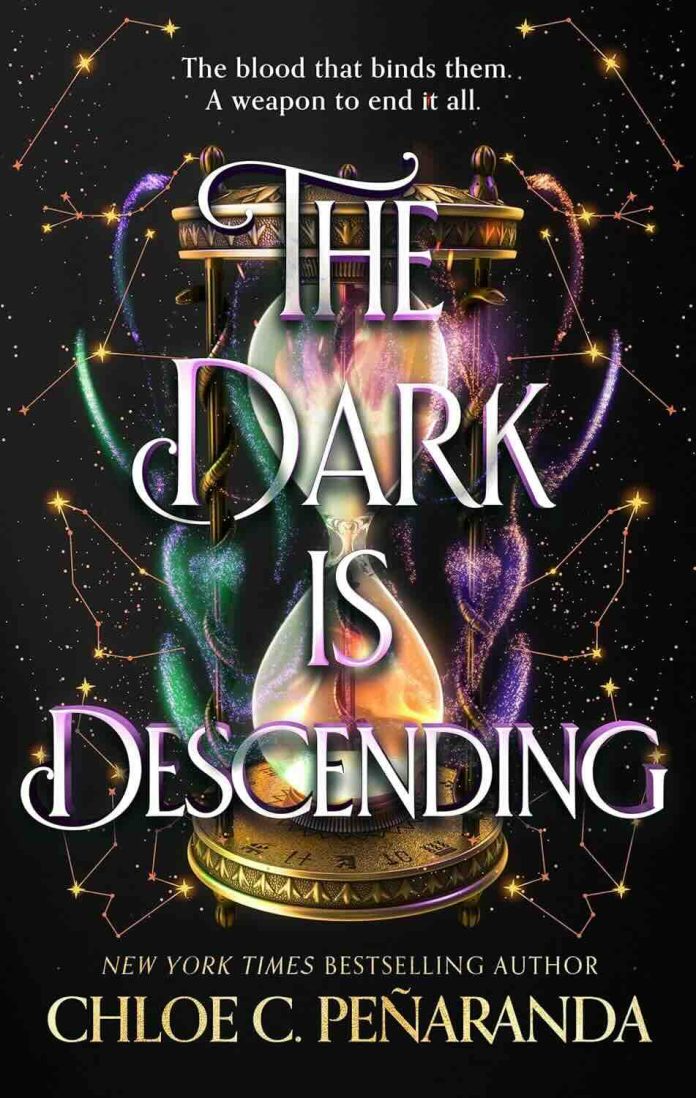
The conclusion to Chloe C. Peñaranda’s Nytefall trilogy arrives not with a whisper but with the cosmic force of colliding celestial bodies. The Dark Is Descending weaves together the intertwined fates of Astraea Lightborne, the star-maiden created by gods, and Rainyte “Nyte” Azreal Ashfyre, the vampire prince cursed with an entity of pure darkness. This final installment delivers an emotionally devastating yet ultimately triumphant exploration of what it means to choose love over destiny, sacrifice over self-preservation, and hope over despair.
Following The Stars Are Dying and The Night Is Defying, Peñaranda’s series has built a devoted readership captivated by the forbidden romance between light and dark. The concluding volume faces the monumental task of resolving cosmic-scale conflicts while honoring the intimate character journeys that have defined the trilogy. The result is a bittersweet symphony that succeeds more often than it stumbles, though not without significant pacing challenges that occasionally dim its brilliance.
A World Tearing at the Seams
Peñaranda constructs a dying realm with visceral urgency. The opening chapters paint a landscape in crisis—meteors rain from crimson skies, the land fractures with devastating chasms, and the very stars that once promised eternity now fall as harbingers of destruction. This apocalyptic backdrop serves as more than mere spectacle; it mirrors the internal fragmenting of Astraea herself as she grapples with the revelation that the celestial afterlife she believed in is a lie crafted by her godly creators.
The world-building shines in its exploration of complex power systems. The relationship between souls trapped in stars, the manipulation of starlight matter, and the cosmic balance maintained by primordial entities creates layers of intrigue. Peñaranda demonstrates particular skill in revealing how systems of belief can be weaponized for control—the celestials’ mythology serves to consolidate power while perpetuating suffering. This thematic depth elevates the narrative beyond simple good-versus-evil dichotomies.
However, the scope sometimes overwhelms coherence. Multiple dragon awakenings, competing godly factions, vampire resistance movements, and interpersonal betrayals create a crowded canvas where certain elements receive insufficient development. The water dragon Fedora’s attack feels rushed, and several supporting characters introduced in earlier books drift to the periphery when their arcs deserve resolution.
The Battle Between Self and Power
At its core, The Dark Is Descending examines the seductive nature of absolute power and the cost of wielding it. Astraea’s struggle with Lightsdeath—an entity of pure destructive light—parallels Nyte’s ongoing battle with Nightsdeath. Peñaranda crafts these internal conflicts with psychological nuance, showing how trauma, grief, and rage can manifest as something that feels separate from the self yet remains intrinsically connected.
The sequences where Astraea surrenders to Lightsdeath are simultaneously terrifying and mesmerizing. Peñaranda’s prose transforms during these moments, becoming more lyrical and detached as Astraea sees the world through the lens of souls to be reaped rather than people to be saved. These passages capture the intoxicating appeal of letting go of moral complexity in favor of absolute judgment. The starlight wolf manifestation serves as striking visual metaphor for power that has grown beyond human scale.
Yet the resolution of this internal battle feels somewhat anticlimactic. After building tension around whether Astraea can maintain her humanity while channeling godlike power, the final confrontations rely more on plot mechanics than character transformation. The moments where she must choose restraint over destruction deserve more page time to fully explore the psychological weight of these decisions.
Love as Defiance and Anchor
The romance between Astraea and Nyte remains the trilogy’s emotional foundation, and Peñaranda delivers on the promise of their bond being tested to breaking point. Their separation—with Nyte trapped in a curse-induced sleep while Nightsdeath walks free—creates genuine anguish. The scenes where Astraea must cooperate with Nightsdeath, seeing Nyte’s face while confronting an entity that wants to destroy her, are masterfully executed exercises in emotional torment.
Peñaranda excels at intimate character moments even amid epic stakes. Nyte’s desperate quest to find a way to save Astraea from the poisoned blade wound, his willingness to become gods themselves rather than lose each other, and his patient
understanding of her grief all demonstrate a love that has matured beyond initial attraction into genuine partnership. Their bond serves not as weakness but as the source of their greatest strength.
The secondary romance between Drystan and his dragon Athebyne, while not traditional, provides interesting contrast. The dragon bonds throughout the trilogy explore different forms of connection and loyalty, enriching the tapestry of relationships beyond the central romance.
Sacrifice, Loss, and the Price of Victory
Where The Dark Is Descending truly devastates is in its unflinching portrayal of loss. Zephyr’s sacrifice—choosing to use the key despite knowing it will cost his life—ranks among the most heartbreaking moments in the series. His final words, asking Astraea to protect his children, and the image of him forced to look into his possessed wife’s eyes as he dies, demonstrate Peñaranda’s willingness to make her readers feel the weight of war.
The deaths of Cassia and Calix, the twins who choose to drink Dawn’s blood to become the new dawn itself, offers a poignant meditation on sacrifice as an act of love rather than defeat. Their choice to become the sunrise so Astraea and Nyte can remain mortal transforms them from supporting characters into symbols of hope renewed. Peñaranda’s decision to have them literally become every dawn creates a bittersweet immortality that honors their bond with Astraea.
However, Auster Nova’s arc concludes with more ambiguity than satisfaction. His transformation from Astraea’s childhood friend to her enemy driven by jealousy and betrayal receives adequate buildup, but his final confrontation lacks the emotional catharsis such a complex relationship deserves. The revelation of his deepening corruption and his bond with the dragon Edasich hints at layers of tragedy that remain somewhat unexplored.
Pacing: The Story’s Greatest Adversary
The novel’s most significant weakness lies in its uneven pacing. The middle section, focused on temple quests to retrieve key pieces, occasionally drags despite the presence of Nightsdeath as Astraea’s reluctant companion. These sequences, while necessary for plot progression, interrupt narrative momentum when the apocalyptic stakes demand urgency.
Conversely, the final act rushes through revelations and confrontations that warrant more development. The defeats of both Dusk and Dawn, while spectacular in imagery, feel compressed. The mechanics of using their true names as weapons against them provides a clever payoff to earlier worldbuilding, but the execution in both instances prioritizes action over the psychological complexity of destroying one’s creators.
The epilogue restores some balance, providing a satisfying glimpse of the peace Astraea and Nyte have fought to achieve. Their coronation as queen and king consort, the restoration of daylight to their realm, and the closing scene in a phoenix realm connected to Nyte’s heritage offers hope for the future while acknowledging scars that remain.
The Dance of Light and Shadow
In The Dark Is Descending, Peñaranda’s prose oscillates between lyrical beauty and straightforward narrative, with the former emerging during emotionally heightened moments. Her descriptions of starlight, shadow, and the interplay between them create memorable imagery. Passages like Astraea’s dance channeling magic—”my body was an instrument and my magick a song”—exemplify the author’s ability to transform action into poetry.
The dual perspective structure, alternating between Astraea and Nyte’s viewpoints, allows readers to experience both sides of their bond. Nyte’s chapters provide essential context for his internal struggle with Nightsdeath and his desperate schemes to save Astraea, preventing him from becoming a passive damsel despite being cursed for much of the book.
The flashback chapters interspersed throughout, labeled “Past,” offer crucial context for understanding how Astraea and Nyte’s relationship developed. These glimpses into their early bond, the conflicts with Auster, and the gradual revelation of their feelings provide emotional grounding for the present-day stakes.
Thematic Resonance and Narrative Ambition
Beyond the romance and fantasy elements, The Dark Is Descending grapples with weighty themes. The revelation that souls aren’t peacefully resting in stars but trapped as energy sources for magic speaks to how systems of oppression disguise themselves as benevolent beliefs. Astraea’s role as Death’s Maiden, tasked with freeing these trapped souls, transforms her from goddess of justice into agent of mercy and liberation.
The question of what makes someone worthy of redemption runs throughout. Nightsdeath, born from Nyte’s centuries of suffering, embodies pain weaponized. Auster’s villainy stems from wounded pride and jealousy. The gods themselves act not from malice but from an inability to understand mortal value. Peñaranda suggests that understanding motivation doesn’t excuse harm, but it does complicate simple condemnation.
The decision to have Astraea and Nyte ultimately choose to remain mortal rather than become gods permanently, despite the cost, affirms the trilogy’s central thesis: mortal life, with all its pain and brevity, holds more authentic meaning than eternal power detached from consequence.
Where It Stands in the Dark Romance Landscape
The Dark Is Descending occupies interesting territory within dark romance and fantasy romance. It shares DNA with Sarah J. Maas’s high-stakes fantasy romance and Jennifer L. Armentrout’s paranormal romance series, but Peñaranda’s willingness to make her protagonists genuinely suffer—and to kill beloved characters—sets it apart from some contemporaries who promise darkness but deliver gentler outcomes.
Fans of Elise Kova’s A Deal with the Elf King will appreciate the romance between supposed enemies forced to confront prejudice and misunderstanding. Readers who enjoyed Raven Kennedy’s The Plated Prisoner series will find similar themes of reclaiming agency from those who would control you. The dragon bonds throughout the trilogy might appeal to fans of Rebecca Yarros’s Fourth Wing, though Peñaranda’s dragons serve more symbolic than romantic functions.
Final Verdict: A Flawed but Resonant Conclusion
The Dark Is Descending achieves what matters most—delivering an emotionally satisfying conclusion to Astraea and Nyte’s journey while honoring the themes established across the trilogy. The novel’s willingness to embrace genuine tragedy, to make its protagonists pay real costs for their choices, and to suggest that love means partnership rather than possession creates memorable character work that transcends genre conventions.
The pacing issues and occasionally crowded plotting prevent this from achieving masterpiece status, but the emotional authenticity of the central relationship, the vivid world-building, and several genuinely devastating moments of loss create an experience that will stay with readers long after the final page. Peñaranda demonstrates clear growth as a storyteller, building on the foundations of earlier books while pushing toward more complex thematic territory.
For readers invested in the trilogy, this conclusion will prove both heartbreaking and hopeful—a reminder that the darkest night precedes the dawn, and that sometimes the greatest act of defiance is choosing to love anyway.
If You Loved This, Try These
Readers seeking similar experiences as The Dark Is Descending should explore:
- From Blood and Ash by Jennifer L. Armentrout for forbidden romance with similar stakes and betrayal themes
- A Deal with the Elf King by Elise Kova for enemies-to-lovers with similar redemption arcs
- The Plated Prisoner series by Raven Kennedy for dark fantasy romance with strong character growth
- Kingdom of the Wicked by Kerri Maniscalco for morally gray love interests and god-level power struggles
- Serpent & Dove by Shelby Mahurin for light/dark romantic dichotomy and religious/magical world conflict
Peñaranda’s An Heir Comes to Rise series, which connects to the Nytefall world through subtle crossover elements, offers additional exploration of her fantasy universe for readers craving more.







