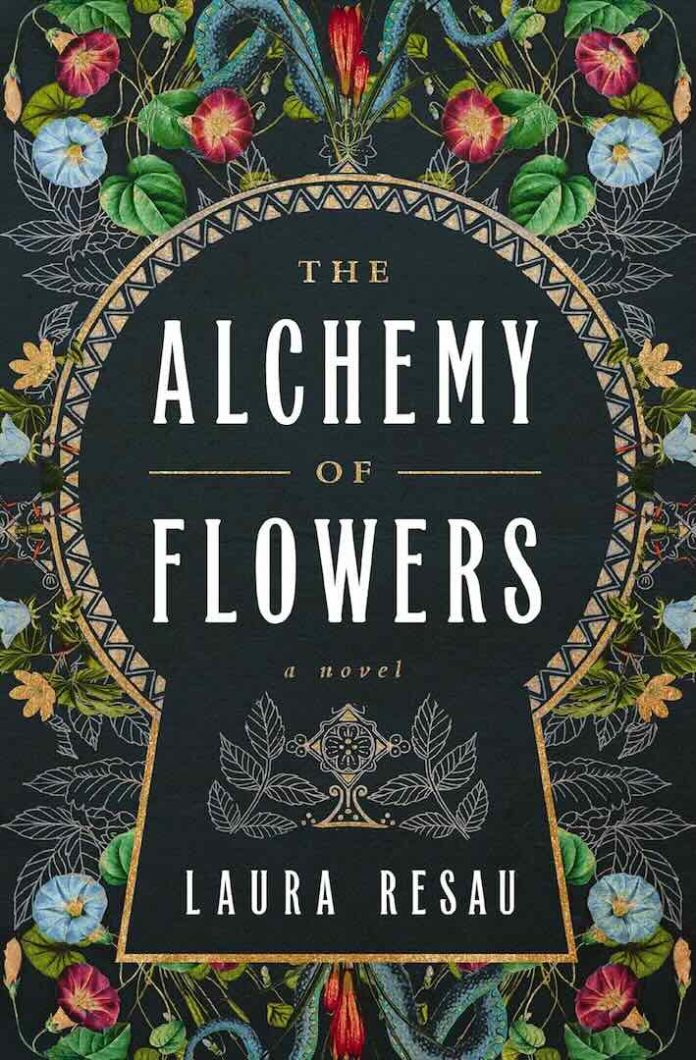
Laura Resau’s adult fiction debut, The Alchemy of Flowers, transports readers to the secretive walled gardens of Le Château du Paradis in Provence, where broken souls seek refuge among mystical blooms. This ambitious novel successfully bridges the gap between contemporary women’s fiction and magical realism, creating a sanctuary where grief metamorphoses into possibility—much like the “impossible task” of turning merde into fleurs that serves as the story’s central metaphor.
Eloise Bourne arrives at this mysterious French estate carrying the weight of four miscarriages and a failed adoption, desperate to escape a world that constantly reminds her of children she cannot have. The job advertisement’s archaic process—handwritten letters, paper plane tickets—immediately signals that this place exists outside ordinary time and space. Resau masterfully establishes the otherworldly atmosphere from Eloise’s first glimpse of the limestone château rising from ancient ruins, its medieval turrets watching over gardens that whisper secrets.
The Complexity of Healing: Character Development That Breathes
What elevates this novel beyond typical escapist fiction is Resau’s nuanced portrayal of grief and recovery. Eloise’s journey isn’t a simple redemption arc but a complex dance between hope and despair, acceptance and resistance. The author’s personal experience with infertility infuses the narrative with authentic emotional depth—particularly in scenes where Eloise discovers the grave marker reading “HERE LIES A LITTLE ONE WHO NEVER DREW A BREATH” in the poison garden.
Resau creates a compelling ensemble cast of fellow “refugees for the broken”: Mina, whose childhood trauma manifests as selective mutism and chronic illness; Bao, the gentle Vietnamese groundskeeper haunted by wartime memories; and Raphaël, the enigmatic handyman whose own secrets unfold like the garden’s seasonal blooms. Each character represents a different facet of healing, showing that recovery isn’t linear but cyclical, like the garden’s eternal rhythm of death and rebirth.
The supporting characters avoid stereotypes through carefully crafted backstories that reveal themselves gradually. Mina’s evolution from silent observer to confidant feels organic, while Bao’s wisdom emerges through actions rather than exposition. Even the mysterious Antoinette, whose descent into madness serves as the novel’s dark heart, elicits both fear and sympathy as her own tragic losses are revealed.
Magical Realism That Grows from Emotional Truth
Resau’s magical elements never feel forced or fantastical for their own sake. The flowers that whisper to Eloise, the mysterious child Sabine who may or may not be a “woodsprite,” and the ancient château’s supernatural undercurrents all spring from the characters’ emotional states. When Eloise finally accepts her gift as a “flower whisperer,” it represents her reconnection with intuition and wonder—aspects of herself that grief had numbed.
The poison garden serves as the novel’s most potent symbol, representing how beauty and danger coexist, how healing and harm can spring from the same source. Antoinette’s (La Patronne’s) obsession with toxic blooms reflects her inability to transform her pain into growth, contrasting sharply with Eloise’s journey toward acceptance.
The author’s background in cultural anthropology enriches the novel’s exploration of feminine archetypes and goddess mythology, though these elements sometimes feel slightly overdetermined. The Celtic and Roman ruins beneath the château, the three sister figures, and the seasonal celebrations create rich symbolic layers that reward careful readers while remaining accessible to those seeking primarily emotional resonance.
The Romance That Blooms Slowly
The developing relationship between Eloise and Raphaël unfolds with refreshing restraint. Rather than instant attraction, their connection grows through shared work, quiet conversations, and mutual respect for each other’s healing processes. Raphaël’s revelation that he’s Sabine’s father adds complexity without relying on melodramatic twists. Their physical intimacy, when it finally develops, feels earned rather than inevitable.
Most importantly, Resau resists the temptation to have romantic love “cure” Eloise’s grief. Instead, her capacity for love expands through multiple relationships—platonic friendship with Mina and Bao, surrogate parenthood with Sabine, and partnership with Raphaël. This approach feels both more realistic and more satisfying than traditional romance novel resolutions.
Prose That Captures Provençal Magic
Resau’s sensory descriptions transport readers directly into the gardens. Her prose captures the weight of lavender-scented air, the taste of rosé at sunset, the feeling of ancient stone beneath bare feet. The writing style adapts beautifully to different emotional registers—playful during Eloise’s interactions with Sabine, lyrical in garden sequences, and tense during the Gothic final act.
The author’s multilingual background adds authenticity to the French setting without overwhelming English-speaking readers. French phrases are integrated naturally, and cultural details feel lived-in rather than researched. The dialogue balances contemporary voice with the timeless quality that magical realism requires.
However, the pacing occasionally suffers from the novel’s ambitious scope. Some middle chapters feel overly meditative, and certain secondary plot threads—particularly involving the château’s dark history—could have been streamlined without losing impact.
Gothic Elements and the Price of Paradise
The novel’s final act embraces full Gothic horror as the gardens’ darker secrets emerge. Antoinette’s transformation into a delusional “Goddess of the Gardens,” her use of psychoactive plant toxins, and the revelation of child endangerment create genuine tension. These elements succeed because they’re grounded in recognizable human psychology—grief twisted into obsession, isolation breeding madness.
The underground tunnel system and the medieval oubliette where Eloise becomes trapped provide literal manifestations of the emotional depths characters must navigate. When Sabine’s voice calls down to sing to the trapped Eloise, it creates one of the novel’s most emotionally powerful scenes—a child’s innocent request that becomes an act of salvation.
Yet some readers may find the shift from gentle magical realism to Gothic thriller jarring. The novel’s tone becomes noticeably darker in its final third, and while this mirrors Eloise’s willingness to confront difficult truths, it may disappoint those seeking pure escapism.
Themes That Resonate Beyond the Garden Walls
The Alchemy of Flowers succeeds in addressing universal themes through its specific premise:
- Alternative paths to motherhood: Eloise’s relationship with Sabine explores how maternal love can transcend biological connections
- Community as family: The “found family” of garden residents demonstrates healing’s collaborative nature
- Trauma and recovery: Multiple characters show different responses to loss, avoiding simplistic “healing journey” narratives
- Nature as medicine: The garden setting isn’t merely decorative but integral to characters’ emotional restoration
- The coexistence of beauty and danger: Life’s complexity resists easy categorization into good and evil
Literary Connections and Influences
Resau explicitly acknowledges influences from Frances Hodgson Burnett’s The Secret Garden and Glendy Vanderah’s Where the Forest Meets the Stars, but the novel also echoes Sarah Addison Allen’s garden magic and Kate Morton’s atmospheric mysteries. The Provençal setting invites comparison to Peter Mayle’s memoirs and M.F.K. Fisher’s culinary writing, though Resau’s focus remains firmly on emotional rather than lifestyle tourism.
The author’s previous work in young adult fiction serves her well here—she understands how to balance wonder with reality, how to create child characters who feel authentic rather than precious, and how to address difficult topics without overwhelming readers.
Minor Criticisms in Paradise
While The Alchemy of Flowers largely succeeds in its ambitious goals, several elements could have been refined:
- Predictable plot threads: Some mysteries resolve exactly as attentive readers expect, particularly regarding Sabine’s parentage and Antoinette’s true identity.
- Exposition through dialogue: Characters occasionally deliver backstory through conversation in ways that feel slightly artificial.
- Symbol overload: The novel sometimes layers symbolic meaning so heavily that it overshadows character development.
- Pacing inconsistencies: The contemplative middle section contrasts sharply with the action-packed finale, creating an uneven reading experience.
Despite these minor issues, the novel’s emotional authenticity and atmospheric richness more than compensate for structural imperfections.
Books for Readers Who Love Magical Gardens
If The Alchemy of Flowers captivates you, consider these similar reads:
- Garden Spells by Sarah Addison Allen – Southern magical realism with botanical elements
- The Language of Flowers by Vanessa Diffenbaugh – Victorian flower meanings meet contemporary healing
- The Midnight Girls by Alicia Jasinska – Folklore and magic in atmospheric settings
- The Ten Thousand Doors of January by Alix E. Harrow – Portal fantasy with profound emotional depth
- The Invisible Bridge by Julie Orringer – Historical fiction exploring family, loss, and survival
- Where the Forest Meets the Stars by Glendy Vanderah – Contemporary fiction blending mystery with magical thinking
- The Night Circus by Erin Morgenstern – Atmospheric fantasy focused on wonder and transformation
Final Verdict: A Sanctuary Worth Entering
The Alchemy of Flowers succeeds as both escapist fiction and emotional journey. Resau has created a world readers will want to inhabit while addressing real-world grief with sensitivity and wisdom. The novel’s flaws—occasional overwriting, predictable plot elements—pale beside its achievements in creating authentic characters and meaningful transformation.
This debut establishes Resau as a significant voice in contemporary magical realism, demonstrating that adult fiction can embrace wonder without sacrificing emotional complexity. Like the gardens themselves, the novel offers both beauty and thorns—and shows how both contribute to growth.
For readers seeking literary fiction with fantastical elements, women’s fiction with depth, or simply a beautifully written escape to the French countryside, The Alchemy of Flowers provides exactly the kind of transformation its title promises. Sometimes the most impossible tasks—turning pain into beauty, finding family in strangers, creating hope from despair—turn out to be the most necessary magic of all.







