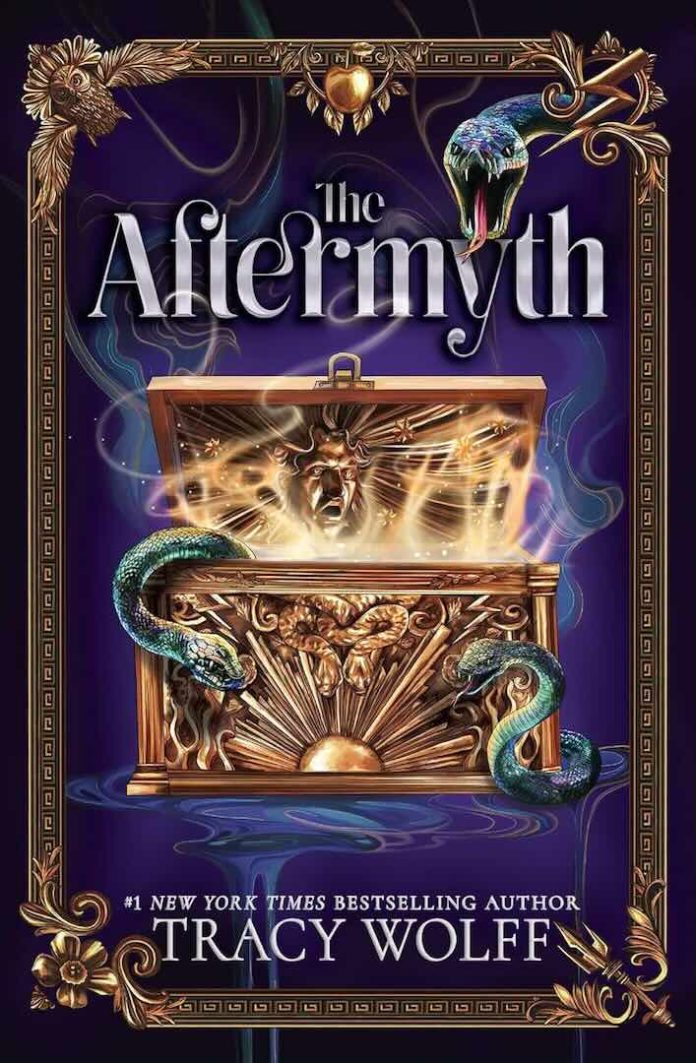
What happens when the universe itself seems determined to rewrite your carefully planned future? Tracy Wolff, the bestselling author behind the Crave series, ventures into middle-grade territory with The Aftermyth by Tracy Wolff, a mythology-infused tale that asks readers to question whether destiny is something we follow or something we create. This dark academia fantasy transforms Greek mythology from ancient history into living, breathing magic, where students don’t just study myths—they become them.
Penelope Weaver has spent her entire life preparing for one singular moment: her sorting ceremony at Anaximander’s Academy. Every member of her family has been sorted into Athena Hall, the house for the practical, intelligent, rule-following students. Penelope knows—absolutely knows—she belongs there. She’s memorized all eleven volumes of Ancient Myths for Any Occasion, the Abridged Version. She’s studied the gods, practiced her composure, and prepared herself mentally for the twelve labors that will define her academic journey. But when the sorting ceremony goes catastrophically wrong, Penelope finds herself placed in Aphrodite Hall instead, surrounded by glitter-loving, party-planning students who seem to embody everything she isn’t.
The Architecture of Adolescent Identity
The genius of The Aftermyth by Tracy Wolff lies not in its magical boarding school setting—though Anaximander’s Academy is magnificently realized—but in how it weaponizes that setting to explore the pressure of expectations. Penelope’s journey mirrors the experience of countless young readers who’ve felt the weight of family legacy, academic pressure, and the terror of not measuring up. When her twin brother Paris is sorted into Athena as expected, the sting of Penelope’s “failure” cuts even deeper. Wolff captures this sibling dynamic with painful accuracy, showing how success and disappointment can drive wedges between even the closest relationships.
The boarding school itself pulses with imaginative details that bring Greek mythology into contemporary focus. Students receive muses who guide them through their labors—though Penelope’s muse, the disorganized and perpetually distracted Calliope, arrives hours late with Penelope’s labor list crumpled and ketchup-stained in her pocket. The eternal fire that should burn in the amphitheater has mysteriously gone out. Moving mosaic tiles hide secrets in plain sight. And beneath the school lies something even more unexpected: a functioning subway system that connects to the Underworld itself.
Wolff’s world-building shines brightest in these moments of mythological innovation. The concept of students being sorted by divine patronage creates immediate tension, but the execution goes deeper. Each hall embodies not just the characteristics of their patron god, but the stereotypes and limitations those associations create. Athena students are brilliant but rigid. Aphrodites are creative but dismissed as frivolous. These distinctions force readers to confront their own biases about intelligence, worth, and what makes a “serious” student.
Friendship as Revolutionary Act
Perhaps the greatest strength of The Aftermyth by Tracy Wolff is the friendship between Penelope, Fifi, and Arjun. Fifi—with her boundless energy, rhinestone heart stickers, and unshakeable confidence—becomes the antithesis of everything Penelope thought mattered. She’s loud where Penelope is careful, spontaneous where Penelope is planned, and absolutely certain of her own worth despite others’ dismissal of Aphrodite Hall. Arjun, thoughtful and kind, provides balance between them. Together, this trio demonstrates that the strongest magic isn’t found in individual achievement but in genuine connection.
Their dynamic carries the emotional core of the novel. When Penelope accidentally discovers the Book of Death—one of seven objects in a school-wide scavenger hunt—she could have pursued glory alone. Instead, she includes her friends, valuing their perspectives and strengths. These moments showcase Wolff’s understanding that middle-grade readers crave stories about loyalty and belonging as much as they crave adventure and magic.
The scavenger hunt subplot, based on the seven evils that escaped from Pandora’s box, provides structure for Penelope’s character development:
- Despair (Unlightable Candle)
- Disease (Empty Syringe)
- Greed (Bag of Coins)
- Conflict (Broken Hearts)
- Envy (Emerald Key)
- Pride (Shattered Mirror)
- Death (Book of Death)
Each object represents not just a magical artifact but a lesson about human nature. Wolff uses this framework cleverly, allowing Penelope’s quest to mirror her internal journey from rigid perfectionism toward self-acceptance.
Where the Myth Cracks
While The Aftermyth by Tracy Wolff succeeds as an entertaining adventure, it occasionally stumbles under the weight of its own ambitions. The pacing suffers in the middle section, where Penelope’s repeated attempts to prove her worthiness to Athena can feel repetitive. Readers might find themselves wishing she’d embrace her Aphrodite placement sooner, though this frustration is arguably intentional—mirroring Penelope’s own resistance to change.
The mythology sometimes feels more decorative than deeply integrated. References to Greek myths provide atmosphere and naming conventions, but the novel could function with different mythological trappings without significantly altering its core themes. Readers seeking the intricate mythological reimagining of Rick Riordan’s work might find this approach more surface-level, though younger readers will likely appreciate the accessibility.
Secondary characters, particularly Paris and his new friend Rhea, occasionally veer into two-dimensional territory. Paris’s transformation from supportive twin to dismissive Athena student happens quickly enough to serve the plot but feels emotionally rushed. More nuanced exploration of his perspective would have enriched the sibling dynamic that forms such a crucial part of Penelope’s motivation.
The mysterious Kyrian, a Hades Hall student who helps Penelope navigate the Underworld, introduces romantic possibilities that remain underdeveloped. While this restraint is appropriate for the target age group, his character feels somewhat underutilized—a placeholder for future books rather than a fully realized presence in this one.
The Myth Weaver’s Promise
Despite these critiques, The Aftermyth by Tracy Wolff delivers exactly what its intended audience craves: a protagonist they can root for, friendships worth believing in, and a world magical enough to escape into. Wolff’s prose moves with energy and clarity, never talking down to readers while remaining accessible. Her experience writing for young adults translates well to this slightly younger demographic, maintaining sophistication while embracing the wonder appropriate for middle-grade fiction.
The novel’s greatest triumph arrives in its final revelation: Penelope’s true identity as the Myth Weaver, someone capable of rewriting stories themselves. This concept—that stories can and should be reexamined and rewritten—resonates powerfully. In positioning Penelope not as someone who learns existing myths but as someone who can change them, Wolff makes a statement about authority, tradition, and the power of questioning narratives we’ve been told are fixed.
For Readers Who Loved…
Fans of The Aftermyth by Tracy Wolff should explore:
- Percy Jackson and the Olympians series by Rick Riordan (for deeper mythological adventure)
- Keeper of the Lost Cities by Shannon Messenger (for magical boarding school dynamics)
- The Trials of Apollo series by Rick Riordan (for myth-adjacent world-building)
- Fablehaven by Brandon Mull (for magical discoveries and family legacy)
- Amari and the Night Brothers by B.B. Alston (for chosen one subversion)
Final Thoughts
The Aftermyth by Tracy Wolff works best when read as an exploration of identity formation rather than pure mythological fantasy. It speaks to readers navigating the gap between who they’re expected to be and who they’re becoming. While not without flaws, the novel offers genuine heart, creative world-building, and a protagonist whose journey from rigid perfectionism to flexible strength feels earned.
In the spirit of transparency and as testament to the peculiar ways books find their readers: this particular copy arrived via mystical publisher conduits—much like how Prometheus’s unlightable candle found its way to Penelope. The publisher’s generosity influenced access but not analysis; after all, even goddesses appreciate honest feedback.







