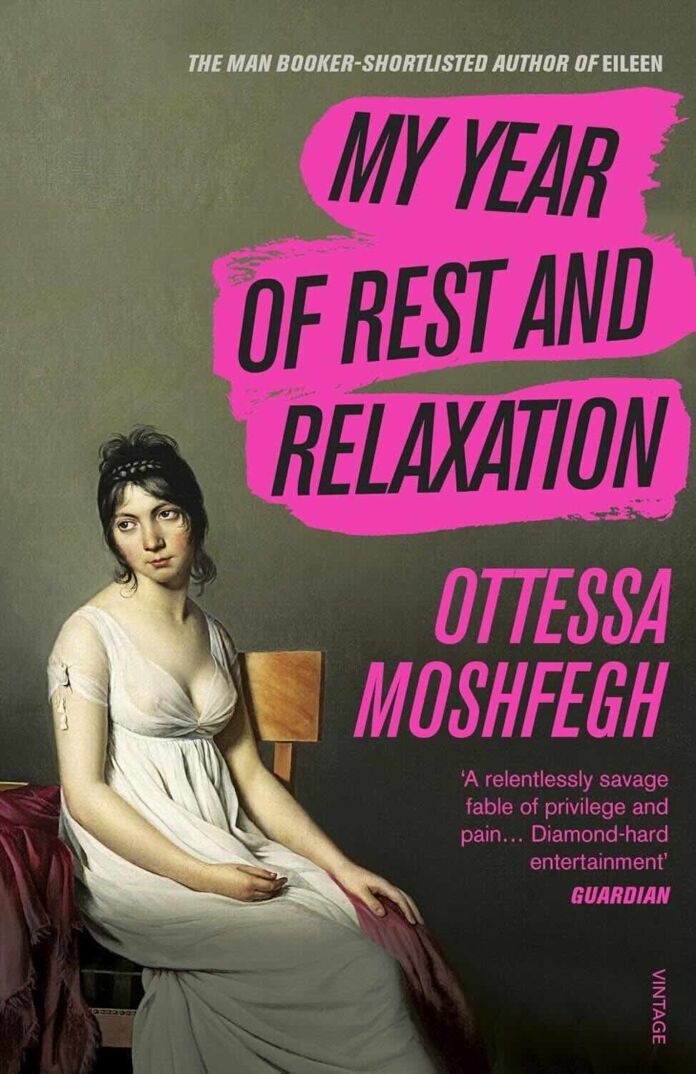
In Ottessa Moshfegh’s darkly comedic novel “My Year of Rest and Relaxation,” we meet a protagonist so thoroughly disillusioned with life that her only solution is to literally sleep it away. Set against the backdrop of New York City in the year 2000, this tale of voluntary narcotic hibernation challenges our notions of wellness, escape, and what it means to reinvent oneself in a world that offers everything except fulfillment.
The unnamed narrator—young, blonde, thin, Columbia-educated, and financially secure thanks to a modest inheritance—embarks on a pharmaceutical journey toward oblivion. Her goal: a year-long hibernation to reset her psyche and emerge reborn. Armed with a collection of prescription medications provided by the comically incompetent psychiatrist Dr. Tuttle, she withdraws from the world, aiming to sleep through most of 2000-2001.
Moshfegh has crafted a character study that is simultaneously infuriating and captivating. Our narrator is often cruel, particularly to her only friend Reva, yet beneath her caustic exterior lies a vulnerability that becomes increasingly apparent as her story unfolds. This tension between repulsion and sympathy creates an unsettling reading experience—one that challenges us to examine our own capacity for empathy.
The Hollow Privilege of Numbness
What makes this novel particularly resonant is Moshfegh’s unflinching portrayal of privilege as a form of emptiness. The narrator’s material comforts—her Upper East Side apartment, her ability to quit her job without financial concerns, her physical beauty that opens doors—serve not as advantages but as void-making machines, stripping away meaning rather than providing it.
The novel excels in its critique of contemporary wellness culture and pharmaceutical solutions for existential problems. Dr. Tuttle, with her haphazard approach to medication and her bizarre tangential musings, represents a scathing indictment of mental healthcare as commercialized quackery. The narrator’s cocktail of medications—Ambien, Xanax, Seroquel, and fictional drugs like “Infermiterol”—becomes a pointed commentary on America’s faith in chemical solutions to spiritual malaise.
Perhaps most impressive is Moshfegh’s ability to make literary hay from narrative stasis. A novel about someone who sleeps constantly should, by all rights, be painfully dull. Instead, it’s riveting. The author finds narrative momentum in the protagonist’s blackouts, her deteriorating relationship with Reva, her encounters with the opportunistic artist Ping Xi, and in her own internal monologue—which remains acerbic and hyper-observant even as she descends deeper into pharmaceutical oblivion.
Stylistic Precision in the Face of Emptiness
Moshfegh’s prose is a masterclass in controlled affect. The flat, detached narration perfectly mirrors the protagonist’s emotional state, yet occasionally cracks open to reveal stunning insights and observations. Her ability to craft sentences that are simultaneously deadpan and devastating creates a reading experience that mimics the narrator’s drug-induced state—a kind of hypnotic numbness punctuated by sudden moments of brutal clarity.
Consider lines like: “That was how I mourned, I guess. I paid strangers to make me feel good.” Or: “Sleep felt productive. Something was getting sorted out. I knew in my heart—this was, perhaps, the only thing my heart knew back then—that when I’d slept enough, I’d be okay.” These moments offer glimpses of self-awareness that suggest the narrator’s pursuit isn’t entirely misguided, even as the methods are extreme.
The author’s command of tone is remarkable—she maintains a delicate balance between satire and sincerity that prevents the novel from tipping into either pure cynicism or unearned sentimentality. This tonal control is what elevates the book beyond mere literary provocation.
Shortcomings: A Narrowness of Vision
For all its strengths, “My Year of Rest and Relaxation” suffers from certain limitations. The narrator’s privilege—her whiteness, her beauty, her financial security—remains largely unexamined by the character herself. While this may be intentional, highlighting her blindness to her own advantages, it sometimes feels like the novel itself shares this blindness.
The supporting characters occasionally verge on caricature. Reva, with her bulimia, brand obsession, and desperate need for approval, sometimes reads more as a foil than a fully realized person. Trevor, the sadistic ex-boyfriend, seems designed primarily to embody a particular type of male emotional unavailability rather than exist as a complex character.
Additionally, the structure of the novel can feel repetitive in its middle section. As the narrator cycles through periods of drugged sleep and brief consciousness, the narrative occasionally stalls, mirroring the protagonist’s stasis perhaps too effectively.
The Ending: Transcendence Amidst Tragedy
Without revealing too much, the novel’s culmination—which coincides with a national tragedy—provides a conclusion that is both earned and unsettling. Moshfegh pulls off the difficult feat of suggesting a kind of redemption for her protagonist without negating the darkness that preceded it or offering easy answers.
The final pages contain an image of someone “diving into the unknown” that serves as both a terrible counterpoint to the narrator’s self-imposed hibernation and a validation of her quest for authentic experience. It’s a complex, troubling ending that resists simplification and lingers long after the book is closed.
Comparisons to Other Works
“My Year of Rest and Relaxation” sits comfortably within Moshfegh’s body of work, which includes the novels “Eileen,” “Lapvona,” “Death in Her Hands,” and “McGlue” and the short story collection “Homesick for Another World.” All share a fascination with characters who exist at the margins of social acceptability, whose inner lives are defined by alienation from conventional values.
The novel bears comparison to Sylvia Plath’s “The Bell Jar” in its portrayal of a privileged young woman’s psychological breakdown, though Moshfegh’s protagonist chooses her descent rather than being overcome by it. There are also echoes of Jean Rhys’s “Good Morning, Midnight” in its unflinching examination of female isolation and Albert Camus’s “The Stranger” in its emotionally detached narration.
Key Strengths and Weaknesses
Strengths:
- Moshfegh’s distinctive voice—detached, darkly funny, and precisely calibrated
- The novel’s unflinching examination of privilege as a form of emptiness
- Complex handling of the narrator’s relationship with Reva
- Scathing critique of pharmaceutical culture and wellness industry
- Ability to create compelling narrative momentum despite the protagonist’s inertia
Weaknesses:
- Occasional repetitiveness in the middle section
- Supporting characters sometimes reduced to types rather than fully realized individuals
- Limited engagement with the narrator’s privileged position
- The fictional drug “Infermiterol” and its effects sometimes strain credulity
Final Assessment: A Polarizing but Important Novel
“My Year of Rest and Relaxation” is not a comfortable read. Its protagonist is often unlikable, its worldview frequently bleak, and its subject matter potentially triggering for those with histories of substance abuse or mental health struggles. Yet it’s precisely this discomfort that makes the novel valuable.
Moshfegh has crafted a work that functions as both social critique and psychological portrait, exploring how extreme detachment might be a reasonable response to a world that offers material plenty but spiritual poverty. The novel asks difficult questions: Is disconnection a valid response to a toxic culture? Can one truly reinvent oneself? What does it mean to be “awake” in a society that incentivizes sleepwalking?
For readers willing to engage with these questions and tolerate a protagonist whose journey involves cruelty, narcissism, and self-destruction, “My Year of Rest and Relaxation” offers considerable rewards. It’s a novel that brilliantly captures a particular kind of millennial malaise—the emptiness that can lurk beneath surfaces of privilege and success.
While flawed, “My Year of Rest and Relaxation” marks Moshfegh as one of our most interesting contemporary American writers—one whose unflinching gaze and distinctive voice make even the most extreme human behaviors comprehensible, if not always sympathetic.







