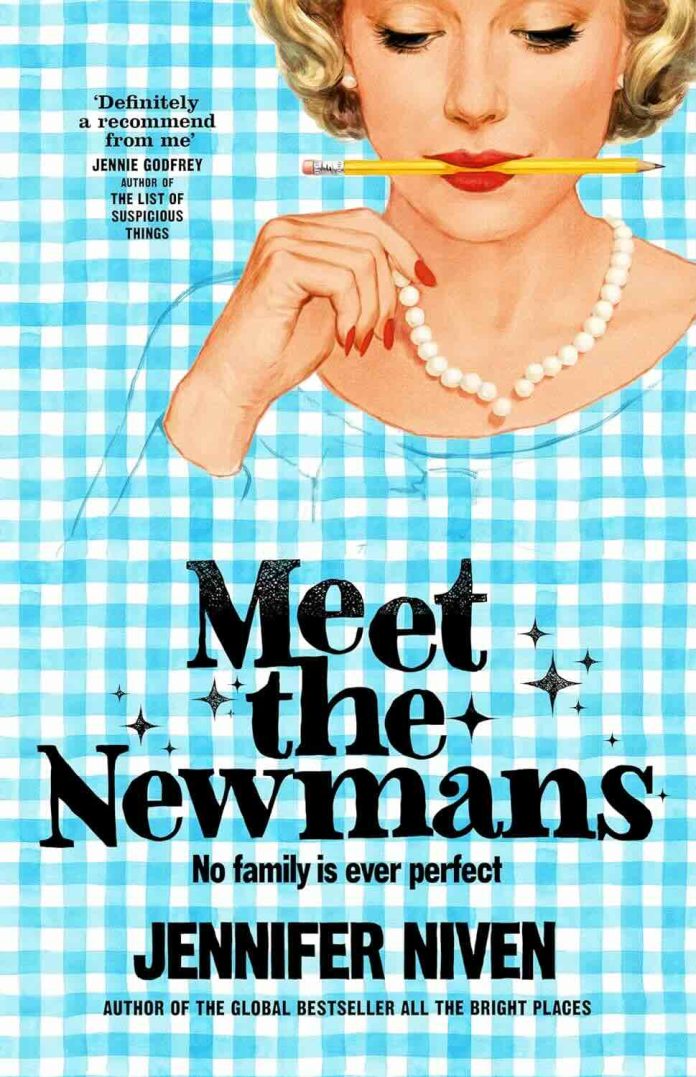
In the spring of 1964, as America teeters between the buttoned-up conformity of the fifties and the seismic cultural shifts about to explode, the Newman family’s television empire is crumbling. Meet the Newmans by Jennifer Niven pulls back the velvet curtain on a fictional sitcom dynasty to reveal a story that is equal parts Hollywood exposé, feminist awakening, and family drama—a novel that interrogates the very idea of the perfect American family while the nation watches.
For twenty years, Del and Dinah Newman and their sons Guy and Shep have entertained millions as America’s Favorite Family, serving up wholesome black-and-white comfort week after week. But when ratings plummet and patriarch Del ends up unconscious after a mysterious car accident, everything the Newmans have carefully constructed threatens to unravel. What follows is not just the story of one family’s crisis, but a meditation on the masks we wear, the boxes we inhabit, and what happens when we finally dare to step outside them.
Behind the Scenes of a Crumbling Empire
Niven, bestselling author of All the Bright Places and Holding Up the Universe, demonstrates remarkable range with this departure into adult historical fiction. Her prose sparkles with the glamour of golden-age Hollywood while never shying away from the era’s suffocating constraints. The narrative architecture mirrors the three-act structure of the Newmans’ show itself, divided into “The Renewal,” “The Rewrite,” and “The Return”—a clever structural choice that reinforces the novel’s central preoccupation with performance and authenticity.
The story unfolds primarily through Dinah’s perspective, though Niven deftly weaves in other viewpoints to create a kaleidoscopic portrait of a family in crisis. When Del Newman lies comatose in Central Hospital following his accident on March 20, 1964, his wife Dinah discovers she’s been living in her own kind of coma—a numb existence of pearls and pork chops, of scripted perfection that has slowly erased her sense of self. Into this vacuum steps Juliet Dunne, a sharp-tongued young reporter from the Los Angeles Times who challenges everything Dinah thought she knew about her life, her marriage, and her complicity in selling women a dangerous fantasy.
The Woman Behind the Apron
Meet the Newmans by Jennifer Niven succeeds most powerfully in its excavation of Dinah’s interior life. At forty-three, she’s a woman who has spent decades playing herself on television—or rather, playing an idealized version that bears less and less resemblance to the person she’s become. Niven captures with devastating precision the particular suffocation of mid-century American womanhood, where Dinah finds her body “going numb” in moments that should bring connection or pleasure.
The novel’s incorporation of Betty Friedan’s The Feminine Mystique—which Dinah reads in secret, late at night—never feels heavy-handed. Instead, Niven uses it as a catalyst for Dinah’s awakening, a mirror held up to her carefully curated existence. When Dinah realizes she’s spent years asking herself “Is this all?”—the very question Friedan identified as haunting countless suburban housewives—the recognition is both painful and liberating.
Niven excels at showing rather than telling, allowing readers to experience Dinah’s transformation through small, accumulating details: the way she starts smoking in public, her growing comfort with profanity, her decision to toss out jars of Folgers coffee after losing their sponsorship, and most significantly, her collaboration with Juliet to write a finale that will shock America by depicting Dinah Newman having an orgasm—metaphorically speaking—from meaningful work rather than from “shining the kitchen floor.”
A Family of Performers Playing Themselves
While Dinah anchors the narrative, Meet the Newmans by Jennifer Niven creates a rich ensemble of characters whose private struggles belie their public perfection. Guy, the responsible older son forced to marry his costar Eileen in a sham wedding to save the show, carries the weight of being a gay man in 1960s Hollywood, where even a whisper of “deviant” behavior could destroy careers and lives. His relationship with Kelly Faber, a rising film star, is rendered with tenderness and heartbreak—two men who love each other but must constantly perform heterosexuality to survive in an industry that would gladly sacrifice them to the tabloids.
Shep, the younger son and teen idol, battles different demons. At seventeen going on eighteen, he’s simultaneously America’s favorite little brother and a burgeoning rock ‘n’ roll artist who yearns to make music that matters—”Carl-Perkins-on-a-bender kind of music” rather than the sanitized pop his television image requires. Niven captures the particular tragedy of youthful talent constrained by corporate image-making, showing how Shep’s rebellions—the motorcycle, the girls, the drugs—are desperate attempts to feel real in a life scripted by others.
Even Del, who spends much of the novel in a coma, emerges as a fully realized character through flashbacks and others’ perspectives. The revelation that the mysterious “M. Leslie” receiving monthly payments is not a mistress but Del’s estranged father adds unexpected emotional depth, complicating our understanding of the patriarch’s need for control and his financial deceptions.
Generational Fault Lines and Cultural Earthquakes
One of the novel’s greatest strengths lies in how it captures America at a cultural crossroads. The year 1964 sits precariously between eras: Kennedy’s assassination still raw, the Beatles fresh on American shores, the civil rights movement gaining momentum, second-wave feminism beginning to find its voice. Niven weaves these historical threads throughout Meet the Newmans by Jennifer Niven with a light but knowing touch.
The friction between Dinah and Juliet—separated by barely more than a decade but worlds apart in worldview—dramatizes the generational divide reshaping American society:
- Juliet’s fierce idealism challenges Dinah’s accommodations to patriarchy
- Dinah’s hard-won experience tempers Juliet’s tendency toward judgment
- Their collaboration becomes a bridge between waves of feminism, proving that change requires both the wisdom of those who’ve been fighting and the energy of those just entering the battle
The novel’s attention to period detail never overwhelms the story but instead grounds it in lived specificity. From Dinah’s discovery of Betty Friedan to Guy’s participation in civil rights protests at Woolworth’s, from references to the Lavender Scare to Mama Cass’s welcoming presence in Laurel Canyon, Niven creates a richly textured 1964 Los Angeles that feels both historically accurate and emotionally immediate.
The Art of the Rewrite
Where Meet the Newmans by Jennifer Niven occasionally stumbles is in its pacing. The middle section, as Dinah and Juliet work through multiple drafts of the finale script, can feel repetitive. Niven includes several “false starts” and script fragments that, while demonstrating the creative process, sometimes stall the narrative momentum. Additionally, some secondary characters—particularly Flora, the housekeeper, and Sydney Weiss, the producer—remain somewhat underdeveloped despite their important roles in the story.
The novel’s climax, the live broadcast of the finale, delivers the emotional and dramatic payoff the story has been building toward. Niven stages it masterfully, intercutting between the broadcast itself, the studio audience reaction, and the personal revelations unfolding backstage. When Dinah Newman removes her pearls, hands them to Del, and walks away from the house toward an uncertain but self-determined future, the moment resonates on multiple levels—as character arc, as social commentary, and as a bold reimagining of what television could be.
However, some readers may find the resolution too tidy. Del’s relatively quick acceptance of the revolutionary script strains credibility given his established character, and the novel’s epilogue, which fast-forwards five years to show the happy outcomes for each character, feels somewhat at odds with the messier, more ambiguous truths the story has been exploring.
A Testament to Niven’s Evolution
Meet the Newmans by Jennifer Niven represents a significant evolution for an author best known for YA novels like All the Bright Places and Holding Up the Universe. While those books tackled serious themes of mental health and body image, this adult novel demonstrates Niven’s ability to handle more complex historical and political material while maintaining the emotional authenticity that has always been her hallmark.
Her prose here is more polished and controlled than in her earlier work, capable of evoking both the glossy artifice of television and the raw vulnerability of her characters’ interior lives. She writes with particular insight about performance and authenticity, about the exhausting labor of being constantly watched and the radical courage required to stop performing and simply be.
The novel’s self-awareness about television as a medium—its power to shape social norms, its capacity for both reinforcing and challenging cultural values—gives the story an extra layer of resonance. In an age where reality TV and social media have collapsed the distance between public and private selves, Meet the Newmans by Jennifer Niven feels surprisingly contemporary in its exploration of authenticity versus image.
For Readers Who Seek Stories of Transformation
This novel will particularly resonate with readers who enjoyed:
- The Seven Husbands of Evelyn Hugo by Taylor Jenkins Reid – Another Hollywood story about the masks we wear and the price of fame
- Lessons in Chemistry by Bonnie Garmus – A woman finding her voice in the 1960s despite societal constraints
- Daisy Jones & The Six by Taylor Jenkins Reid – The clash between artistry and commercial success in the music industry
- Malibu Rising by Taylor Jenkins Reid – Family secrets and the performance of perfection in the entertainment world
- The Final Revival of Opal & Nev by Dawnie Walton – Music, race, and authenticity in 1970s America
A Show Worth Watching
Despite some structural unevenness and occasional narrative indulgences, Meet the Newmans by Jennifer Niven succeeds as both an entertaining period drama and a thoughtful exploration of women’s liberation, family dynamics, and the courage required to live authentically. Niven writes with compassion for her characters even as she exposes the systems that constrain them, and her obvious affection for television as a medium enriches rather than undermines her critique of its limitations.
The novel asks important questions about the stories we tell ourselves and each other, about who gets to tell them, and about what happens when we dare to rewrite the script. In Dinah Newman’s journey from perfect television housewife to authentic woman claiming her own narrative, Niven has created a character whose transformation feels both historically specific and universally resonant.
For readers who appreciate character-driven historical fiction that balances entertainment with social commentary, Meet the Newmans by Jennifer Niven delivers a compelling story about finding the courage to step out of the spotlight others have created for us and into the messy, uncertain, but infinitely more interesting light of our own making. It’s a novel that reminds us that sometimes the bravest thing we can do is remove our pearls, take off the apron, and walk through the door toward the life we actually want to live.







