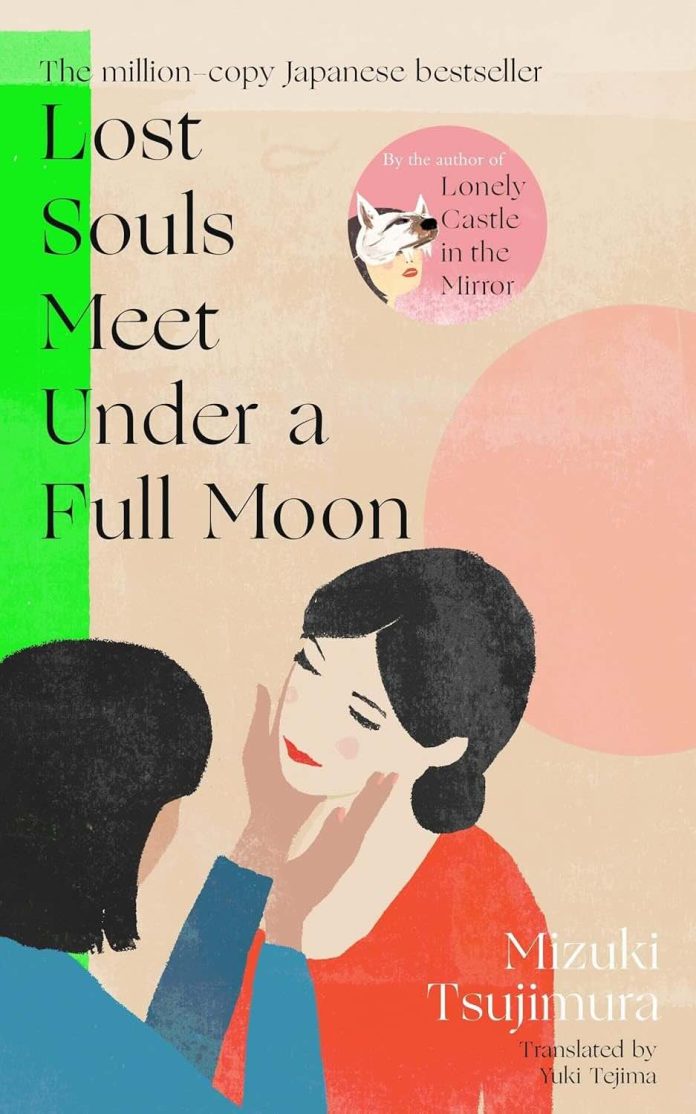
Mizuki Tsujimura’s Lost Souls Meet Under a Full Moon presents readers with an extraordinary premise wrapped in deceptively simple prose: what if the dead could be summoned for one final conversation? This haunting work of magical realism, masterfully translated by Yuki Tejima, explores the profound human need for closure while questioning whether such meetings truly serve the departed or merely satisfy the living.
The novel centers around Ayumi Shibuya, a mysterious teenager who serves as the titular “go-between,” facilitating meetings between the living and the dead. Dressed in his signature Junya Watanabe duffel coat and carrying a weathered notebook, Ayumi operates with bureaucratic precision, explaining rules that feel both arbitrary and sacred: each person gets only one meeting in their lifetime, the deceased can refuse, and encounters must occur during a full moon at luxury hotels.
The Architecture of Loss
Tsujimura constructs her narrative through five interconnected stories, each revealing different facets of grief and the desperate hunger for resolution. The opening tale follows Manami Hirase, a lonely office worker seeking to thank celebrity Saori Mizushiro for a moment of kindness years earlier. What begins as fan devotion slowly reveals deeper currents of depression and suicidal ideation, establishing the novel’s recurring theme that the living often need the dead more than they realize.
The author’s genius lies in how she gradually shifts focus from the clients to Ayumi himself. Initially appearing as an oddly mature teenager with inexplicable powers, he slowly emerges as a complex character bearing his own tragic burden. The revelation of his family history—his parents’ mysterious deaths when he was young—transforms him from mystical facilitator to wounded child carrying generational trauma.
Tsujimura’s exploration of family dynamics proves particularly compelling in “The Rule of the Eldest Son,” where businessman Yasuhiko Hatada seeks his deceased mother’s guidance. Their reunion reveals the suffocating weight of traditional Japanese family expectations while offering unexpected tenderness. The author deftly balances cultural specificity with universal emotions, making these relationships resonate regardless of the reader’s background.
The Weight of Secrets and Shame
Perhaps the most emotionally devastating chapter, “The Rule of the Best Friend,” follows teenage Misa Arashi’s desperate attempt to see her deceased friend Natsu Misono. Tsujimura here demonstrates her unflinching ability to explore guilt and responsibility, particularly the self-destructive patterns that emerge from trauma. Arashi’s story serves as a dark mirror to Ayumi’s own journey, showing how surviving tragedy can either destroy or eventually heal.
The author’s treatment of adolescent psychology feels authentic and nuanced. Neither Arashi nor Ayumi are simple victims; they’re complex individuals making choices—some destructive, some redemptive—in response to overwhelming circumstances. Tsujimura refuses to offer easy absolution, instead presenting the messy reality of how people process loss and guilt.
A Study in Atmospheric Storytelling
Tsujimura’s prose, elegantly rendered by translator Yuki Tejima, maintains a dreamlike quality that perfectly suits the supernatural premise. The author creates a Japan where the mystical feels matter-of-fact, where luxury hotels serve as liminal spaces between worlds, and where the moon’s phases govern the laws of death itself. Hospital courtyards become sites of revelation, while rainy nights offer opportunities for redemption.
The writing style shifts subtly with each narrator’s perspective, demonstrating Tsujimura’s impressive range. Manami’s sections carry a muted melancholy, while Yasuhiko’s voice bristles with masculine bravado masking vulnerability. Ayumi’s chapters gradually mature as his character develops, reflecting his reluctant acceptance of responsibility and growing emotional awareness.
Mythology and Meaning
The novel’s supernatural elements never feel arbitrary or purely fantastical. Instead, Tsujimura grounds her magic in recognizable human emotions and relationships. The bronze mirror that serves as Ayumi’s tool carries genuine danger—one wrong look can prove fatal—creating stakes that extend beyond mere emotional resolution. This concrete threat underscores the serious responsibility inherent in facilitating connections between worlds.
The author’s exploration of what constitutes “real” versus “memory” proves philosophically sophisticated. When Ayumi questions whether the deceased are actual souls or merely collections of memories, Tsujimura touches on fundamental questions about consciousness, identity, and what persists after death. These metaphysical concerns never overwhelm the human story but add intellectual depth to the emotional journey.
Cultural Resonance and Universal Themes
While deeply rooted in Japanese culture—from family hierarchies to the specific geography of Tokyo—the novel’s themes transcend cultural boundaries. The need for closure, the weight of unspoken words, and the complexity of survivor’s guilt speak to universal human experiences. Tsujimura’s attention to social dynamics, particularly around class and family status, adds sociological depth without becoming didactic.
The author’s portrayal of modern Japan feels authentic and lived-in. From convenience store culture to the pressures of academic achievement, she captures contemporary Japanese life with precise detail. Yet these specifics serve the larger story rather than overwhelming it, creating a world that feels both exotic and familiar to international readers.
Critical Considerations
Despite its many strengths, the novel occasionally suffers from pacing issues. Some supernatural explanations feel rushed, particularly the revelation of the mirror’s true nature and the specific rules governing the go-between’s power. Additionally, certain resolutions arrive too neatly, potentially undermining the book’s otherwise nuanced approach to grief and healing.
The interconnected nature of the stories, while thematically satisfying, sometimes creates coincidences that strain credibility. The revelation that Ayumi attends the same school as both Natsu and Misa feels particularly convenient, though Tsujimura handles this connection with sufficient emotional weight to mostly overcome logical objections.
A Meditation on Carrying Forward
Ultimately, Lost Souls Meet Under a Full Moon succeeds as both supernatural thriller and profound meditation on how the living must carry the dead within them. Tsujimura suggests that closure isn’t about final conversations but about accepting the responsibility to live fully while honoring those who cannot. Ayumi’s decision not to use his one meeting for himself becomes an act of faith in his own future, a choice to remain open to new relationships rather than dwelling in past trauma.
The novel joins a growing canon of contemporary Japanese literature that blends supernatural elements with psychological realism, standing alongside works like Haruki Murakami’s Hard-Boiled Wonderland and the End of the World and Yoko Ogawa’s The Memory Police. However, Tsujimura’s approach feels more grounded in recognizable emotions and relationships than her more surreal contemporaries.
Recommended Reading for Similar Experiences
Readers drawn to this unique blend of magical realism and emotional depth might consider:
- The Ten Loves of Nishino by Hiromi Kawakami
- Strange Weather in Tokyo by Hiromi Kawakami
- Convenience Store Woman by Sayaka Murata
- Mina’s Matchbox by Yoko Ogawa
- Kitchen by Banana Yoshimoto
Lost Souls Meet Under a Full Moon establishes Mizuki Tsujimura as a significant voice in contemporary Japanese literature, combining supernatural intrigue with profound emotional insight. While not without minor flaws, the novel succeeds brilliantly in its central mission: exploring how the dead live on in the choices of the living, and how healing often requires accepting rather than resolving our deepest wounds.







