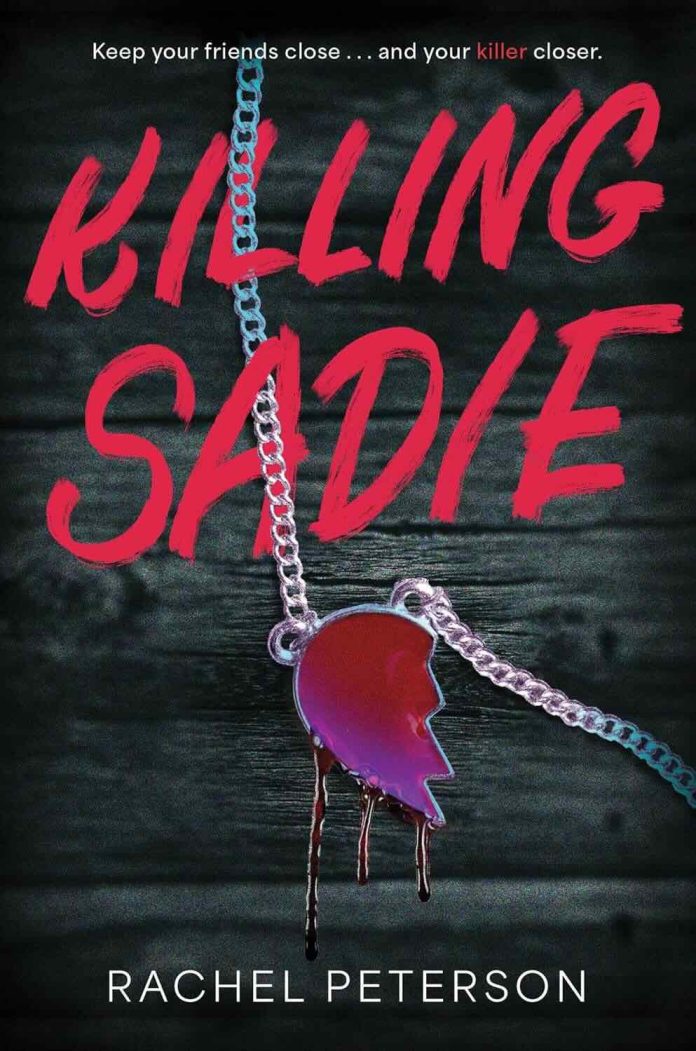
Some thrillers hide their killer. This one hands you the crime scene on page one and dares you to figure out why nothing about it adds up. Killing Sadie by Rachel Peterson opens the morning after a barn party in small-town Ohio, with two teenagers dead and three survivors sitting in separate interrogation rooms, each swearing they are telling the police everything. They are not. And the fun, the squirming, delicious fun of this book, is catching them in the act.
The Setup: A Party, a Barn, and an Open-and-Shut Case That Isn’t
Seventeen-year-old Sadie Cooper, homecoming queen and golden girl, was stabbed to death in an old stone barn at Trevor McClain’s infamous farm party. Her killer, quiet art kid Mason Vreeland, died moments later at the hands of Sadie’s boyfriend, Ben, who was trying to save her. Sadie’s twin sister, Jayne, witnessed it all. Case closed, right?
Except the accounts don’t line up. Sadie’s best friend, Liz, remembers one timeline. Jayne remembers another. Ben’s story bends whenever the questions get uncomfortable. Small contradictions about a drink, a text, a necklace start stacking up into something much uglier, and a sharp state detective named Sloane Budd arrives to pull at every loose thread. Then, in a bold third act, the microphone passes to Sadie herself, narrating the weeks before her death, and the whole picture snaps into horrifying focus.
Quick Verdict at a Glance
Before we go witness by witness, here is the short version of my case notes:
- Structure: An interrogation-room frame with rotating narrators, capped by a dead girl’s testimony. Ambitious, and mostly it works beautifully.
- Voice: Liz, Jayne, and Ben sound genuinely distinct, which is rarer in multi-POV thrillers than it should be.
- Twist factor: The Act Three reveal recontextualizes everything you read before it. I flipped back to earlier chapters just to admire the wiring.
- Pacing: Strong start, slight sag in the middle, ferocious finish.
- Content notes: Underage drinking, murder, manipulation, and toxic relationships, handled with a YA-appropriate hand but not a timid one.
Witness by Witness: The Voices That Carry the Book
The greatest strength of Killing Sadie by Rachel Peterson is characterization through contradiction. Liz, a transplant from an Alabama trailer park who reinvented herself inside the wealthy Cooper family’s orbit, narrates with a wounded, sarcastic drawl that made her my favorite in the room. Her chapters ache with class anxiety; she knows she is the “bonus daughter” whose invitation can be revoked at any time. Jayne, the aloof twin with equestrian trophies and zero patience for high school, speaks in cool, controlled paragraphs that feel rehearsed in the best, creepiest way. Ben, the football prince living under his powerful father’s shadow, is all swagger and self-soothing mantras, and Peterson lets him hang himself with his own internal monologue.
What impressed me most is how the lies are built. Peterson doesn’t rely on a narrator conveniently withholding a scene. Instead, she lets three people describe the same evening and trusts the reader to notice that the timestamps, the drinks, and the drama don’t reconcile. The recurring image of three matching broken-heart friendship necklaces becomes a quiet masterstroke of plotting; by the final pages, a piece of cheap Christmas-market jewelry carries more menace than the murder weapon.
Sadie’s own section deserves special mention. Giving the victim the last word is a risk, since it could easily read as a gimmick. Here it lands like a verdict. Her voice is vain, funny, self-aware, and heartbreaking, a girl dissecting her own flaws while walking, unknowing, toward the barn. Peterson threads Romeo + Juliet references through Sadie’s chapters (the Baz Luhrmann film, naturally), and the doomed-romance framing pays off in ways I won’t spoil.
Cross-Examination: Where the Case Wobbles
An honest review has to press on the weak spots, and Killing Sadie by Rachel Peterson has a few worth flagging.
- The middle drags. Because three narrators must each recount the same afternoon and party, Act Two occasionally retreads ground. The repetition is intentional, since the discrepancies are the point, but a leaner edit could have kept the tension tighter through the midsection.
- The local police are cardboard. Detectives Norris and Hunt exist mainly to be outwitted, and the small-town force is so conveniently sloppy that it strains belief. Thankfully, Detective Sloane Budd, the no-nonsense state investigator with her McDonald’s peace offerings, is a genuine standout who balances the ledger.
- The pop culture skews old. These teens reference Say Anything, Dawson’s Creek, When Harry Met Sally, and Casablanca with suspicious fluency. Individually charming, collectively it reads like the author’s nostalgia wearing a teenager’s outfit.
- A few conveniences in the endgame. The final reveal is chilling and earned on an emotional level, but the logistics involving a certain phone and some very precise timing don’t fully survive a second look. Readers who autopsy their thrillers may raise an eyebrow.
None of these issues sink the book. They keep an excellent debut from being a flawless one, which feels about right for where most readers and early reviewers have landed on it.
The Author Behind the Crime Scene
This is Rachel Peterson’s debut novel, published by Simon & Schuster’s relaunched Simon Pulse imprint, and it arrives with real polish. Peterson grew up in Hudson, Ohio, studied English and creative writing at Miami University of Ohio, and spent roughly two decades in advertising and marketing before turning to fiction, writing several unpublished manuscripts along the way. That apprenticeship shows. The Ohio setting breathes with lived-in detail, from cornfield geography to the social physics of a school where everyone knows whose father owns what. Since she has no previous published books, this is the ground floor for her readers, and it’s a confident place to start.
Exhibit A: One Disclosure, Entered Into the Record
Every witness in this story hides something, so let me be the one person in the interrogation room who doesn’t. The publisher provided me with a copy of this book for review purposes. No conditions were attached, no script was handed over, and every opinion above, the applause and the eyebrow-raises alike, is entirely my own honest testimony. Consider it sworn.
Case Files You Should Open Next
If this book worked for you, or if you want to warm up before reading it, these are natural companions:
- How to Survive Your Murder by Danielle Valentine, a direct comp with a victim-centered twist
- Dead Girls Can’t Tell Secrets by Chelsea Ichaso, another small-town web of teen lies
- Two Can Keep a Secret by Karen M. McManus, for twins, buried history, and a town with a body count
- A Good Girl’s Guide to Murder by Holly Jackson, for readers who love re-examining a “solved” case
- The Cheerleaders by Kara Thomas, a moody dig into deaths everyone stopped questioning
- We Were Liars by E. Lockhart, if the unreliable narration was your favorite ingredient
Closing Argument
Killing Sadie by Rachel Peterson is a sharp, mean-in-the-best-way YA thriller that understands a simple truth: teenagers lie better than adults because they get more practice. It stumbles slightly in its pacing and asks for a little forgiveness on plot mechanics, but its voices are vivid, its twist genuinely re-frames the novel, and its final image lingers like a scream across a dark field. Hand it to fans of unreliable narrators, twisted sister stories, and anyone who has ever suspected the perfect family down the street is anything but. I closed Killing Sadie by Rachel Peterson wanting exactly two things: a flashlight for my next walk past a barn, and whatever this author writes next.







