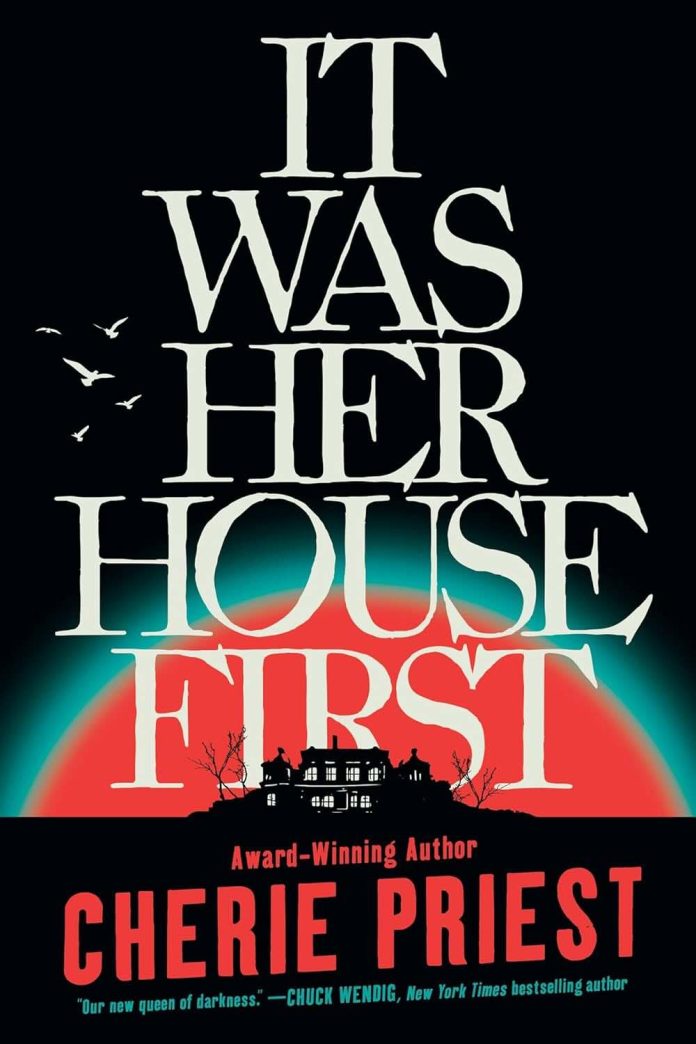
Cherie Priest has built a remarkable career spanning multiple genres, from her acclaimed steampunk Clockwork Century series anchored by Boneshaker to the modern young adult mystery I Am Princess X. With It Was Her House First, Priest ventures into classic Gothic horror territory, and the result is perhaps her most atmospheric and emotionally resonant work to date. This haunted house tale transcends the genre’s familiar trappings to deliver a sophisticated exploration of guilt, grief, and the terrible weight of consequences that echo across decades.
The novel follows Ronnie Mitchell, a grieving woman seeking a fresh start who purchases a decaying mansion sight unseen with an unexpected inheritance. What she doesn’t know is that her new home comes with a murderous pedigree and vengeful spirits who have been locked in eternal conflict since the 1930s. The house was once home to silent film star Venita Rost, whose mysterious death sent her husband Oscar to the gallows and drove detective Bartholomew Sloan to suicide—all three now trapped within the mansion’s walls, each carrying their own version of a tragedy that destroyed them all.
Narrative Architecture That Mirrors Its Setting
Priest employs a brilliant structural device, alternating perspectives between Ronnie in the present day and the ghostly residents from different time periods. This multi-temporal approach creates a sense of temporal vertigo that perfectly mirrors the disorienting experience of living in a haunted house where past and present bleed together. The narrative architecture itself becomes a metaphor for the house—layered, complex, and hiding dangerous secrets in its foundation.
Ronnie’s chapters are grounded in the practical reality of renovation work, complete with authentic details about restoring old houses that clearly draw from Priest’s own experience. Her voice carries the world-weary pragmatism of someone who has learned to trust her instincts about both houses and people. When Ronnie encounters the supernatural, her skepticism gives way gradually, realistically, as the evidence becomes impossible to ignore.
The historical sections, told primarily through Bartholomew Sloan’s perspective, reveal the tragic events that created the haunting. Priest excels at creating period-appropriate voices without falling into pastiche or overly mannered prose. Sloan’s sections in particular showcase her ability to capture the formal cadences of 1930s speech while maintaining emotional immediacy.
The Ghosts in the Machine
What elevates It Was Her House First above typical haunted house fare is Priest’s psychological complexity in portraying her supernatural characters. Venita Rost emerges as a genuinely terrifying antagonist precisely because her rage is so understandable. A mother who lost her child, a woman who felt betrayed by the men she trusted, she has had nearly a century to perfect her fury. Priest writes her scenes with a theatrical flair that evokes classic film stars while never reducing her to mere camp.
Bartholomew Sloan serves as the story’s tragic heart—a man whose quest for supernatural assistance led to unspeakable consequences. His guilt has literally anchored him to the house, and his attempts to protect Ronnie from both Venita and the living threats she faces provide the novel’s most compelling emotional throughline. The revelation of his backstory, involving a Faustian bargain that went disastrously wrong, adds layers of cosmic horror to what could have been a simple ghost story.
Gothic Elements and Modern Sensibilities
Priest demonstrates masterful control of Gothic atmosphere throughout the novel. The decaying mansion becomes a character unto itself, with its boarded windows, water-damaged rooms, and mysterious basement shrine creating an environment where anything might happen. The house’s physical decay mirrors the emotional deterioration of its supernatural inhabitants, while Ronnie’s renovation efforts become both literal and metaphorical attempts to heal old wounds.
The author particularly excels in her descriptions of the mirror that serves as a supernatural focal point. Originally from Venita’s parlor, this ornate piece becomes a window between worlds and a repository of traumatic memory. Priest’s handling of this classic Gothic trope feels fresh because she grounds it in specific character psychology rather than generic spookiness.
However, the novel occasionally stumbles when modern characters encounter period elements. Some of Ronnie’s friends, particularly Kate, sometimes feel more like devices for exposition than fully realized people. Their conversations can veer toward the functional, serving primarily to convey information about the house’s history rather than developing their relationships naturally.
Thematic Depths Beyond the Surface Chills
Beneath its supernatural trappings, It Was Her House First grapples with profound themes of accountability and the ripple effects of our choices. Bartholomew’s supernatural bargain didn’t just cost him his soul—it led to the death of an innocent child and the destruction of a family. The novel asks difficult questions about whether good intentions can excuse terrible outcomes and whether redemption is possible after causing irreparable harm.
The book also functions as a meditation on home ownership and the weight of inherited history. Ronnie’s renovation project becomes a metaphor for how we deal with the past when we take on spaces that carry other people’s trauma. Every old house has stories, Priest suggests, and some of those stories refuse to stay buried.
Technical Craftsmanship and Atmospheric Mastery
Priest’s prose style adapts effectively to her different narrative voices and time periods. Her contemporary sections move with the easy rhythm of modern speech, while her historical chapters adopt more formal cadences without becoming stilted. She has a particular gift for sensory details that bring scenes to life—the smell of old gin, the texture of water-damaged books, the weight of dust-covered furniture.
The pacing builds steadily throughout the novel’s first half before accelerating into genuine terror in the final acts. Priest knows when to let atmosphere simmer and when to unleash supernatural mayhem. The climactic sequences, involving multiple timeline convergences and supernatural confrontations, manage to feel both inevitable and surprising.
Where the novel occasionally falters is in some of its contemporary dialogue, which can feel slightly forced when characters are required to deliver exposition about historical events. Additionally, some of the romantic subplot elements feel underdeveloped compared to the richly detailed supernatural and historical elements.
Standing Among Gothic Traditions
It Was Her House First positions itself confidently within the tradition of American Gothic literature, drawing clear inspiration from classics like The Haunting of Hill House while updating the formula for contemporary readers. Like Shirley Jackson, Priest understands that the most effective horror emerges from psychological truth rather than simple shock tactics.
The novel also shares DNA with modern Gothic masters like Sarah Waters and Tana French in its attention to historical detail and character psychology. Priest’s background in speculative fiction serves her well here, as she brings the same worldbuilding rigor to her haunted house that she applied to her steampunk adventures.
Comparative Context Within Priest’s Oeuvre
Readers familiar with Priest’s Clockwork Century series will recognize her gift for atmospheric worldbuilding, though It Was Her House First trades steampunk adventure for psychological horror. Those who appreciated the contemporary mystery elements in I Am Princess X will find similar attention to character development and modern concerns, though applied to supernatural rather than technological threats.
This novel represents a mature synthesis of Priest’s strengths as a writer—her facility with multiple genres, her attention to historical detail, and her ability to create compelling characters facing extraordinary circumstances. It stands as perhaps her most emotionally complex work, tackling themes of guilt and redemption with unusual depth for horror fiction.
Final Verdict: A Haunting Success
It Was Her House First succeeds as both atmospheric horror and character study, delivering genuine scares while exploring deeper themes about responsibility, guilt, and the possibility of redemption. Priest has crafted a haunted house story that earns its supernatural elements through psychological truth and historical specificity.
While the novel occasionally stumbles in its contemporary characterizations and exposition delivery, these minor flaws pale beside its considerable strengths. This is Gothic horror that respects both its genre traditions and its readers’ intelligence, offering sophisticated thrills alongside genuine emotional resonance.
For readers seeking atmospheric horror with substance, It Was Her House First delivers a deeply satisfying experience that will linger long after the final page. Cherie Priest has created a haunted house story that understands the real horror lies not in supernatural threats, but in the very human capacity for causing irreparable harm to those we love.
Recommended for Readers Who Enjoyed
- The Silent Companions by Laura Purcell
- Mexican Gothic by Silvia Moreno-Garcia
- The Little Stranger by Sarah Waters
- The Haunting of Hill House by Shirley Jackson
- The Broken Girls by Simone St. James
- The Death of Jane Lawrence by Caitlin Starling







