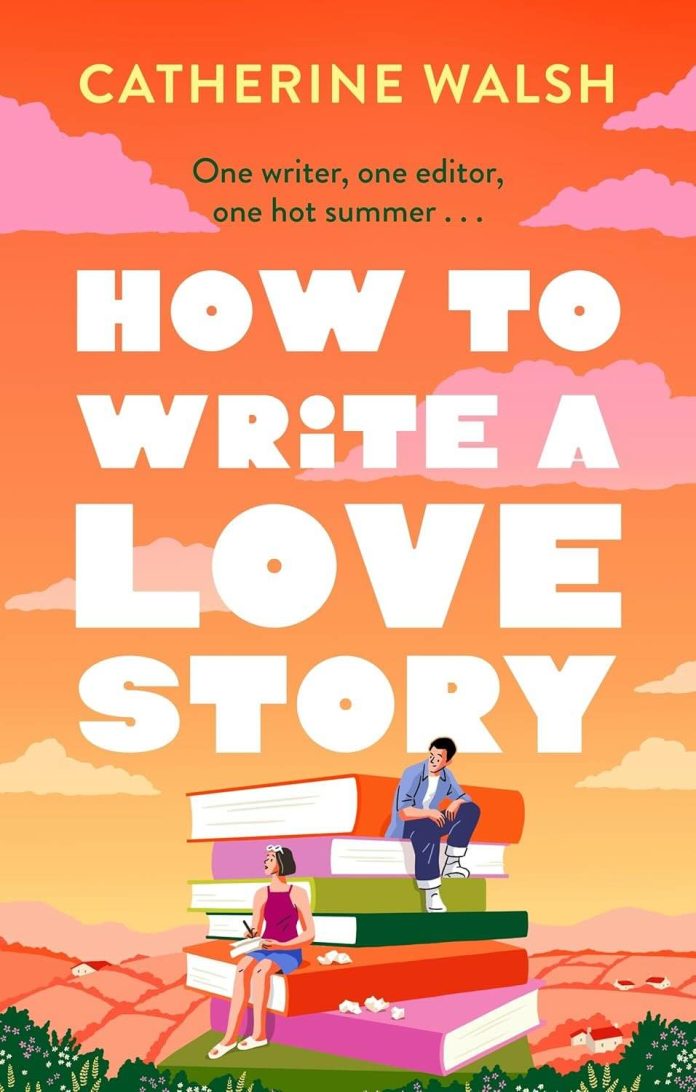
There is a particular kind of ache that lives in a house someone loved more than they should have. It seeps into the walls, pools in the floorboards, hums through the silence of rooms that once rang with laughter and the scratching of a pen. Catherine Walsh understands this. In How to Write a Love Story by Catherine Walsh, the Irish bestselling author of Holiday Romance and Snowed In delivers a romance that is as much about letting go of the dead as it is about choosing the living. It is warm and sharp, funny and gutting, and it might just be the most emotionally layered book Walsh has written to date.
A Premise That Writes Itself
The setup is deceptively clever. Ciara Sheridan is the daughter of Frank Sheridan, a legendary fantasy author whose nine-book Ravian series sold tens of millions of copies worldwide. When Frank dies, he leaves Ciara three things: a ramshackle estate on the coast of County Kerry, crippling financial pressure, and an outline for the tenth and final Ravian book he wanted only her to complete. There is just one problem. Ciara cannot write a word.
Enter Sam Avery, a sharp, career-hungry editor from New York’s Richardson Books, dispatched to Ciara’s doorstep to coax the novel out of her. He is a lifelong Ravian fanboy with a tattoo to prove it. She was expecting someone old and crusty. He was expecting someone who had actually started writing. Their mutual disappointment makes for a brilliant opening gambit, and Walsh milks the tension between professional obligation and personal attraction with expert timing.
The Irish Coast as a Living, Breathing Character
Walsh’s prose does something quietly masterful with setting. Carrigwest, the fictional village where most of the action unfolds, is not simply a backdrop. It is the story’s emotional weather system. The record-breaking Irish heat wave that blankets the novel’s timeline operates as a kind of pressure cooker, forcing characters out of their routines and comfort zones while mirroring the slow, building tension between Ciara and Sam.
The descriptions of the landscape are vivid without becoming postcard-pretty. Walsh writes Ireland as someone who has sweated through its rare summers and cursed its endless gray, and that lived-in quality gives the setting an authenticity that a lesser writer might have traded for charm. Ronan’s pub, the empty church, the treehouse in the woods dripping with rain, the beach at five in the morning with no one else around — each location feels earned, not staged.
Dual Perspectives That Actually Earn Their Keep
How to Write a Love Story by Catherine Walsh alternates between Sam’s and Ciara’s first-person perspectives, and both voices are distinctly rendered. Sam is observant, slightly self-deprecating, and quietly ambitious. His narration has the crisp energy of someone used to New York’s pace, and Walsh captures the disorientation of an American dropped into rural Ireland with a dry, affectionate humor that never slides into caricature.
Ciara, meanwhile, is the emotional center of the novel. Her voice carries the weight of grief without drowning in it. Walsh threads her chapters with a restless, self-aware humor that reads like a defense mechanism — because it is one. Ciara deflects with jokes, volunteers at her best friend’s smoothie truck, and avoids her inbox with the dedication of an Olympic athlete. But beneath the wisecracks is a woman terrified that she will fail her father’s legacy and, worse, that she might not care enough to try.
The balance between these two voices is one of the book’s great strengths, though it is not without occasional imbalance. Sam’s early chapters lean slightly more toward workplace logistics than emotional interiority, and it takes a few chapters for his perspective to develop the same richness that Ciara’s possesses from the start.
The Romance: Slow-Burn, Sharp-Witted, and Surprisingly Physical
Walsh builds the central love story with the patience of someone who trusts her readers. The romance does not rush. It breathes. There are small moments — a raindrop tracked down a cheek, the accidental brushing of legs in a tree house, a flashlight beam sweeping a dark country road — that accumulate into something genuinely electric.
What makes the romantic thread work so well is that it is entangled with the creative process. Sam and Ciara are not just falling for each other; they are collaborating on a story within the story. Their arguments about character motivation, their debates over plot direction, their push-and-pull over whether Ciara is procrastinating or processing — all of it feeds the romance with an intellectual charge that distinguishes How to Write a Love Story by Catherine Walsh from more conventional meet-cute setups.
The physical chemistry, when it arrives, is handled with Walsh’s characteristic directness. A scene in which Sam helps Ciara act out a pivotal moment between two fantasy characters is both genuinely funny and unexpectedly sensual, blurring the lines between fiction and feeling in a way that feels thematically perfect.
Where the Narrative Stumbles
No book is without its rough patches, and this one has a few worth noting:
- The leak subplot feels slightly contrived. The mechanism by which news of the book becomes public — Sam’s sister Lizzie telling her husband, who tells a colleague — stretches plausibility just enough to notice. The fallout is emotionally effective, but the domino chain that triggers it could have used a more organic catalyst.
- Pacing dips in the second act. There is a stretch in the middle where the daily rhythm of Ciara writing and Sam editing becomes somewhat repetitive. Walsh captures the monotony of creative work accurately, perhaps too accurately, and a tighter edit might have trimmed a chapter or two without losing anything essential.
- Some secondary arcs feel underdeveloped. Maddie’s budding relationship with Shane, the burger truck owner, and Ronan’s hints about closing the pub are introduced with real promise but resolved with convenient speed. These threads deserved more room to breathe.
That said, these are minor criticisms in a book that otherwise sustains its emotional momentum through to a deeply satisfying final act.
A Storm, a Tree, and the Art of Letting Go
Without revealing specifics, the novel’s climactic sequence is breathtaking. Walsh shifts gears from warm romantic comedy into something genuinely harrowing with a confidence that proves her range extends well beyond the genre’s perceived limits. It is the moment where all the book’s themes — grief, legacy, the tension between holding on and moving forward — converge with devastating clarity.
The epilogue, set eighteen months later, is a masterclass in restraint. It is sweet without being saccharine, forward-looking without ignoring everything that came before. And it contains a small, pocket-sized detail that will make attentive readers clutch their hearts.
Catherine Walsh’s Growth as an Author
Walsh has been building her readership steadily since her debut One Night Only in 2021, followed by The Rebound, Holiday Romance, Snowed In, and The Matchmaker. Each book has showcased her gift for witty dialogue and grounded characters, but How to Write a Love Story by Catherine Walsh marks a clear step forward in ambition and emotional depth. The meta-fictional layer — a romance about two people writing a story while living one — gives Walsh room to explore creativity, loss, and identity in ways her earlier, more tightly plotted romcoms did not.
Who Should Read This Book
How to Write a Love Story by Catherine Walsh is ideal for readers who enjoy romance that takes its emotional stakes seriously without losing its sense of humor. If you have ever loved a book so much it felt like a world you could live in, or if you have ever struggled to create something in the shadow of someone you admired, this novel will speak to you.
Books You Might Also Enjoy
If this review has piqued your interest, consider adding these to your list:
- Beach Read by Emily Henry — Another romance where two writers challenge each other creatively and personally, with a similar push-pull dynamic and sharp banter
- The Flatshare by Beth O’Leary — Dual-perspective storytelling with distinctive voices, a slow-burn romance, and British humor that will appeal to Walsh fans
- Lessons in Chemistry by Bonnie Garmus — For readers drawn to Ciara’s struggle with identity and legacy under public scrutiny, wrapped in wit and warmth
- People We Meet on Vacation by Emily Henry — Friends-to-lovers with the same balance of laugh-out-loud comedy and genuine emotional vulnerability
- One Day in December by Josie Silver — A sweeping love story set across years and continents, with the same bittersweet ache and Irish-adjacent charm







